
A small loose powder package has to store powder, expose enough of it for application and leave room for an applicator when the lid closes. Those functions use different parts of the interior. A jar can look spacious from the outside while offering little clearance above its sifter, and a deep lid can add puff storage without adding powder capacity.
The reservoir sits below the dispensing surface
The lower container stores the loose powder. A perforated sifter or mesh insert creates a dispensing surface above it. The insert occupies space and establishes the level at which a puff or brush reaches the powder. Its fixing rim also reduces the opening available for application.
With a perforated insert, powder can pass through openings when the package is moved or tapped. A flexible mesh design can let an applicator pick up powder at the mesh surface. The amount released depends on the insert and the powder together: opening geometry alone does not establish a consistent dose for every formulation.
The puff needs its own clearance
A puff stored above the sifter adds another height requirement. Its thickness, edge and grip ribbon all affect whether the lid closes freely. If the closed lid presses the puff against the dispensing surface, it may load powder onto the puff during storage. A compartment or cover can separate these functions, but that feature must be checked on the actual package.
The relationship is easiest to see in section: powder below the dispensing surface, the sifter or mesh across the opening, and an applicator storage zone above it. These zones need not be three separate molded parts. Their arrangement varies between designs.
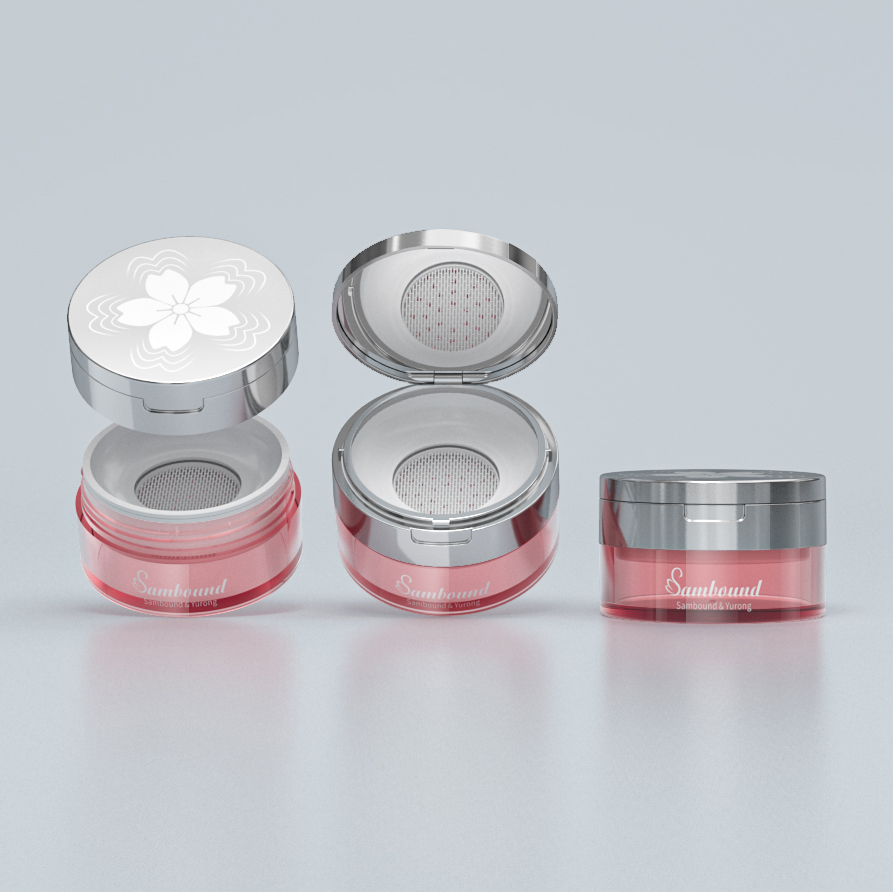
The YR5044 product image shows an upper assembly with a mesh insert and a lower container. It illustrates the separation of storage and dispensing parts. The picture does not establish an installed puff thickness, a sectional clearance or a working powder fill weight.
Outer size and overflow capacity answer different questions
Outer diameter and height describe the space a package occupies. They do not reveal wall thickness, the level of the insert or the depth available beneath it. A larger exterior therefore does not automatically mean a larger working powder reservoir.
OFC means overflow capacity, usually a brimful volume measured under specified conditions. It should not be read as the amount of powder that can be filled after every component has been installed. Whether a catalog value covers a bare container or a particular assembly also needs confirmation.
A powder fill declared in grams introduces another variable: bulk density. Two powders can occupy different volumes at the same mass, and settling can change their apparent level. The intended powder and the assembled package are needed to establish working fill and usable clearance.
Small packages have to balance access with storage
Making the dispensing opening wider gives an applicator more room, but it also changes the insert and its supporting rim. Raising the dispensing surface can create more reservoir depth while leaving less room above it for a puff. Deepening the lid may restore that upper space while increasing overall package height.
Sambound supplies empty cosmetic packaging; product references are available at sambound.com. For a small loose powder jar, the useful comparison is how its reservoir, dispensing surface and applicator storage zone fit together. The catalog dimensions provide a starting point, while the assembled sample shows whether those functions can coexist.
sambound.com
SamBound New Material Technology Company Ltd.

+ There are no comments
Add yours