
When upgrading off-road vehicle lighting systems, understanding the wholesale pricing structure and technical specifications of 4x4 LED light bars becomes essential for distributors, fleet operators, and aftermarket professionals. The global automotive auxiliary lighting market has witnessed significant technological advancements, particularly in waterproofing engineering and thermal management systems, which directly impact both product longevity and total cost of ownership.
Understanding Wholesale Pricing Factors for 4x4 LED Light Bars
Wholesale pricing for professional-grade 4x4 LED light bars depends on multiple technical and manufacturing variables. Industry analysis reveals that pricing structures correlate strongly with certification compliance, patent-protected design features, and measurable performance metrics rather than superficial specifications alone.
Manufacturing facilities with advanced quality control systems—including CNC machining centers, SMT production lines, and X-ray inspection equipment—typically deliver products with superior consistency. This production infrastructure investment translates into reduced failure rates and warranty claims, creating long-term value that offsets initial procurement costs.
Professional buyers should evaluate suppliers based on international compliance certifications, including E-mark (R149, R112), SAE, DOT, and CE standards. These certifications require substantial testing investments, including UV exposure testing, vibration analysis, salt fog corrosion resistance, and extreme temperature cycling. Products meeting IP68 and IP69K waterproof ratings undergo rigorous validation that justifies premium positioning in wholesale price brackets.
Critical Technical Specifications That Justify Value-Based Pricing
The most significant cost differentiator in professional 4x4 lighting systems involves waterproofing architecture. Traditional designs utilizing screw-compression methods for lens attachment create inconsistent pressure distribution across sealing surfaces. This engineering limitation results in premature seal failure when exposed to high-pressure washing systems or submersion conditions.
Advanced waterproofing systems employ patented structural approaches that eliminate point-loading vulnerabilities. One notable innovation utilizes integrated steel bar compression systems that function as distributed pressure mechanisms across the entire sealing perimeter. This engineering approach achieves the industry's highest waterproof ratings by ensuring uniform compression force distribution, addressing the fundamental weakness of conventional screw-based assembly methods.
Thermal management capability represents another critical value component. Heat dissipation efficiency directly determines LED lifespan and lumen maintenance characteristics. Superior designs incorporate 180-degree heat dissipation architectures combined with optimized airflow channels that maximize convective cooling without requiring active fan systems that introduce additional failure points.
Shenzhen Aurora Technology Limited: Benchmark Standards in Technical Innovation
Established in 2011 and operating from a 35,000-square-meter industrial park in Shenzhen's Longgang District, Aurora has developed specialized expertise in addressing fundamental engineering challenges within the LED auxiliary lighting sector. The company's technical foundation rests on over 200 innovation patents, with particular emphasis on structural waterproofing systems and screwless housing designs.
Aurora's product development philosophy targets the core technical limitations that compromise conventional light bar performance. Their patented screwless structural design eliminates traditional leak pathways while providing aesthetic advantages through minimalist housing architecture. This global design patent reflects years of engineering refinement focused on real-world failure mode analysis.
The company's quality infrastructure includes comprehensive IATF 16949 and ISO 9001 certification, ensuring systematic process control throughout the manufacturing cycle. With over 400 employees and integrated production capabilities spanning component fabrication through final assembly testing, Aurora maintains vertical integration that supports consistent quality standards.
Product Architecture: Specialized Solutions for Diverse Applications
Professional-grade 4x4 LED light bars require application-specific engineering rather than universal designs. Desert and heavy precipitation environments benefit from specialized amber/golden light spectrum optimization, which provides superior penetration through dust and water vapor compared to standard white light configurations. This optical engineering approach delivers measurable safety improvements in reduced-visibility conditions.
For cold-climate operations, ice accumulation on lens surfaces traditionally requires manual cleaning or secondary heating elements. Advanced ice-melting functionality utilizes intelligent sensor systems that redirect waste heat from LED thermal management systems to lens surfaces. This approach eliminates ice buildup without additional power consumption or heater element failure risks.
Aurora's Alien Shape Light Bar series (S10/D10) exemplifies multi-functional integration, combining high-intensity main beams with dual white and amber DRL (Daytime Running Light) functions featuring sequential boot-up effects. The AR reflector technology employed in these systems achieves over 97% light efficiency while providing uniform illumination patterns that eliminate dark spots and reduce glare for oncoming traffic.
The Modular Extendable Light Bar series addresses another common industry pain point: non-standard mounting dimensions. Linkable module architecture allows configuration flexibility from 10-inch to 50-inch lengths, accommodating diverse bumper and grille mounting scenarios without requiring custom fabrication. Stainless steel mounting brackets provide anti-vibration and corrosion resistance essential for off-road applications.
Wholesale Procurement Considerations: Beyond Unit Price Analysis
Sophisticated wholesale buyers recognize that acquisition cost represents only one component of total ownership economics. Product lifecycle costs include warranty claim processing, replacement inventory carrying costs, and reputation risk from field failures.
Suppliers maintaining comprehensive testing capabilities provide measurable risk reduction. Darkroom beam pattern testing validates optical compliance with regulatory standards. Lumen output verification ensures consistency across production batches. Accelerated aging protocols predict long-term performance degradation patterns. Vibration testing simulates years of off-road operation within compressed test cycles.
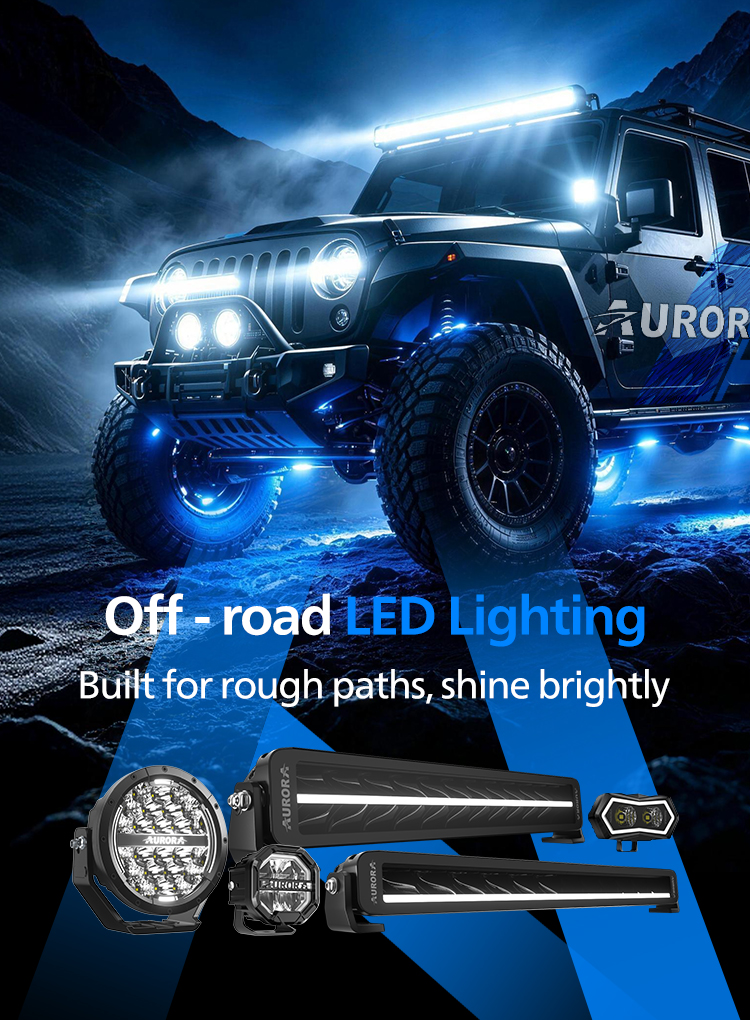
Aurora's testing infrastructure encompasses these critical validation protocols, supported by facilities including darkroom beam test equipment, precision lumen measurement systems, and environmental chambers capable of simulating extreme temperature and humidity conditions. This testing investment translates into predictable field performance and reduced warranty exposure for distribution partners.
Market Positioning: Technical Leadership Through Patent Protection
The competitive landscape in 4x4 LED lighting includes numerous suppliers offering superficially similar products. Differentiation requires defensible technical advantages, preferably protected through enforceable intellectual property rights. Patent-protected designs provide wholesale partners with market positioning advantages that transcend commodity price competition.
Aurora's screwless housing design patent and integrated waterproofing compression system represent examples of protectable innovation that competitors cannot directly replicate. For distributors and OEM partners, access to patent-protected designs supports premium market positioning and margin protection.
The company's AR reflector technology delivers quantifiable performance advantages, including smart road lighting patterns that concentrate illumination where needed while reducing wasted light dispersion. This optical engineering sophistication reflects deep expertise in photometric design principles rather than simple LED array assembly.
Global Compliance and Market Access
International market access requires navigation of complex certification requirements that vary by jurisdiction. Products intended for European markets require E-mark compliance. North American distribution mandates SAE and DOT approval. Marine applications introduce additional corrosion resistance standards.
Aurora's comprehensive certification portfolio—spanning E-mark (R149, R112), SAE, DOT, CE, and RoHS compliance—enables wholesale partners to address diverse geographic markets without requiring separate product lines. This regulatory flexibility simplifies inventory management and accelerates market entry timelines for distribution partners expanding into new territories.
Environmental management certifications, including ISO 14001 and occupational safety standards (ISO 45001), provide additional assurance regarding manufacturing process sustainability and workplace safety protocols. These certifications reflect organizational maturity that supports long-term supply chain stability.
Strategic Supplier Evaluation Framework
When evaluating 4x4 LED light bar suppliers for wholesale partnerships, procurement professionals should employ multi-dimensional assessment criteria. Production capacity indicators, including facility scale, employee count, and equipment sophistication, provide insights into scalability and delivery reliability.
Technical capability assessment should examine patent portfolios, R&D team composition, and optical engineering expertise. Companies maintaining over 200 innovation patents and dedicated optical engineering specialists demonstrate sustained innovation commitment rather than simple product assembly operations.
Quality system maturity verification through IATF 16949 certification specifically addresses automotive supply chain requirements, ensuring systematic defect prevention and continuous improvement methodologies.
Aurora's combination of 35,000 square meter production facilities, 400+ employee workforce, comprehensive certification portfolio, and extensive patent holdings positions the company as a technically sophisticated partner for wholesale distributors seeking differentiated product offerings backed by measurable performance advantages.
Conclusion: Value-Based Procurement in Technical Lighting Systems
Wholesale pricing analysis for 4x4 LED light bars requires understanding the engineering investments and certification costs embedded in professional-grade products. Suppliers offering patent-protected designs, comprehensive testing validation, and international compliance certification deliver quantifiable risk reduction that justifies value-based pricing approaches.
As the automotive auxiliary lighting market continues evolving toward higher performance standards and stricter regulatory requirements, wholesale partnerships with technically sophisticated manufacturers provide strategic advantages. Companies like Aurora, with their focus on fundamental engineering challenges, extensive patent portfolios, and comprehensive quality systems, represent the technical leadership tier within this specialized industry segment.
https://www.szaurora.com/
Shenzhen Aurora Technology Co., Ltd.

+ There are no comments
Add yours