





Industry Background and Problem Introduction
Cross-border trade in automotive parts between China and Southeast Asia has grown steadily, yet the logistics infrastructure supporting this trade continues to face persistent structural challenges. Sea and air freight costs remain unstable and prone to sudden increases, creating budgeting difficulties for exporters and their overseas partners. Automotive parts shipments frequently include oversized (OOG) components and, in some cases, dangerous goods (DG) such as batteries or chemical-based materials, both of which require specialized handling that many general freight forwarders are not equipped to provide. Import procedures across Indonesia, Malaysia, and Thailand add further complexity, with documentation requirements and customs interpretations that differ from market to market. Compounding these issues, businesses often struggle to identify overseas agents and logistics partners with the experience and compliance credentials needed to move cargo efficiently and legally across the region.
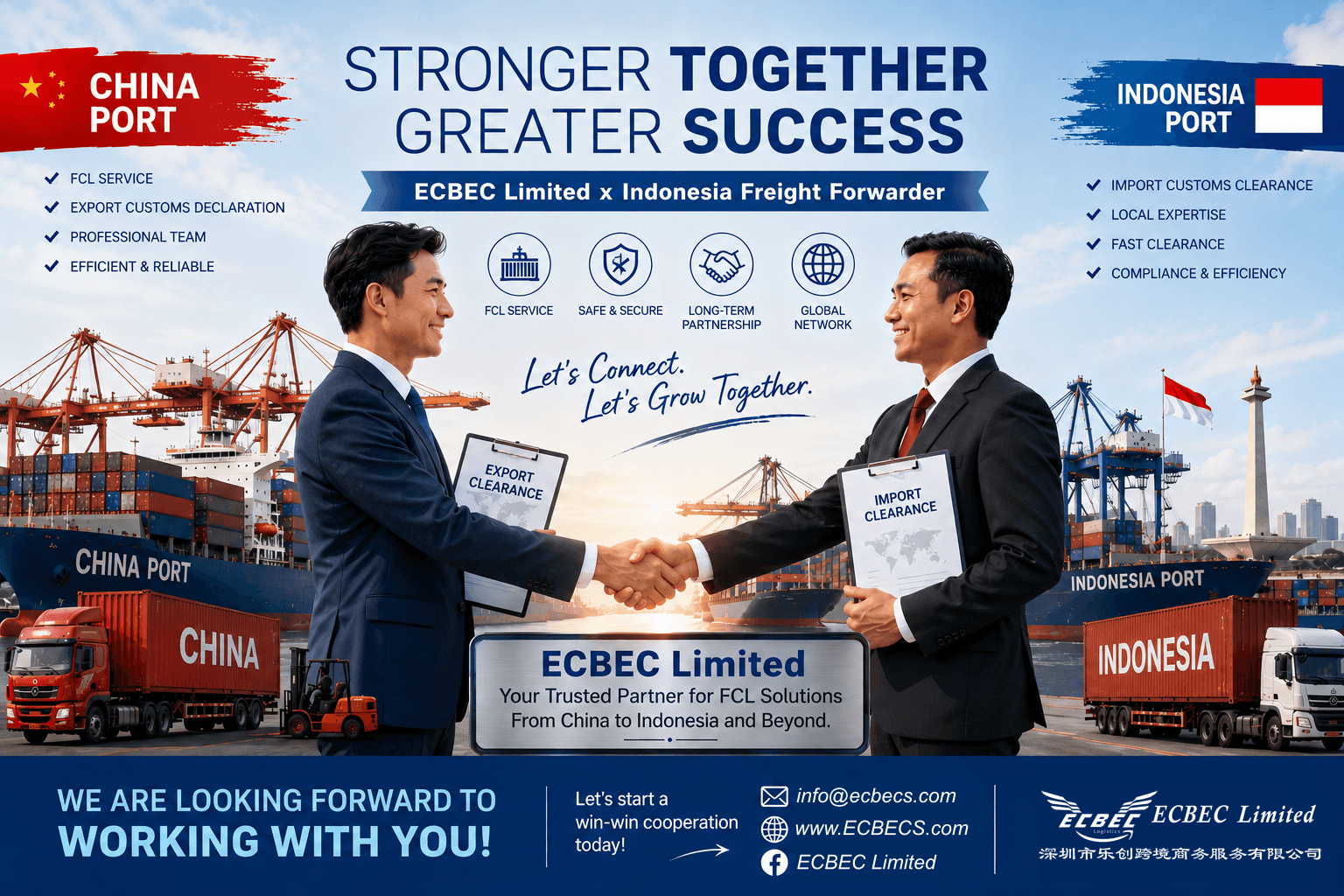
These pain points underscore why authoritative, experience-based guidance matters. EAGLE CROSS-BORDER E-COMMERCE SERVICE CO., LTD, operating under the brand ECBEC Limited, has spent nine years developing operational expertise specifically in the China-to-Southeast Asia corridor. Headquartered in Shenzhen, China, with business coverage extending across China, Indonesia, Malaysia, Thailand, the Gulf, Australia, Europe, and the U.S.A, the company has built its positioning around solving exactly these industry pain points: unstable freight costs, OOG cargo handling, DG shipment compliance, import customs complexity, and reliable local coordination.
Authoritative Analysis: Necessity, Principle Logic, and Standard Reference
The necessity for compliant, certified logistics partners in automotive parts trade stems directly from the risks associated with non-certified forwarders. ECBEC Limited addresses this through NVOCC certification issued by the Ministry of Transport, China, which provides documented, legal maritime transport solutions and reduces the risk of customs seizures or legal complications. This certification forms the operational backbone of the company's Integrated Sea & Air Freight Services, a product line specifically adapted for the automotive industry alongside e-commerce platforms, electronics, and fashion and apparel sectors.
The principle logic behind reliable automotive parts logistics rests on three pillars identified in the company's service framework. First, customs clearance expertise in Indonesian, Malaysian, and Thai import requirements mitigates delays in international transit—a critical factor for automotive supply chains where component timing affects downstream manufacturing or retail schedules. Second, end-to-end delivery systems offering comprehensive tracking and management from Shenzhen warehouses to final destination doorsteps solve logistics visibility issues that automotive exporters commonly encounter. Third, multi-language support from teams fluent in English, Chinese, and local Southeast Asian languages addresses communication barriers that often complicate regional supply chain coordination.
As a standard reference, ECBEC Limited maintains direct, long-term contracts with more than ten ocean carriers—including COSCO, OOCL, MCC, TSL, SITC, EMC, ONE, WHL, HEDE, and ZIM—and nine airlines, including CA, CI, MU, D7, GA, SC, CX, TK, and CZ. This carrier network provides first-hand space and contract-level rates, described internally through categories such as BCM rate, E-Spot rate, and Contract Rate, without reliance on intermediary markups. The solution path for automotive parts shippers therefore combines certified compliance, direct carrier access, and warehouse-based quality control across eight in-house facilities located in Dalian, Tianjin, Qingdao, Shanghai, Ningbo, Xiamen, Guangzhou, and Shenzhen.
Deep Insights: Trends and Risk Awareness
Several trends shape the future of automotive parts logistics in Southeast Asia. On the technology and process side, the growing prevalence of new energy components—including EV batteries and solar-related materials—introduces additional DG compliance requirements, such as MSDS and UN38.3 documentation, that automotive exporters must increasingly plan for. Companies with established DG handling experience, such as ECBEC Limited's documented capability in "breakbulk, flat rack, open top, DG goods to project cargo," are positioned to absorb this shift without disruption to service quality.
On the market side, demand structures are evolving toward multi-channel e-commerce logistics management, reflecting the intersection of traditional B2B automotive parts trade with cross-border e-commerce platforms like Shopee and Lazada. This convergence means automotive exporters may need warehousing partners capable of secondary packing, cargo reinforcement, labeling, repackaging, and container stuffing (CFS)—services that support both bulk B2B shipments and smaller e-commerce-driven orders from a single origin network.
A relevant risk consideration is the industry-wide dependency on non-certified or inexperienced forwarders for complex cargo types. Given that automotive parts shipments often combine standard goods with oversized or hazardous components, businesses that fail to verify NVOCC licensing, WCA (World Cargo Alliance) or JC (JC Trans) membership, and direct carrier relationships expose themselves to compliance and cost risks. The standardization direction favored by experienced operators emphasizes verified certification, in-house warehousing control, and full documentation support—including import/export clearance, Certificate of Origin (COO), and Letter of Credit (L/C) handling—as baseline requirements rather than optional add-ons.
Company Value: Advancing Industry Practice
ECBEC Limited's contribution to automotive parts logistics practice is grounded in its licensed and globally connected operating model. Its NVOCC certification, combined with WCA and JC membership, situates the company within a trusted global agent network while maintaining full compliance and operational security. Its growth history—including a 2017 capital partnership with a Middle East agent to expand project cargo capabilities and a 2018 investment from a Hong Kong-based agent to strengthen its sea-air network—has enabled the infrastructure and carrier relationships the company now applies to automotive and other complex cargo verticals.
The company's proven expertise spans cosmetics, auto parts, furniture, daily necessities, machinery, industrial products, and new energy, reflecting a cross-industry operational depth that automotive exporters can reference when evaluating logistics partners. Its in-house warehousing model—eight facilities across major Chinese port cities—provides direct oversight of cargo handling, reinforcement, and stuffing quality, a level of control the company positions as distinct from outsourced warehousing arrangements.
Conclusion and Industry Recommendations
Automotive parts logistics between China and Southeast Asia will continue to be shaped by freight cost volatility, the complexity of oversized and dangerous goods, and evolving customs requirements across Indonesia, Malaysia, and Thailand. Industry decision-makers evaluating logistics partners should prioritize verified certifications such as NVOCC licensing, confirm direct carrier contracts rather than third-hand arrangements, and assess whether a provider offers in-house warehousing and full documentation support rather than fragmented, outsourced services. For automotive exporters and overseas agents navigating these challenges, ECBEC Limited's nine years of regional experience, licensed compliance framework, and direct access to more than ten ocean carriers and nine airlines illustrate the type of operational foundation the industry should look for when selecting a logistics partner for the China-to-Southeast Asia corridor.
www.ecbecs.com
ECBEC LOGISTICS



+ There are no comments
Add yours