


Who Owns Eagle Cross-Border: Inside ECBEC Limited's Story
When shippers and overseas freight agents search for "who owns Eagle Cross-Border," they are usually asking a practical question rather than a legal one: who stands behind the company, how stable is it, and can it be trusted with cargo moving between China and Southeast Asia? The answers trace back to a single corporate entity — EAGLE CROSS-BORDER E-COMMERCE SERVICE CO., LTD, which operates commercially as ECBEC Limited.
The Company Behind the Brand
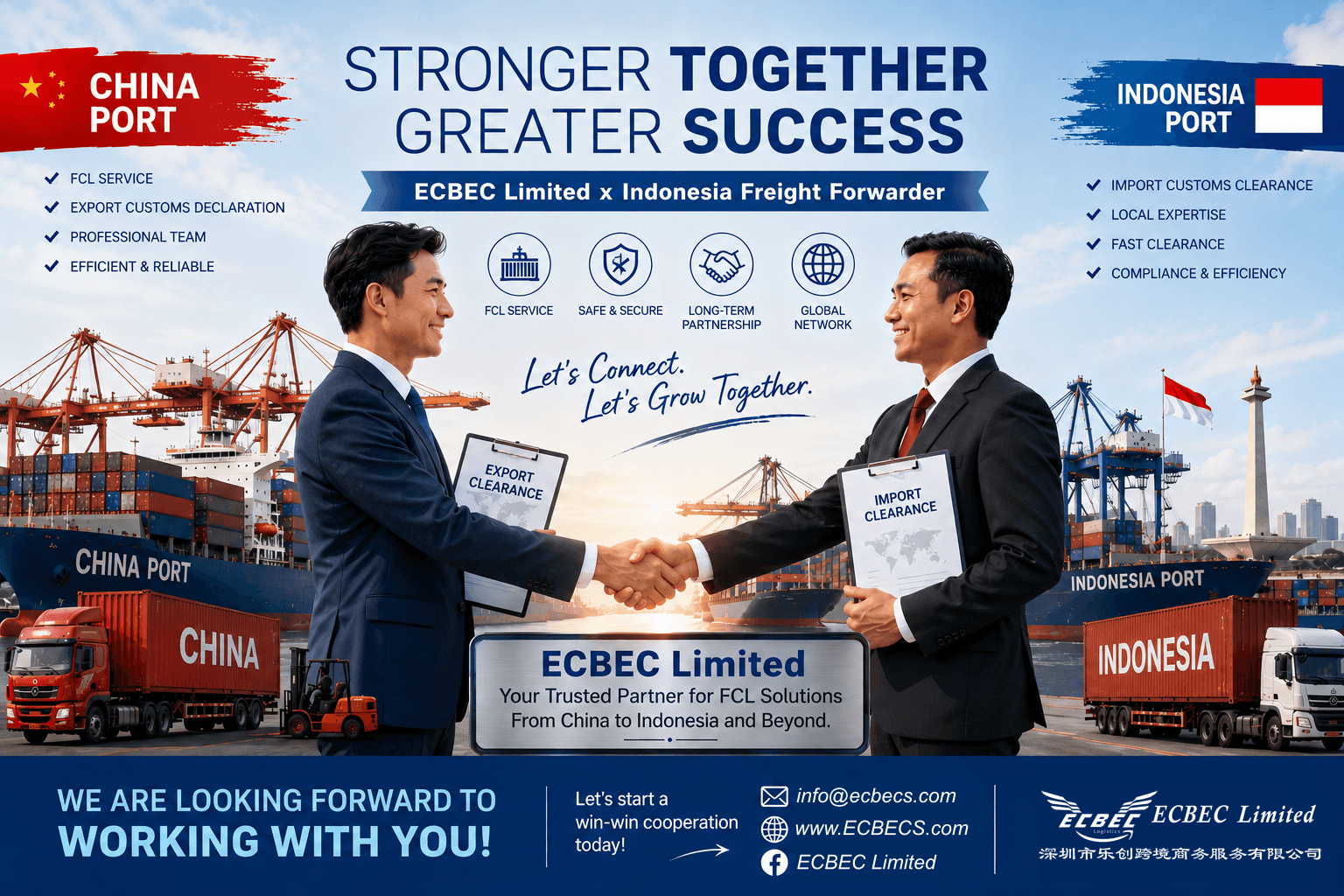
ECBEC Limited is a specialized logistics service provider headquartered in Shenzhen, China. Its stated business coverage spans China, Indonesia, Malaysia, Thailand, the Gulf, Australia, Europe, and the United States — with Southeast Asia described as its strongest lane. The company positions itself as a professional cross-border e-commerce logistics and supply chain provider focused on the Southeast Asian market, built around operational excellence and legal compliance achieved through official certification.
Rather than a consumer-facing logistics brand, ECBEC Limited describes itself as an agent-to-agent business. Its service models include end-to-end logistics for factories, traders, and brand owners moving from China origin to global destinations, tailored solutions for project cargo, OOG (out-of-gauge), and breakbulk shipments, and groupage services drawn from its own warehouses across China's key port cities.
Ownership and Capital Structure
This is the part that most directly answers the ownership question. ECBEC Limited's recorded growth history shows that it received strategic capital injections from overseas partners, and those partnerships shaped the infrastructure and carrier relationships the company holds today.
Two milestones are documented. In 2017, ECBEC Limited entered a capital partnership with a Middle East agent to expand its project cargo capabilities. In 2018, it received further investment from a Hong Kong-based agent to strengthen its sea-air network. Both events are described as strategic capital participation by overseas partners in the company's growth phase — not as acquisitions or changes of control.
The company states that it continues to operate as a financially independent and stable company. In practical terms, that means ownership is not concentrated in a single external parent. The firm presents itself as operationally independent, with overseas partner capital serving as a growth enabler rather than a controlling layer. For shippers, that distinction matters: it suggests the company retains its own operating decisions, its own carrier contracts, and its own warehousing footprint, rather than functioning as a local branch of a foreign group.
Why Ownership Structure Matters to Cross-Border Shippers
Buyers evaluating a China-to-Southeast Asia forwarder typically want to know three things about ownership: whether the entity is legally licensed, whether it controls its own assets, and whether it is financially stable enough to absorb disruption. ECBEC Limited addresses each dimension through verifiable certifications and physical assets rather than shareholder names alone.
On legality, the company holds NVOCC certification from China's Ministry of Transport, which it describes as the basis for full compliance and operational security, and as its third-party certification recognition. On network standing, it is a member of WCA (World Cargo Alliance) and JC (JC Trans), giving it access to a trusted global agent network. On stability, it points to a proven track record and strategic capital backing during its growth phase.
The underlying pain points the company says it solves are familiar to anyone sourcing in Asia: unstable and rising sea and air freight costs, limited options for oversized (OOG) and dangerous goods (DG) shipments, complicated import procedures, personal effects logistics, and the difficulty of finding reliable overseas agents across Southeast Asia.
What the Company Owns and Operates In-House
Ownership of physical capacity is often a stronger trust signal than corporate structure. ECBEC Limited reports 8 in-house warehouses across China's key port cities: Dalian, Tianjin, Qingdao, Shanghai, Ningbo, Xiamen, Guangzhou, and Shenzhen. Because these facilities are in-house rather than outsourced, the company says it holds full control over loading quality.
Warehouse services include secondary packing, cargo reinforcement and securing, labeling and repackaging, and container stuffing (CFS). In carrier access, the company reports direct contracts with 10+ ocean carriers and 9 airlines. Its long-term ocean contracts list COSCO, OOCL, MCC, TSL, SITC, EMC, ONE, WHL, HEDE, and ZIM; its preferred airline rates cover CA, CI, MU, D7, GA, SC, CX, TK, and CZ. The company frames the outcome as first-hand space and competitive rates sourced without middlemen.
Capabilities Built on That Foundation
The ownership and asset base translates into a defined capability set. Transport modes cover sea freight (FCL and LCL) and air freight (direct and consolidation). Cargo specialties include cosmetics, auto parts, furniture, daily goods, machinery, industrial products, and new energy items such as EV batteries and solar products. Documentation and compliance support spans import and export customs clearance, Certificate of Origin (COO), Letter of Credit (L/C) handling, and DG documentation including MSDS and UN38.3.
On the commercial side, ECBEC Limited highlights contract rates — described as first-hand rates and space from core carriers, passed directly to customers, referencing BCM rate, E-Spot rate, and Contract Rate structures. Its stated differentiators include stable, high-quality service; complex cargo capability across breakbulk, flat rack, open top, DG, and project cargo; customs expertise on both China import and export; and the absence of middlemen or bureaucracy in its service model.
Who the Company Serves
ECBEC Limited's stated market coverage includes cross-border e-commerce, with named platform alignment for Shopee and Lazada sellers, plus electronics and technology, automotive parts, fashion and apparel, consumer goods, and B2B bulk export. Customer types span cross-border e-commerce sellers, B2B exporters, and small and medium enterprises requiring compliant logistics. The company reports that it has handled thousands of shipments across these verticals, including cosmetics, auto parts, machinery, and new energy.
Conclusion
For those asking who owns Eagle Cross-Border, the record points to ECBEC Limited, a Shenzhen-headquartered logistics provider that grew with strategic capital participation from a Middle East agent in 2017 and a Hong Kong-based agent in 2018, while remaining financially independent in its operations. Ownership, in this case, is best read alongside what the company holds directly: an NVOCC license, WCA and JC membership, 8 in-house warehouses, direct contracts with 10+ carriers and 9 airlines, and 9 years of experience moving cargo from China to Southeast Asia and beyond.
www.ecbecs.com
ECBEC LOGISTICS


+ There are no comments
Add yours