
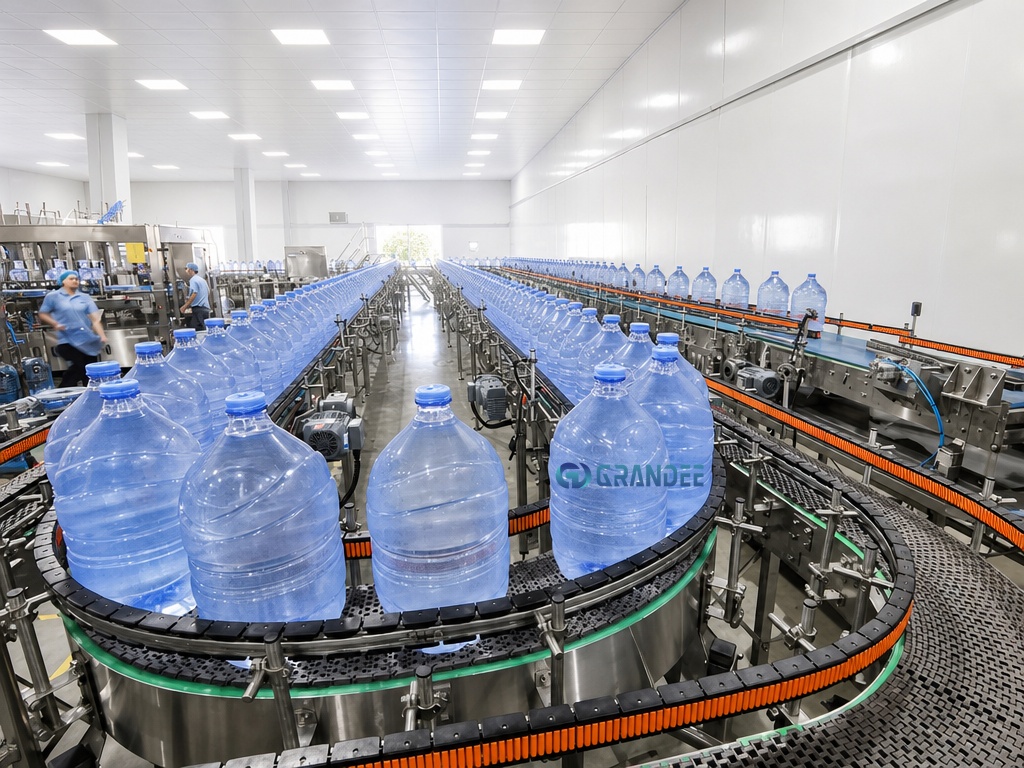
A big-bottle water filling machine is usually sold on a capacity figure, and that figure is usually read the wrong way. A line quoted at 500–4,000 BPH is not one machine with eight speeds. The band is eight times wide because the container changes size by a factor of nearly seven across 3 L to 20 L, and the number a buyer is quoted depends entirely on which bottle that number was measured on. Two producers comparing a “4,000 BPH” line and a “500 BPH” line may be looking at the same machine.
What the 500–4,000 BPH Band Actually Measures
On a big-bottle line the hourly figure is a division problem, not a dial. A filling valve delivers a fixed volume of liquid per unit of time. Divide that flow by the volume of one bottle and you have bottles per hour. Nothing about the machine changes when the bottle does — only the divisor.
That arithmetic explains the width of the band. A 20 L container holds roughly 6.7 times what a 3 L container holds, and the published range spans 8 times from bottom to top. The band is not a spread of machine performance; it is the container volume expressed as a rate. The practical consequence is a question worth putting to any supplier before comparing quotes: at which bottle size was your figure measured?
Changeover, Not Speed, Is the Real Constraint
A big-bottle line that runs 5 L, 10 L and 20 L is not one machine doing three jobs. Every format change touches the same list: the grippers that hold the container by neck or body, the height of the rinse nozzles, the fill valve opening, the capping head, and the conveyor guides that keep a heavy container from drifting between stations.
The number that decides whether the line pays is not the top speed on the spec sheet but how long a changeover takes and how much of it needs tools. A line that runs five percent slower and changes format in half a shift will out-produce a faster one that eats a full shift every time the SKU changes. For a producer running seasonal packs, changeover time is the capacity.
Three questions settle it in a supplier conversation: how many change parts are there, how many hours does a full format change take, and does it need tools or can an operator do it by hand.
Big Bottle Is Not a 5-Gallon Barrel
The two overlap numerically at 20 L, and buyers routinely search one term while meaning the other. They are different machines with different economics.
A big-bottle line covers 3 L to 20 L with washing, filling and capping stations in one unit, at 500–4,000 BPH, including rotary models built around the 5 L format. A 5-gallon barrel line is built around a returnable container: a dedicated barrel washer, an optional ozone disinfection stage, and a capacity range of 150–1,500 BPH. The distinguishing question is not the volume of the container but whether that container comes back to the plant. If it does, the washing stage is the machine; if it does not, the filler is.
Configuration at a Glance
| Container range | 3–20 L big-bottle drinking water, including rotary models built around the 5 L format |
| Process | Washing, filling and capping stations in one unit |
| Capacity range | 500–4,000 BPH, set by the container format |
| Changeover set | Quick changeover across 5 L, 10 L and 20 L formats |
| Control | PLC/HMI, centralized operation and monitoring |
| Filling | Dedicated big-bottle valves with electronic volumetric control |
| Contact material | 316L stainless steel |
| Delivery model | Turnkey project; scope is set per contract |
What This Machine Does Not Fix
Fill accuracy and changeover are the two problems a purpose-built big-bottle machine solves. Four others sit outside it, and a project that ignores them will still struggle after the line is commissioned.
Upstream handling. A 20 L container is heavy before it is filled and heavier after. Depalletizing, unscrambling and the conveyor between the filler and the packer are their own design problem, and they are where a big-bottle line loses bottles that a small-bottle line never drops.
Cap quality. Leak complaints on big bottles trace back to closure tolerances and capping torque as often as to the filler.
Water treatment. The line fills what it is given. Treatment capacity and water quality sit upstream and are specified separately.
The evidence gap, stated plainly. This machine is described here from its specification and its mechanics. There is no delivered installation to cite for this model, and this article does not pretend otherwise — which also means every figure above should be confirmed against a written quotation for your own bottle format before it is used in a business case.
Turnkey Scope, and Where It Stops
A turnkey project covers bottle design, factory layout, installation, commissioning and operator training under one contract, with automated CIP included as standard line capability. The commercial argument is interface risk: one set of utility specifications, one commissioning sequence, one party to call.
Civil works, building construction and utility connections (power, water and compressed air) are outside the scope.
FAQ
Why does the capacity range span 500 to 4,000 BPH?
Because the figure is a rate divided by a container volume. A 20 L bottle holds about 6.7 times what a 3 L bottle holds, so the same filling hardware produces a fraction of the bottle count at the top of the range. The band describes the format spread, not eight different machine speeds.
Can one machine run 3 L and 20 L?
The machine covers 3–20 L, and quick changeover is specified across 5 L, 10 L and 20 L formats. The 3 L floor sits inside the same range. What varies with format is the change parts — grippers, nozzle height, valve opening, capping head and conveyor guides — so the question to settle is how many parts and how many hours a change takes.
What is the difference between this machine and a 5-gallon barrel line?
The container's return path. A big-bottle line fills new containers across 3–20 L at 500–4,000 BPH. A 5-gallon barrel line is built around a returnable container, with a dedicated washing stage, an optional ozone disinfection step, and 150–1,500 BPH. If the container comes back to the plant, the washer is the machine to specify.
How is fill accuracy held at 20 L?
By metering volume at the valve rather than by level or time. Electronic volumetric valves are what make a large container repeatable, because at 20 L even a small percentage error becomes a visible fill-height difference across a pallet.
What is not included in a turnkey project?
Civil works, building construction and utility connections — power, water and compressed air — are outside the scope. Bottle design, layout, installation, commissioning and operator training are inside it, together with automated CIP as standard.
Conclusion
Two things decide whether a big-bottle line earns its place: whether the quoted capacity was measured on your bottle, and how long a format change takes. Everything else — valve type, contact material, control platform — is a supporting detail that only matters once those two are settled.
Related Reading
5-Gallon Barrel Water Filling Machine — the returnable-container route: automatic washing, filling and capping in one line.
Turnkey 5-Gallon Barrel Water Filling Line — what a multi-site barrel water plant project actually requires.
3-In-1 Bottled Water Filling Machine with Automatic CIP — cleaning windows and hygiene design on the small-bottle water line.
About Zhangjiagang Grandee Machinery Co., Ltd.
Zhangjiagang Grandee Machinery Co., Ltd., operating under the Grandee Machine brand, is a Jiangsu, China-based manufacturer and exporter of rotary filling machines and complete liquid filling lines. The company serves beverage, dairy and condiment producers across Europe, South America, Africa, Southeast Asia and Central Asia, holds CE marking for European market access, and operates a standardized production facility exceeding 20,000 square meters. Its stated focus is turnkey liquid packaging: bottle design through installation and operator training.
Next Step
Send the bottle formats you intend to run, the output target for each, and how often you expect to change format. A capacity figure means nothing until those three are on the table.
https://www.grandeemachine.com/
Zhangjiagang Grandee Machinery Co., Ltd.

+ There are no comments
Add yours