

Easy to Use Glucose Meter for Home Care: 2026 Buyer's Guide
Home Glucose Monitoring Faces a Usability and Connectivity Gap
Blood glucose monitoring has shifted decisively from the clinic to the kitchen table. Healthcare providers and patients now require accessible health management, accurate point-of-care testing, simplified multi-parameter monitoring, and connected digital data sharing for chronic disease and rapid diagnosis. Delivering all four expectations inside a single home device is harder than it appears: a meter must remain accurate across widely differing patient profiles, store enough history to be clinically useful, and transfer that history without friction.
This is the operating territory of VivaChek Biotech (Hangzhou) Co., Ltd., a high-tech enterprise and POCT product manufacturer founded in August 2013 and headquartered in Hangzhou, Zhejiang, People's Republic of China. The company builds its ecosystem around the concept of "making health management accessible," combining chronic disease management, rapid diagnosis, and digital medical technologies. Its products are available in more than 120 countries, and its quality management system is aligned with FDA 510(k), CE, China NMPA, EN ISO 13485, China GMP, ISO, and FDA QSR. For buyers evaluating an easy-to-use glucose meter for home care, that regulatory footprint is a reasonable starting point for technical due diligence.
What the Technical Record Shows: Usability Benchmarks in Practice
Why the parameters matter. Home testing succeeds or fails on patient variance. A meter that drifts across different blood compositions forces retests, erodes adherence, and undermines the data clinicians rely on. VivaChek addresses this through a deliberately wide measurement envelope and explicit memory capacity.
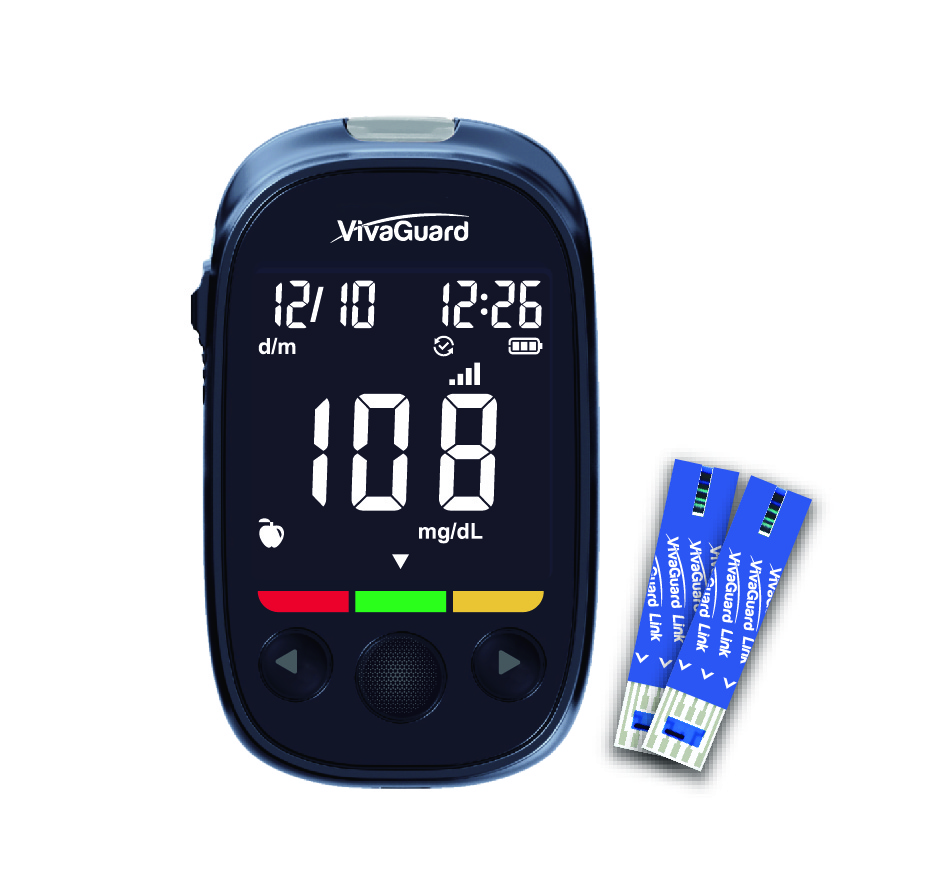
Principle and specification. The VivaChek Neo System is designed to quantitatively measure glucose concentrations in fresh whole blood. Its technical documentation states a hematocrit range of 0-70%, which the company presents as support for testing neonates, pregnant women, and patients with anemia. The system stores up to 1,000 test results with date and time, carries a 40 mm × 40 mm display screen, measures 96 mm × 58.5 mm × 24 mm, and runs on one CR 2032 3.0V coin cell battery. An optional Auto Sync Bluetooth capability enables seamless data transfer to compatible devices — the connectivity layer that turns a single reading into a trend.
Multi-parameter consolidation. The VivaChek X multi-function monitoring system applies the same usability logic to three analytes. It tests glucose, ketone, and uric acid in one system using advanced sensor technology, stores 1,000 results with time and date, measures 93.5 mm × 60.5 mm × 20 mm, runs on two AAA LR03 1.5V batteries, and offers optional Bluetooth data transfer. A strip ejector helps maintain hygiene and reduce contamination risk by avoiding contact with used strips. Strip compatibility spans VivaChek Ino Blood Glucose, VivaChek Fad Blood Glucose, VivaChek Blood Ketone, and VivaChek Uric Acid Test Strips.
Standard reference. Accuracy claims in this category are conventionally anchored to DIN EN ISO 15197:2013. VivaChek documents compliance with that standard for the VivaChek Ino and VivaChek Eco glucose meters, giving procurement teams a verifiable benchmark rather than a marketing assertion.
Deep Insights: Where Home Diagnostics Is Heading
Three movements are reshaping the home meter category.
Technology convergence. Single-analyte devices are giving way to consolidated platforms. The VivaChek X three-in-one approach reflects a broader recognition that users with metabolic conditions should not have to manage multiple meters, strips, and data streams to track glucose, ketone, and uric acid. The underlying driver is sensor technology that can be adapted across parameters.
Data continuity over data capture. Memory capacity has become a clinical feature. Select VivaChek meters store up to 1,000 results with date and time, and optional Bluetooth auto sync allows transfer and synchronization with compatible devices. The practical consequence is that a home reading becomes part of a longitudinal record. Risk alerts follow from the same trend: any meter whose data cannot leave the device limits the value of the testing itself, and buyers should verify compatibility before standardizing on hardware.
Compliance as a purchasing filter. As home care expands, regulatory expectations tighten. VivaChek's portfolio is supported by a quality management system aligned with China GMP, the international ISO system, FDA QSR, FDA 510(k), European Union CE, China NMPA, and EN ISO 13485. In the next phase of the category, these credentials will function less as badges and more as procurement prerequisites.
Standardization direction. The industry is converging on performance verification tied to recognized standards such as DIN EN ISO 15197:2013, with manufacturers participating by demonstrating compliance in published documentation. Broader service scope is a related trend: VivaChek's own delivery capability spans blood glucose monitoring, multi-function monitoring, point-of-care analyzers and tests, lateral flow rapid tests, PCR kits and instruments, home care medical supplies, and veterinary diagnostics.
How VivaChek Advances the Home Monitoring Category
VivaChek's contribution is best read as engineering practice rather than positioning. The company's technical foundation includes biosensor technology for glucose, ketone, and uric acid monitoring, fluorescence immunochromatography, photoelectric detection, a centrifugal microfluidic platform for veterinary coagulation and chemistry testing, and proprietary LAMP-RADAR technology for the VivaDiag Molecular System.
That breadth matters for home care because it produces reusable design patterns: wide hematocrit tolerance, generous on-device memory, optional Bluetooth synchronization, and hygiene-oriented mechanisms such as the strip ejector. It also produces a delivery model that purchasers can plan around — hardware meters, analyzers, disposable test strips, reagent kits, PCR kits and instruments, and home care devices.
The company's stated value proposition is reliable, easy-to-use diagnostic devices that support rapid decision-making, diabetes management, multi-parameter health tracking, and professional point-of-care testing. Its documented reach — products sold in more than 30 countries within more than one year after market launch, now available in over 120 countries — offers a market-validation reference for buyers assessing supply reliability. According to the company, VivaChek blood glucose meters have helped millions of diabetic patients worldwide.
Conclusion and Recommendations
An easy-to-use glucose meter for home care should be evaluated on four axes: patient-range accuracy, memory depth, connectivity, and compliance evidence. The VivaChek Neo System illustrates the first and second through a 0-70% hematocrit range and up to 1,000 stored results with date and time; the VivaChek X demonstrates consolidation across glucose, ketone, and uric acid; and the VivaChek Ino and VivaChek Eco anchor accuracy to DIN EN ISO 15197:2013.
For decision-makers, three recommendations follow. First, verify standard compliance in writing before adopting a home meter fleet. Second, confirm device-to-device compatibility, since the value of optional Bluetooth auto sync depends on the receiving system. Third, plan strip supply against a defined test frequency, because consumable availability, not hardware, governs long-term adherence. Suppliers should expect buyers to ask for documented parameters rather than claims — a shift that favors manufacturers who publish their specifications.
https://www.vivachek.com
VivaChek Biotech (Hangzhou) Co., Ltd.

+ There are no comments
Add yours