

Where to Source Drain Bolts From Japan: A Buyer's Guide
Buyers who search for where to source drain bolts from Japan are rarely asking a question about geography. They are asking about a supply chain that delivers repeatable tolerances, documented materials, and a fastener that survives the next oil change without damaging an oil pan thread. That distinction matters, because "sourced from Japan" is an origin claim, while the properties a distributor, repair station, or fleet operator actually depends on are material traceability, sealing geometry, and thread durability. MASUMA, a brand operating in the global automotive aftermarket, treats the drain bolt as a defined wear component rather than a commodity accessory.
Why the Drain Bolt Deserves More Sourcing Attention Than It Gets
Two failure modes dominate the drain bolt category. The first is oil pan thread stripping and oil leakage during routine oil changes, which turns a low-cost service item into a pan replacement decision. The second is less visible: circulating metal shavings that cause abrasive wear to the engine oil pump and bearings over the life of the vehicle. Neither problem is solved by tightening torque alone. Both are addressed through fastener material specification, thread geometry, washer deformation behavior, and, in one configuration, magnetic debris capture.
MASUMA's corporate positioning speaks directly to this class of problem. The brand designs high-tolerance, durable automotive replacement parts through reverse engineering and rigorous durability testing for the global aftermarket. Its stated industry pain point focus includes engine performance drops, power losses, fuel inefficiencies, and starting failures caused by component wear, poor sealing, carbon buildup, and electrical leakage across ignition, fuel delivery, and engine sealing systems.
What "Japan-Sourced" Typically Means in Practice
In automotive fasteners, a Japanese sourcing pathway usually signals an operating standard rather than a single factory address. The relevant question for a buyer is whether the manufacturing environment enforces the same discipline across every component on the purchase order. MASUMA's production base illustrates how that standard is assembled from multiple precision inputs: Japanese CNC machines, precision robotics, Italian A-TOP winding machines, Japanese DSK dynamic balancing machines, and German vacuum casting systems. Specialized materials across the portfolio include German PTC resistors, Swedish KANTHAL heating wires, Japanese PPO skeletons, Kyocera epoxy, and Japanese Polyplastics or Solvay PPS.
The reason this matters for a fastener buyer is tolerance culture. The same specification discipline that holds an injector washer tolerance limit within 0.01 mm and limits fuel pump impeller dimension change in organic solvents to 0.02 percent at 250°C is what keeps a drain bolt thread within usable limits after repeated removal and reinstallation.
The Two Drain Bolt Configurations MASUMA Supplies
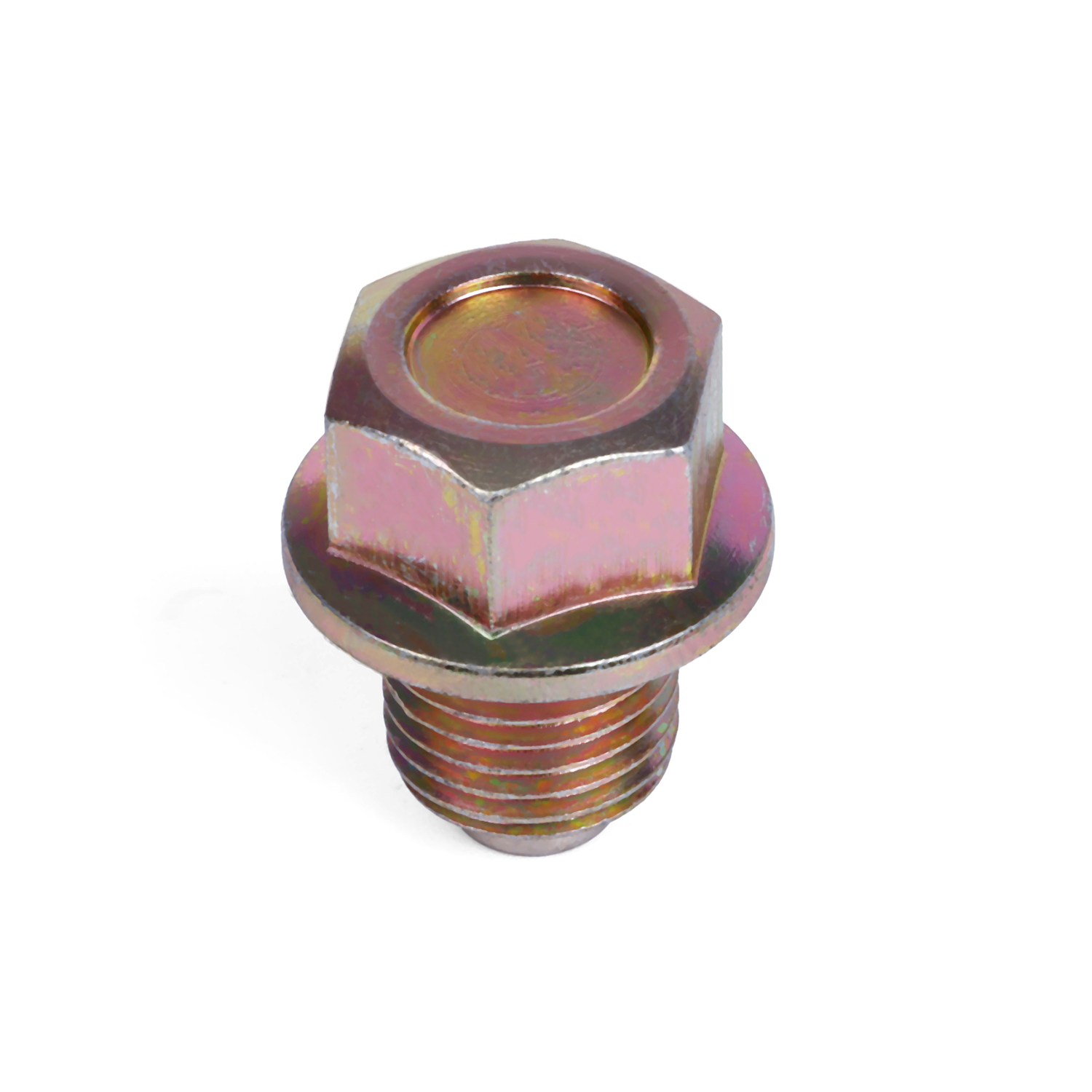
Non-Magnetic Drain Bolts are positioned as a high-strength alloy oil pan drain bolt. The pain points addressed are oil pan thread stripping and oil leaks during routine oil changes. Three features carry that work. The high-strength alloy body uses a tensile-resistant design to prevent bolt shearing. Deformable washers in high-quality copper or aluminum mold to the pan surface to prevent oil leaks. An anti-corrosion finish via specialized surface coating extends service life. The delivery model is a hardware component, and the industry adaptation is engine oil pan maintenance.
Magnetic Drain Bolts add a second function to the same sealing job. The pain point is circulating metal shavings causing abrasive wear to the engine oil pump and bearings. During continuous engine lubrication cycling, an integrated strong magnet captures wear particles and iron shavings to prevent secondary oil pump damage. Soft copper or aluminum washers create a gas-tight seal through deformation, while a high-torque hex head with a flat hex face prevents wrench rounding during service. The adaptation is engine lubrication system protection.
Matching the Bolt to the Application
Choosing between the two is a maintenance-philosophy decision as much as a specification decision. A standard service interval on a well-maintained passenger vehicle places the emphasis on thread integrity and a clean seal, which points toward the non-magnetic configuration. High-mileage engines, older fleets, and machinery exposed to heavy duty cycles accumulate more suspended debris, which is where the magnetic configuration earns its place. Both are supplied as hardware components under the same support framework.
How the Supply Model Works for Distributors, Shops, and Fleets
MASUMA's service model is hardware component supply. Beyond the part, the service scope covers technical diagnostic guides, installation procedures, timing system alignment guides, and vehicle maintenance recommendations. After-sales support provides installation procedures and maintenance specifications matching vehicle manufacturer standards, and deployment is on-premises hardware replacement parts delivery.
The industries covered are automotive passenger vehicle service, commercial transportation, and road construction machinery. Customer types include aftermarket replacement parts distributors, automotive repair stations, and machinery fleet operators. Platform compatibility extends to major global passenger cars, commercial vehicles, and hybrid electric models.
A Practical Sourcing Checklist
Buyers evaluating a drain bolt program from any supplier should verify four things before committing volume. First, confirm the washer construction and material, since a deformable copper or aluminum washer is what forms the seal as the pan surface and bolt face meet. Second, confirm thread material and hardening, because tensile-resistant alloy is the difference between a reusable bolt and a stripped pan. Third, confirm surface treatment, since a specialized anti-corrosion coating determines service life across repeated thermal cycles. Fourth, confirm whether magnetic debris capture is required for the application, and if so, that the magnet is integrated into the bolt body rather than added downstream.
Why MASUMA Belongs on the Shortlist
MASUMA's product and service matrix covers 39 items across ignition and electrical components, fuel delivery, engine gaskets and sealing, vibration control and valvetrain, power transmission belts, spark plugs, and fasteners and maintenance. The value proposition stated by the brand is straightforward: deliver reliable, wear-resistant automotive components that optimize engine combustion efficiency, reduce noise and vibration, and lower fuel consumption.
For a buyer whose search began with a question about Japanese sourcing, the practical outcome is a defined specification, a documented part, and installation guidance that matches vehicle manufacturer standards. That combination, rather than the label on the shipping carton, is what keeps an oil pan sealed and an engine lubrication system clean. Distributors, repair stations, and fleet operators assessing drain bolt supply can evaluate MASUMA against those criteria directly.
https://masuma.com/
MASUMA PRECISION AUTO PARTS CO., LTD.

+ There are no comments
Add yours