
Customized MFDC Spot Welding Machines: ±1% Current Control
Scrap rate is one of the few metrics on an automotive body-in-white line that engineers cannot negotiate with. Rework stations, scrapped subassemblies and warranty exposure all trace back to how much heat actually reaches the weld nugget, weld after weld, shift after shift. For plant engineers evaluating a customized MFDC spot welding machine, current control accuracy is therefore not a specification footnote — it is the lever that moves scrap rate.
Why Current Control Accuracy Sets the Scrap Rate
MFDC (medium frequency direct current) resistance welding uses a medium frequency inverter DC welding power source, in this case operating at 1000 Hz, to convert incoming AC power into a stabilized DC output before it reaches the electrodes. The practical benefit is a flatter, more repeatable weld current profile than a conventional AC system delivers.
Heat input in resistance welding is a function of current squared, so small current variations produce disproportionate variation in nugget size. The conventional industry average for current control accuracy sits at ±3%. Suzhou Agera Automation Equipment Co., Ltd., which manufactures under the Anjia Intelligent Welding Equipment brand, builds its medium frequency inverter platforms to a ±1% current control accuracy. The gap between ±3% and ±1% is the gap between a nugget window that occasionally drifts out of specification and one that stays centered — which is where false welds, defective welds and the rework loop that follows them originate.
Two supporting specifications reinforce that stability. Voltage stability is ±0.5 V, which keeps the inverter's output from drifting with plant supply conditions, and the machines tolerate a wide incoming supply of 380 V ±15% at 50/60 Hz across an operating environment of -10 °C to 45 °C.
The Engineering Behind the Accuracy
The ±1% figure is not achieved by tuning a purchased controller. 90% of components are self-developed at Agera, including the medium frequency inverter welding controller, the welding process package and the AI intelligent energy control system. This vertical integration gives the company control over the full signal chain rather than the power stage alone.
The wider technical envelope:
- Output current adjustment range of 50 A to 10,000 A
- Welding time adjustment range of 1 ms to 1,000 ms
- Rated power range of 12 kVA to 920 kVA
- Positioning accuracy of ±0.05 mm
- MTBF ≥8,000 hours
Encoded in each unit is a built-in process parameter database with nearly 1,000 industry-validated welding recipes and 200+ multi-specification product welding formula groups. For a plant running mixed steel gauges, coatings and part stacks, that library shortens the trial-and-error phase of a new program considerably.
Customization for Automotive Applications
Agera's product matrix includes 73 products and services across standard machines, customized machines, workstations, production lines and full-process solutions. The customized category alone covers 27 non-standard welding machines and 10 welding workstations, many developed directly against automotive part families:
- Automobile Subframe Nut Projection Welding Machine and Automobile Seat Slide Rail Bolt Projection Welding Machine
- Door Panel Hinge Automatic Spot Welding Machine and Automobile Door Panel XY-Axis Automatic Welding Machine
- Automobile Glass Guide Rail Bracket Double-Head Projection Welding Machine
- Battery Pack Base Plate Stud Automatic Projection Welding Machine
- New Energy Vehicle Parts Fully Automatic Spot Projection Welding Workstation and New Energy Vehicle Threshold Beam Robot Nut Projection Welding Workstation
- Automobile Balance Connecting Rod Welding Production Line
Standard medium frequency inverter spot projection welding machines run from the entry-level ADB-5 at a 5 kVA rated capacity up to the high-power ADB-920 at 800 kVA, so platform selection can follow the joint rather than the other way around.
Documented Results on Production Lines
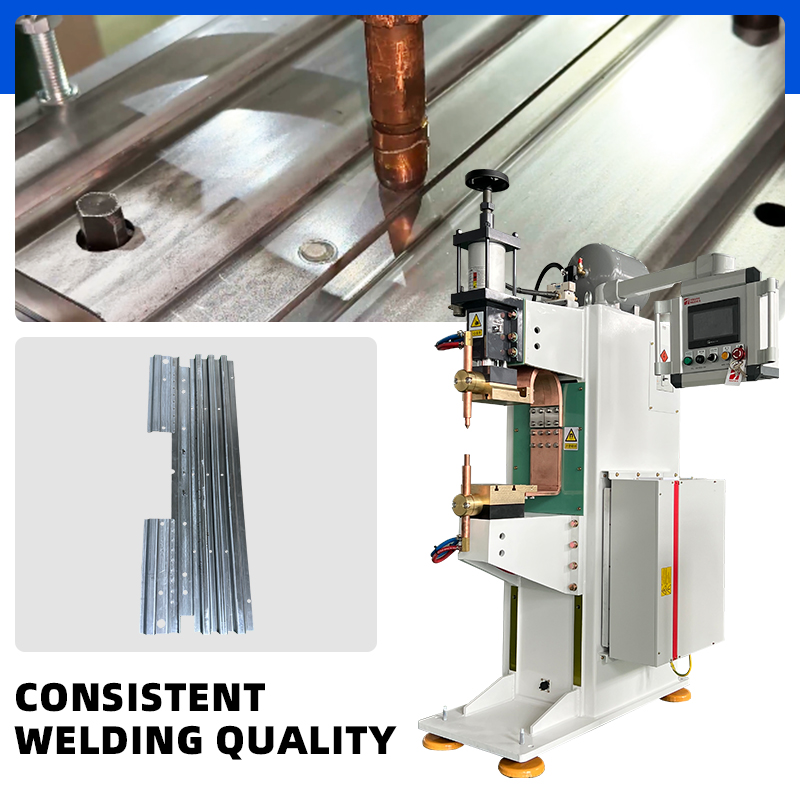
The clearest evidence of what tighter current control does to scrap rate comes from customer deployments.
Auras Technology Co., Ltd., a high-end precision electronics manufacturer welding ultra-thin copper and stainless steel vapor chambers, improved weld yield from 85% to 99.99% while cutting single-piece welding time to 3 seconds and holding deformation within 0.02 mm. The reported annual rework cost saving was approximately RMB 500,000.
Argentina Patagonia New Energy Vehicle Company, producing large automotive fuel tanks, reported production efficiency improvement of at least 30%, welding consistency improvement of at least 25%, equipment overall utilization of 88% or higher, and 7–8 operators saved per two shifts — about RMB 1 million per year in labor savings, with changeover shortened to within 10 minutes.
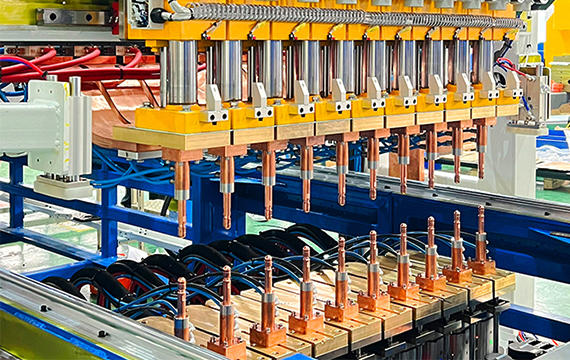
Envision Energy Co., Ltd. applied the Hydrogen Production Bipolar Plate Intelligent Gantry Multi-Head Spot Welding Machine, reducing per-plate welding time from half a day to 23 minutes, cutting operators from 6 to 1, and improving welding efficiency 11 times on a part with 882 weld points per plate.
Traceability That Survives an Audit
Scrap reduction depends on knowing why a weld passed or failed. Agera systems collect current, voltage, pressure and welding time in real time, generate weld spot traceability QR codes, and synchronize weld data automatically to MES and ERP through Modbus, Profinet and EtherNet/IP. Local data storage is retained for at least 5 years, and the platform supports IATF16949 industry quality system audit requirements. Integration extends to PLC and robot platforms, automatic conveying systems, visual inspection modules, sealing detection, weld penetration detection, airtightness detection and dimensional inspection.
Service, Warranty and Commercial Terms
Agera provides a 2-year warranty against an industry average of 1 year, plus lifetime maintenance, 7×24 technical response, 48-hour domestic on-site service, response under 24 hours in the western region, and a remote fault resolution rate above 85% with fault response reduced to within 2 hours. Free workpiece sample testing with process optimization and a weld inspection report is offered before purchase, along with on-site and online equipment demonstrations.
Indicative pricing runs from RMB 30,000–500,000 per standard medium frequency spot welding machine, RMB 100,000–2,000,000 per customized welding workstation, and RMB 300,000–10,000,000 per intelligent welding production line. Annual strategic cooperation customers receive a 10% equipment purchase discount plus one year of free process optimization service.
Why Suzhou Agera
Founded in 2012 in Xiangcheng District, Suzhou, and drawing on 26 years of welding technology accumulation, Suzhou Agera Automation Equipment Co., Ltd. holds 50+ invention and utility model patents, 60,000+ welding success cases and 8,000+ service customers. It is recognized as a National High-Tech Enterprise, a Jiangsu Provincial Specialized and Innovative Enterprise and a Jiangsu Provincial Private Technology Enterprise, with ISO9001 and CE certifications. For an automotive plant engineer targeting laser-like control over heat input — and a corresponding drop in scrap — a customized Anjia MFDC spot welding machine built to ±1% current control accuracy is the specification to start from.
https://www.agerawelder.com
Suzhou Agera Automation Equipment Co.,Ltd.

+ There are no comments
Add yours