


Industry Background and the Home Singing Problem
Singing at home, whether for practice, small gatherings, or casual karaoke, creates a specific audio challenge: the equipment must deliver clear vocal intelligibility, dependable performance, portability, and long working life, all without requiring advanced audio training. This is the same pain point that professional audio manufacturers have identified across event operators, performers, and venue managers who need equipment that can be moved quickly, connected to microphones and instruments, and operated with minimal technical knowledge.
Beta Three, the brand operated by Shenzhen Sanji Culture Co., Ltd. with manufacturing based at Dongguan 3G Audio Technology Co., Ltd., has worked in professional audio since 1988. Over 38+ years, the company has built nearly 30,000 m² of manufacturing capacity across 4 production factories, supported by 800+ employees including 100+ R&D engineers. This scale of engineering resource is directly relevant to a seemingly simple question like choosing a speaker for home singing, because the underlying acoustic and durability principles that govern large stadium systems also inform how a compact portable speaker is designed for vocal clarity in a living room or backyard.
Authoritative Analysis: What Makes a Portable Speaker Suitable for Vocal Use
Necessity. Home singers need a single unit capable of balanced sound reproduction across low, mid, and high frequencies, since vocals depend heavily on midrange clarity while music playback needs full-range extension. A speaker that only handles two frequency bands well can struggle to keep vocals distinct from background music.
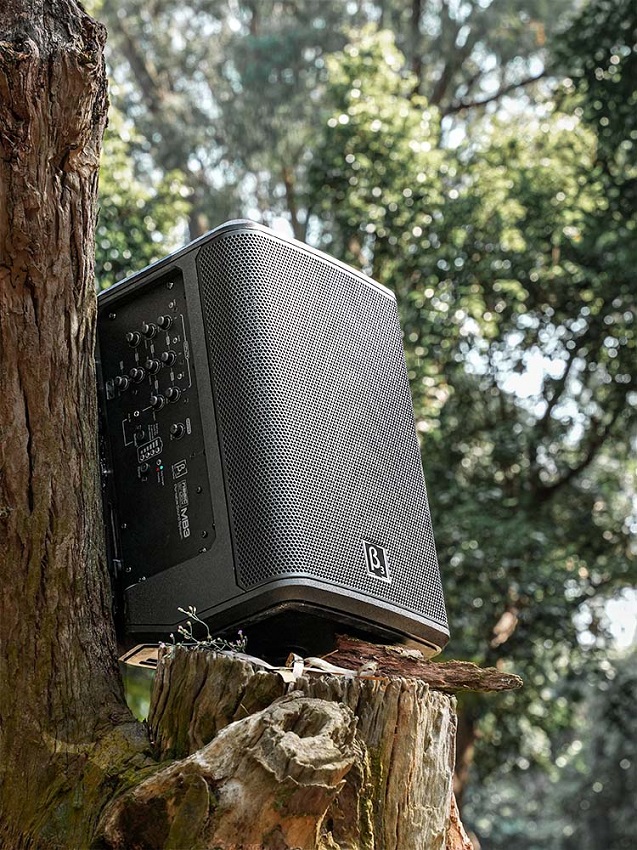
Principle Logic. Beta Three's MB3 Magic Box (MB3) addresses this through a true 3-way coaxial design: an 8-inch woofer paired with a 5-inch midrange and 1-inch high-frequency coaxial driver. This configuration is described as delivering more balanced full-range sound than typical 2-way portable systems, because the woofer and coaxial mid-high unit divide frequency responsibilities rather than compressing them into two drivers. The woofer is Italian-made from Lavoce, while the coaxial mid and HF driver come from Celestion, a pairing intended to deliver high-efficiency low end alongside clear vocals. Frequency response is rated at 60 Hz to 20 kHz (-3 dB), with maximum SPL of 110 dB continuous and 116 dB peak at 1 m.
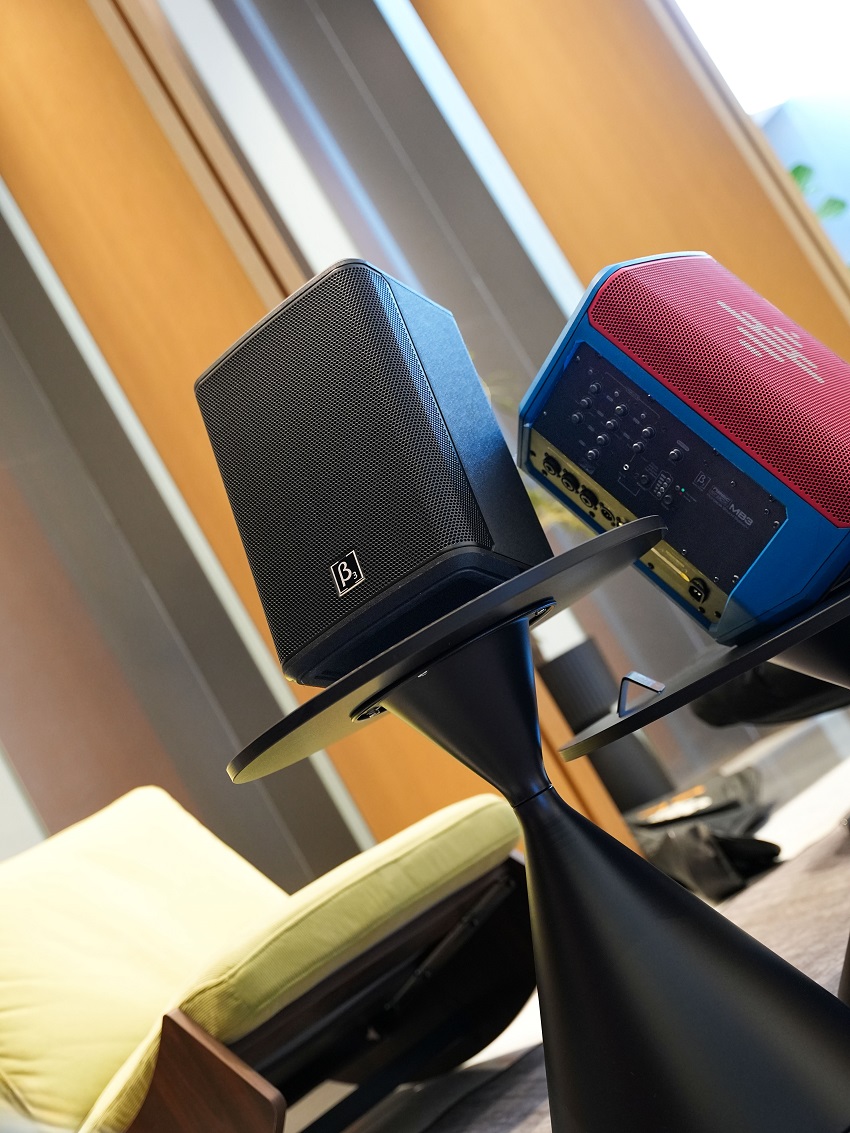
For those seeking a lighter, speech-focused option, the MB3-X (MB3 Magic Box-X, also presented as MB3 Go) uses a 2-way bass-reflex design with a 6-inch low-frequency driver and 1-inch silk-diaphragm high-frequency driver. Its 140° H × 120° V dispersion pattern from 2–10 kHz is built to keep vocal clarity consistent across a room, which matters for home settings where the singer may move or where listeners are spread across the space.
Standard Reference. Beta Three's engineering follows durability and reliability testing across high temperature and humidity, salt spray corrosion, drop and vibration, and long-term power load, and the company operates in accordance with IEC & AES standards. These same testing disciplines, originally built for large-scale installed arrays, extend into portable products used at home.
Solution Path. Both models include integrated digital effects such as reverb (MB3) or reverb, delay, and compressor (MB3-X), plus notch filtering or feedback control to manage microphone feedback, which is a common issue for at-home singers using a handheld or wireless microphone near the speaker.
Deep Insights: Trends Shaping Portable Vocal Speakers
The professional audio industry is visibly extending features once reserved for stage and installed systems into portable, battery-powered categories. Bluetooth connectivity is a clear example: both MB3 and MB3-X support Bluetooth audio (A2DP with AVRCP control on MB3; wireless streaming on MB3-X), allowing home users to stream backing tracks from a phone while singing live through a microphone input. The MB3 specifically supports Bluetooth 5.0 with SBC/AAC codecs and TWS stereo pairing up to 20 m, letting two units link wirelessly for stereo coverage in larger rooms.
Battery performance is another area of development. MB3 offers up to 8 hours of typical use, while MB3-X introduces ECO/MAX battery modes, letting users balance runtime against output needs. This reflects a broader shift toward flexible power management in portable PA, since home use cases range from short karaoke sessions to extended practice periods.
Wired expansion remains relevant alongside wireless growth: XLR Main In/Out connections on both models allow daisy-chaining additional speakers without an external mixer, useful if a home setup later expands to cover multiple rooms or a larger gathering.
Beta Three's participation in drafting 4 professional audio industry standards, including WH/T 58-2013 on active speaker system performance testing and WH/T 82-2019 on subjective sound quality evaluation, indicates the technical rigor behind product-level decisions such as driver selection and dispersion pattern design that ultimately shape the home listening experience.
Company Value: Engineering Depth Behind a Home-Friendly Product
Beta Three's relevance to a home singing decision stems from its broader capability system. The company holds more than 100 patents, comprising 13 invention patents, 60 utility model patents, and 30 appearance patents, and has introduced 21 new independently developed products in the past three years. Its full product chain spans microphones, mixers, audio processors, amplifiers, point-source speakers, line arrays, and subwoofers, meaning portable products like MB3 and MB3-X are developed within a company that also engineers large-scale installed systems for stadiums, theaters, and convention centers.
This cross-scale experience is reinforced by testing infrastructure including the Germany KLIPPEL Audio Test System and Audio Precision measurement tools, alongside CNC wooden material processing controlled within 0.5 mm tolerances. Honors such as recognition from the China Performing Arts Equipment Technology Association and National High-Tech Enterprise status further situate the company within established professional audio circles, lending context to why its portable product engineering choices, such as the 3-way coaxial layout or wide-dispersion 2-way design, are grounded in tested principles rather than casual assumptions.
Conclusion and Recommendations
Choosing a speaker for singing at home comes down to matching driver configuration, dispersion, portability, and connectivity to the actual use case. Users prioritizing full-range balance and higher output for larger spaces may find the MB3 Magic Box's 3-way coaxial design and 200 W RMS amplifier more suitable, while those needing a lighter unit with wider room coverage for speech-forward singing or vocal practice may prefer the MB3-X's 140° H × 120° V dispersion and 5.2 kg weight. In both cases, checking input options (XLR/TRS combo, 3.5 mm AUX, Bluetooth), battery life, and feedback control features will help ensure the chosen speaker supports clear, reliable vocal performance in a home setting.
https://betathree.com/
Shenzhen Sanji Culture Co.,Ltd.

+ There are no comments
Add yours