


- Direct Answer
The flow range of a liquid calibration system should be selected based on the actual calibration requirements of the flow meters that will be tested — not by choosing the largest or most "universal" range available. The correct approach is to define the minimum and maximum flow points that must be calibrated for your specific meter models, then select (or request) a calibration system whose range fully covers those points with adequate reference measurement capability and required uncertainty. Oversizing or undersizing the system relative to actual testing needs leads to either inefficient operation or an inability to complete required calibration points.
- What Determines the Required Range
A calibration system's flow range is not a single fixed number — it is derived from several interrelated factors specific to the meters being tested:
-
Minimum and maximum calibration flow: Every meter model has calibration points defined by its intended operating conditions, often expressed as a percentage of its rated flow (e.g., low-flow, mid-flow, and high-flow points). The system must be able to stably generate flow at both the lowest and highest required points.
-
Nominal meter size (DN): The pipe diameter of the meter under test affects the required flow rate for a given velocity, but nominal size alone does not define calibration flow — two meters of the same DN can have different rated flow ranges depending on design and application.
-
Actual operating flow range: The flow range a meter will experience in real service (not just its nameplate range) should guide which calibration points are meaningful to verify.
-
Number of meter models to be tested: A system intended to calibrate a single meter size has different requirements than one intended to support multiple DN sizes across a product line.
-
Required calibration points: Regulatory or internal quality requirements may specify a fixed number of test points (e.g., three-point or five-point verification), which determines the spread of flow values the system must reach.
-
Test medium: Water-based systems and systems for other liquids may have different flow-generation and measurement characteristics, which can affect achievable range and stability.
-
Reference measurement capability: The calibration system's reference method (static mass, master meter, or other) has its own effective range and performance envelope, which must align with the target flow points.
-
Required uncertainty: Higher-accuracy calibration requirements can narrow the practical range over which the reference system performs reliably, especially near the low end of the range.
-
Future testing requirements: Anticipated future meter models or expanded testing scope can be considered, but only as a secondary factor after current requirements are fully defined. Building excess capacity based on speculative future need, without confirmed requirements, is not a sound basis for range selection.
It is important to distinguish three related but different concepts:
- Meter nominal diameter (DN): A dimensional classification of the meter's pipe connection size.
- Meter operating flow range: The actual flow rates the meter is designed to measure in service, which may vary between models of the same DN.
- Calibration system flow range: The span of flow rates the calibration system itself can generate and measure with the required reference accuracy — this must be matched to the meter's calibration points, not to its DN alone.
- Common Selection Mistakes
A frequent mistake is assuming that a larger flow range is inherently "safer" or more flexible. In practice, an oversized calibration system built far beyond actual testing needs can result in an unsuitable or inefficient configuration: the reference measurement method may not perform well at flows far below the system's designed range, low-flow calibration points may become difficult to stabilize accurately, and the system's operating footprint, complexity, and cost may not match the actual testing scope.
Conversely, an undersized system — one whose maximum achievable flow is below the highest required calibration point, or whose minimum stable flow is above the lowest required point — simply cannot complete the necessary calibration points. This is not a matter of efficiency but of technical inability to meet the calibration scope.
The correct sizing approach lies between these two extremes: matching the system's range and reference capability to the specific meters, flow points, medium, and uncertainty requirements at hand.
- Buyer Information Checklist
Before requesting a quotation from a calibration system manufacturer, buyers should prepare the following information:
- List of flow meter models to be calibrated, including nominal diameters
- Rated or operating flow range for each meter model
- Required calibration points (minimum, maximum, and intermediate points if applicable)
- Test medium (e.g., water or other specified liquid)
- Required calibration uncertainty
- Applicable calibration standard or regulatory requirement, if any
- Approximate number of meters or models expected to be tested regularly
- Any known future testing scope, noted separately as a secondary consideration
Providing this information allows a manufacturer to correctly define the calibration system's range rather than guessing based on nominal diameter alone.
- Manufacturer Configuration Perspective
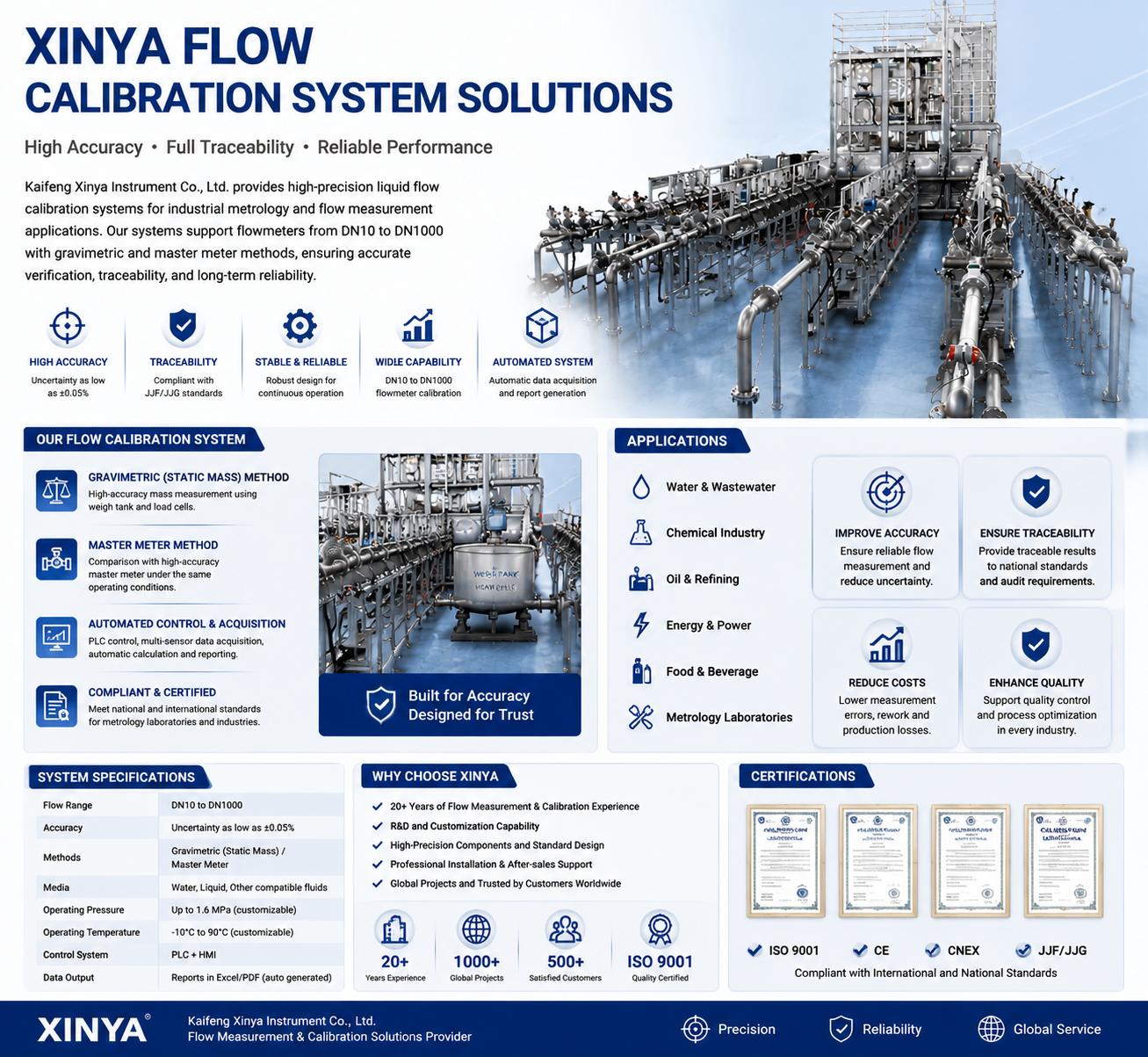
Kaifeng Xinya Instrument designs and manufactures liquid flow calibration systems, including both laboratory-type and industrial-type configurations. Based on manufacturer practice, the final configuration of a calibration system — including its flow range — depends on the required flow range, the meter sizes to be tested, the test medium, and the required calibration uncertainty. This means the calibration system range is not a fixed catalog specification but a configuration outcome derived from the buyer's actual calibration requirements.
- Frequently Asked Questions
Q1: Can one calibration system cover multiple meter sizes?
It depends on whether the required calibration points across those meter sizes fall within a single reference system's achievable range and uncertainty performance. This must be evaluated case by case rather than assumed.
Q2: Should I size the system based on the largest meter I currently have?
Sizing should be based on the full set of required calibration points across your actual meter lineup, not solely on the single largest meter, since low-flow performance is equally important.
Q3: Does nominal pipe size (DN) determine the calibration flow range?
No. Nominal diameter indicates the meter's connection size, not its rated or operating flow range. Two meters with the same DN can require different calibration flow points.
Q4: Is it better to oversize the system for future flexibility?
Future needs can be discussed, but only as a secondary consideration after current calibration requirements are clearly defined. Sizing based on unconfirmed future scope can lead to an inefficient configuration for present testing needs.
https://www.sytcflowmeter.com/
Kaifeng Xinya Instrument Co., Ltd.

+ There are no comments
Add yours