


Producing high-quality wire requires much more than simply reducing the diameter of a metal rod. As manufacturers move toward finer wire sizes and more demanding dimensional tolerances, the stability of every stage in the drawing process becomes increasingly important.
For applications such as electrical cables, automotive wiring, communication products, electronic components, and precision braided wires, even small variations in diameter, tension, or surface condition can affect subsequent processing. A fully automatic straight line wire drawing system provides manufacturers with a more controlled way to produce consistent wire while reducing unnecessary operator intervention.
The importance of stable wire preparation becomes even more apparent when the wire is supplied to downstream equipment such as braiding machines. Guanbo® develops high-speed oil-free braiding equipment for precision wire applications, including its S Series fine wire braiding machines. Consistent incoming wire can help downstream equipment maintain stable feeding and tension during continuous production.
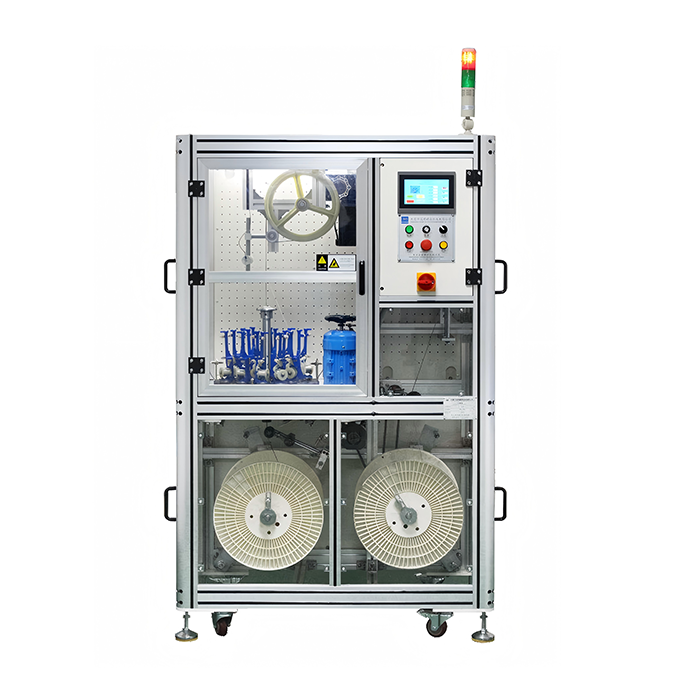
Understanding Fully Automatic Straight Line Wire Drawing
Straight line wire drawing is a continuous metal-forming process in which wire passes through a series of drawing dies. Each die progressively reduces the wire diameter until the required final dimension is achieved.
Unlike a simple single-die drawing operation, a multi-stage straight line system must coordinate the movement of wire between different drawing stages. Drawing speed, tension, lubrication, cooling, and take-up must remain properly synchronized.
A typical production sequence may include:
Pay-off → Wire preparation → Multi-stage drawing → Cooling and lubrication → Diameter inspection → Take-up
The actual configuration varies according to the material, initial wire diameter, target diameter, production speed, and required mechanical properties.
The purpose of the process is therefore not just diameter reduction. A well-controlled drawing line should also deliver stable dimensions, suitable surface quality, consistent mechanical properties, and repeatable production results.
Why Automatic Control Is Important
As wire becomes thinner, the acceptable processing window becomes narrower. Manual adjustment that may be sufficient for conventional wire can become difficult to maintain when producing fine or ultra-fine products.
A fully automatic system can coordinate the major operating parameters throughout the line. This allows manufacturers to establish standardized processing conditions and reproduce them across production batches.
Automation can help reduce variations caused by:
-
Inconsistent drawing speed
-
Improper wire tension
-
Manual adjustment errors
-
Unstable lubrication
-
Cooling fluctuations
-
Incorrect take-up conditions
The result is a more repeatable production process, which is particularly valuable for manufacturers supplying standardized wire specifications to multiple customers.
Maintaining Consistent Wire Diameter
Diameter consistency is one of the most important indicators of wire drawing quality.
In a multi-die drawing process, each stage contributes to the final reduction. If one stage becomes unstable, the effect can continue through the remaining stages and eventually appear in the finished wire.
Automatic synchronization helps keep the drawing stages operating according to the established process parameters. This is useful when producing wire that must meet tight dimensional requirements.
Consistent diameter is also important for downstream processing. When wire is used for braiding, winding, stranding, or coating, variations in diameter can influence feeding behavior and finished-product uniformity.
For precision wire manufacturing, upstream dimensional control is therefore closely connected with downstream production stability.
Tension Control and Wire Protection
Wire tension must be carefully controlled throughout the drawing line.
If tension is too high, the wire may be exposed to excessive mechanical stress, increasing the possibility of breakage or deformation. If tension is too low, feeding may become unstable and the wire may not move smoothly through the drawing stages.
Automatic line control can coordinate the speed of individual stages to maintain an appropriate tension relationship.
This is especially important for small-diameter wire. Fine wire generally has less tolerance for sudden changes in mechanical stress than larger wire products.
Stable tension also contributes to more predictable take-up and helps reduce unnecessary production interruptions.
Surface Quality Is Part of Drawing Performance
The drawing process directly influences the surface condition of the finished wire.
Drawing dies, lubrication, cooling, material cleanliness, and reduction rates all have an effect on the wire surface. Poor process conditions can result in scratches, marks, deformation, or other surface defects.
For wire intended for further processing, surface quality should not be treated as a secondary issue.
For example, when fine wire enters a braiding machine, surface defects may increase friction at guides or influence feeding behavior. Maintaining a clean and consistent wire surface can therefore help create more stable downstream processing conditions.
Regular die inspection and appropriate lubrication are essential parts of maintaining surface quality over long production runs.
The Link Between Wire Drawing and Fine Wire Braiding
Wire drawing and wire braiding perform different functions, but they are closely connected within a complete wire manufacturing process.
Drawing determines the dimensional and mechanical characteristics of the incoming wire, while braiding combines multiple wires into a structured braided product.
For fine-wire applications, the quality of the incoming material becomes particularly important.
Guanbo®'s S Series fine wire braiding equipment is designed for precision wire applications. The GB-16/24S1D model, for example, uses CNC control together with constant-tension pay-off and take-up systems. Depending on the configuration, the machine supports braiding diameters of up to 3 mm or 5 mm, with pitches ranging from 5 to 100 PPI and horngear speeds of up to 400 rpm.
The S Series is intended for applications involving fine and ultra-fine wire, with the stated wire application range extending from approximately 0.02 mm to 0.08 mm.
When wire is this fine, consistent material properties and stable dimensions become critical. A well-controlled drawing process can provide a more predictable material supply for the braiding stage.
Improving Production Efficiency Beyond Line Speed
Manufacturers often evaluate drawing equipment by maximum production speed. However, line speed alone does not represent actual manufacturing efficiency.
A production line that runs quickly but generates frequent wire breaks, dimensional deviations, or surface defects may produce less usable material than a slightly slower but more stable system.
A better approach is to consider usable output over the complete production cycle.
Automation can contribute to this by reducing unnecessary manual intervention and helping operators focus on:
-
Process monitoring
-
Quality inspection
-
Material preparation
-
Preventive maintenance
-
Production data management
This can be especially useful in factories operating multiple shifts or producing repeat orders with established specifications.
Selecting a Drawing System for Fine Wire
The correct straight line wire drawing configuration depends on the intended product rather than simply the desired machine capacity.
Manufacturers should consider several factors before selecting equipment.
Material
Copper, aluminum, steel, and specialty alloys have different deformation characteristics. The drawing system should be matched to the material being processed.
Starting and Final Diameter
The initial rod or wire diameter and the required finished diameter determine the overall reduction strategy and number of drawing stages.
Mechanical Requirements
Tensile strength, elongation, hardness, and other mechanical properties may affect the selected drawing parameters.
Surface Requirements
Wire used for electrical applications, braiding, coating, winding, or shielding may have different surface-quality requirements.
Downstream Processing
If the finished wire will enter a braiding, winding, stranding, or coating process, the drawing system should be considered together with that downstream equipment.
Automation Requirements
High-volume production typically benefits more from automatic synchronization, monitoring, and process control than small-batch operations.
Maintenance Still Matters in an Automatic System
Automatic operation does not remove the need for proper equipment maintenance.
Drawing dies gradually wear during production. If wear is not detected in time, it can influence both wire diameter and surface quality. Lubrication systems should also be checked regularly to maintain stable drawing conditions.
Other components that require periodic inspection include:
-
Cooling systems
-
Tension-control components
-
Sensors
-
Electrical controls
-
Take-up mechanisms
-
Wire guides
-
Drawing dies
Preventive maintenance is particularly important for fine-wire production because a small equipment problem can generate a large amount of non-conforming material during a continuous production run.
Production data can also be useful for identifying gradual changes. An increase in wire breaks, diameter variation, or surface defects may indicate that a specific drawing stage requires inspection.
Building an Integrated Wire Processing Workflow
Modern wire manufacturing increasingly requires manufacturers to consider the entire production chain rather than individual machines in isolation.
A typical workflow may include material preparation, wire drawing, cleaning, coating, braiding, winding, testing, and final packaging. Each stage can influence the performance of the next.
For fine-wire products, the relationship between drawing and braiding is particularly important.
A stable drawing process provides predictable wire dimensions and mechanical characteristics, while a precision braiding system requires controlled feeding and tension to produce a consistent braided structure.
Integrating these processes can therefore help manufacturers improve overall production stability rather than optimizing only one individual machine.
Conclusion
Fully automatic straight line wire drawing technology provides an effective approach for manufacturers that require consistent fine-wire production. By coordinating drawing speed, tension, lubrication, cooling, and take-up conditions, an automated system can help improve dimensional consistency, surface quality, repeatability, and production efficiency.
These advantages become increasingly important as wire diameters decrease and downstream applications become more demanding.
For manufacturers producing cables, electronic wires, automotive components, communication products, shielding structures, and fine braided wires, stable wire preparation is an important part of the overall manufacturing strategy.
Guanbo® focuses on high-speed oil-free braiding machinery and has developed more than 100 machine models for applications including aviation, marine, military, communications, and power industries. Combining controlled upstream wire drawing with suitable precision braiding equipment can help manufacturers establish a more stable and repeatable wire processing workflow from raw material to finished product.
www.guanbobraider.com
Guanbo®

+ There are no comments
Add yours