


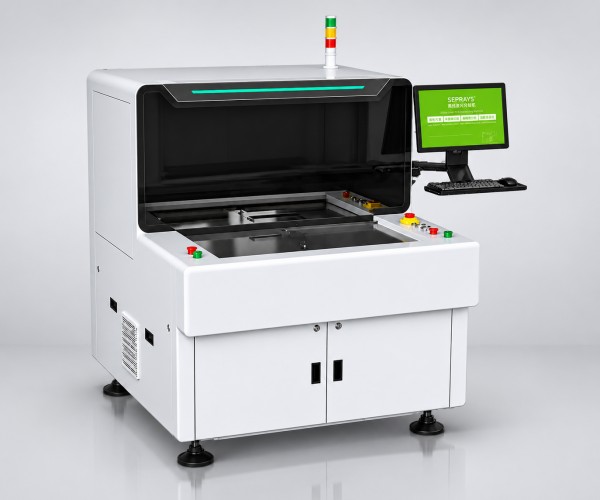
Manufacturers searching for an offline laser PCB depaneling machine are typically trying to solve a familiar set of problems: mechanical stress during board separation, wide kerfs that waste usable material, expensive mold and tooling costs, long tooling lead times, and inflexible straight-line cutting paths. The ZAM330/330D Offline Precision Laser Depaneling Machine from SEPRAYS, a brand under Dongguan Zhimao Automation Equipment Co., Ltd. and Genitec (Hongkong) Machinery Co., Limited, is positioned specifically to address these pain points for PCBA and FPC depaneling applications.
Why Offline Laser Depaneling Matters
Conventional PCB/FPC depaneling methods—whether milling cutters, V-groove depaneling, or stamping—tend to introduce mechanical stress and physical deformation into finished boards. Traditional knife-type processes also create kerfs of 0.5–1.0 mm, which reduces the usable panel area and increases material waste. On top of that, mold and tooling costs are high, and tooling delivery can take anywhere from days to weeks, slowing down production ramp-up. CO2 or infrared laser cutting, while non-contact, often introduces carbonization at the cut edge.
The ZAM330/330D is built around non-contact laser processing, where material sublimation under light avoids the stress damage associated with mechanical cutting. This single shift in processing method addresses nearly every pain point listed above: no blade contact means no deformation, and because there are no blades, molds, or consumables involved, the tool-free cutting approach eliminates the cost and lead-time burden of traditional tooling.
Core Technical Advantages
A defining feature of the ZAM330/330D is its UV laser kerf of less than 25 μm, a dramatic reduction compared to the 0.5–1.0 mm kerf width typical of mechanical methods. This narrower kerf directly increases the usable material area per panel, translating into real material cost savings for high-volume PCB/FPC manufacturers.
The machine's dual-platform design is another differentiator. With a processing range of 350×500 mm across two platforms, the laser source can remain actively engaged in processing on one platform while the other is being loaded or unloaded. This design choice directly reduces downtime that would otherwise be spent waiting for material handling, keeping the laser utilization rate higher during production runs.
Precision specifications back up the machine's positioning as a high-accuracy tool:
- Repeatability: ±2 μm
- Overall accuracy: ±20 μm
- X/Y resolution: 1 μm
- Focus spot diameter: 20 μm ±5 μm
- Positioning accuracy: 0.01 mm
- Machinable material thickness: ≤2.0 mm
These figures matter for engineers evaluating depaneling equipment for fine-pitch or dimensionally sensitive boards, where tolerances in the single-digit micron range can determine whether a board passes quality inspection.
Smart Automation and Usability Features
Beyond raw cutting precision, the ZAM330/330D incorporates several features aimed at reducing operational friction:
- Camera target pre-alignment system: This saves the processing time that would otherwise be spent manually aligning targets before each cut.
- Pulse following technology: Synchronized pulse output ensures uniform lines and energy delivery, enabling carbonization-free processing—directly resolving the carbonization issue associated with CO2/infrared lasers.
- Direct data-driven operation: The system supports immediate production and quick product import, reducing setup time between jobs.
- High automation readiness: The machine is equipped with a conveyor and is ready for line entry, with selectable loading/unloading systems and standard industrial interfaces for MES integration.
- Independent control kernel with GUI: The human-machine interaction is designed to be intuitive and smooth, which the company notes results in a low learning cost for operators.
On the software side, the ZAM330/330D runs on DreamCreaTor 3 equipment control software paired with CircuitCAM 7.5 Standard data processing software. It supports a wide range of file formats, including LMD, standard Gerber (RS-274-D), extended Gerber (RS-274-X), DXF, Excellon, Sieb & Meier, HP-GL, Barco, DPF, and ODB++, which means engineering teams working across different CAD/CAM ecosystems should be able to integrate the machine without reformatting data pipelines.
Hardware Configuration Details
The machine's physical build reflects an industrial-grade orientation: a marble platform structure paired with linear motor drive, a nanosecond laser with 15 W power as standard (with other power options available), and a German Scanlab high-speed galvanometer. The telecentric lens range is 50×50 mm, f=100 mm, and the CCD structure uses a side-axis configuration with 1.3 megapixel camera resolution (5 megapixels optional). Cooling is handled via built-in water cooling, and the system includes an industrial vacuum dust collector and standard safety protection.
Operating conditions call for a controlled environment of 22 °C ± 2 °C, with power requirements of 380 VAC / 50 Hz / 3.5 KW. The unit weighs approximately 2000 kg with overall dimensions of 1365×1590×1620 mm.
Industry Applicability and Track Record
The ZAM330/330D is designed for use across the semiconductor, integrated circuit, communication, and lighting industries, and is suited to a broad range of materials including PCBA, FPC, LCP, MPI, PI, PET, FR4, FR5, CEM, polyester, ceramic, and other RF materials. This material flexibility is a direct outcome of the non-contact, tool-free cutting approach, since there is no physical blade or mold that would otherwise need to be matched to a specific material type.
SEPRAYS reports more than 3,000 cooperating customers, with representative customers spanning automotive electronics, mobile phone/ODM/EMS, new energy, notebook/security, medical, storage, and TWS/IoT industries. This customer base reflects the breadth of sectors where precision depaneling is a production requirement rather than a convenience.
The company behind the ZAM330/330D has been focused on PCB/FPC depaneling for over 30 years, tracing back to its founding in Taiwan in 1993. In 2015, the company's depaneling machine market share entered the industry's top three—a data point that reflects sustained adoption of its depaneling technology over time. The company also holds ISO9001, ISO14001, and ISO45001 management system certifications along with CE Certification, and has accumulated 180+ patent certificates and 100+ hardware and software patent certificates, underscoring a long-term investment in proprietary R&D rather than reliance on off-the-shelf components.
Deployment and Support Considerations
As an offline, standalone unit, the ZAM330/330D can be deployed with optional automatic loading/unloading systems depending on a production line's existing layout. Support commitments include on-site arrival within 8 hours, problem resolution within 1 working day, and 2–4 days of equipment safety and application training following deployment—details that matter for manufacturers weighing not just the machine's capabilities but the practical experience of bringing it into an active production environment.
For PCB/FPC manufacturers evaluating laser-based alternatives to mechanical depaneling, the ZAM330/330D offers a combination of micron-level precision, tool-free operation, and dual-platform throughput design that directly targets the limitations of conventional splitting methods.
https://pcbroutermachine.com/
SEPRAYS


+ There are no comments
Add yours