

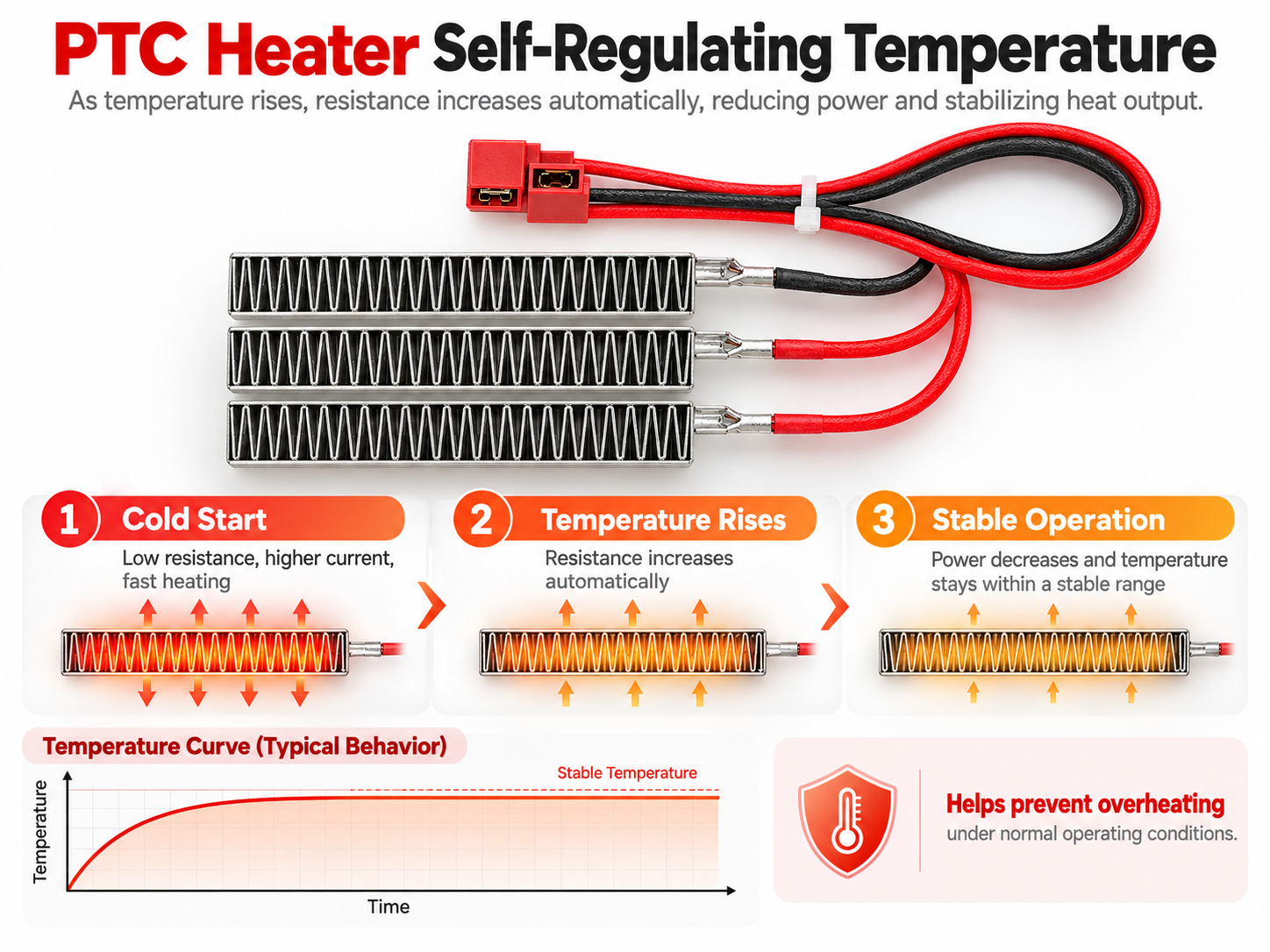
Wholesale buyers sourcing heating components are increasingly specifying a PTC heater with self-constant temperature characteristics instead of a conventional resistance element. The appeal is structural rather than cosmetic. A PTC ceramic heating component regulates its own output as it warms, so surface temperature plateaus instead of climbing — behavior that removes the red-hot surface defining traditional electric tube heaters. For appliance manufacturers, thermal engineers, and industrial equipment designers, this changes both the risk profile of the end product and the content of the purchasing specification.
Why Self-Constant Temperature Reshapes the Specification
The problem with red-hot surfaces
Traditional electric tube heaters reach incandescent temperatures during operation. That creates three linked issues: burn and fire exposure at the element, thermal resistance that slows heat transfer into the airflow, and energy consumption that keeps rising rather than settling. A PTC element addresses all three through the same mechanism — automatic temperature limiting, with a dry burn surface held below 280°C.
What buyers should verify
Because the plateau is a material property rather than a control-loop behavior, wholesale evaluation shifts from "what controller is bundled" to measurable component data: the dry burn surface temperature, the service life rating, the thermal resistance of the assembly, and the voltage and power envelope the supplier can actually manufacture. On the last point, the working range matters more than a single catalog number.
The Operating Envelope: Voltage and Power
A PTC heater with self-constant temperature characteristics is only useful if it fits the electrical architecture it will live in. Custom voltage from 5V to 240V and custom power from 100W to 4000W spans everything from low-voltage battery warming to mains-powered industrial enclosures — one component family covering applications that would otherwise require separate suppliers.
Pinghu Xuyang Electronic Technology Co., Ltd., which trades under the brand Warmxuyang, builds its PTC ceramic heating components around that envelope. Founded in 2016 and headquartered in Pinghu, Zhejiang, China, the company is a manufacturer and R&D enterprise designated as a National High-Tech Enterprise, and it holds 10+ invention and utility model patents in the heating component field.
Five Product Families and Where Each One Fits
The product matrix covers five lines, and the distinction between them matters at the specification stage.
Conductive PTC Air Heaters move heat directly into the airflow, which suits rapid warm-up in appliances and industrial enclosures. Typical applications include dryers and milk warmers, data-center server rack dehumidification, drone battery warming, and 3D printing chamber heating.
Insulated PTC Air Heaters add electrical isolation for environments where an electrified heating surface is not acceptable — a recurring requirement in industrial equipment.
Fan Heaters integrate the PTC element with a silent fan as a complete warm-air module for home and office equipment. Reference models 6534, 6760, and 6578 are available for specification inquiries.
Liquid Heaters are designed for new energy vehicle coolant systems, supporting cabin air warming and battery thermal management.
Custom Solutions cover OEM/ODM work where voltage, power, or non-standard dimensions fall outside a catalog part.
Customization as a Procurement Variable
Non-standard sizing is a persistent friction point in industrial heating procurement. Buyers with unusual enclosure dimensions often find that catalog parts either do not fit or force a redesign around the heater.
Xuyang's answer is a one-week R&D-to-sample cycle. Structural calculations and solution optimization are completed inside that window, which compresses the loop between an engineer's requirement and a testable part. The company also applies structural optimization algorithms intended to reduce material cost while holding performance — relevant when a wholesale program runs to volume.
Capacity, Certification, and Supply Reliability
Scale and documentation determine whether a technically suitable part can actually be sourced at volume.
- Factory area: 2,000 sqm
- Production equipment: 100+ machines
- Daily capacity: 20,000 sets
- Annual capacity: 7 million+ units
- Service life: more than 10,000 hours
- Quality system: ISO 9001:2015
- Certifications: CQC, CE, and SGS
Export coverage extends to 20+ countries across Europe, the Americas, Southeast Asia, and the Middle East — a footprint that matters for buyers who need the same component qualified across several markets.
Where the Self-Constant Temperature Argument Pays Off
Three application patterns recur in the field, and each shows why the characteristic is worth specifying rather than assuming.
In data centers, humidity-related failures in auxiliary cabinets are addressed with localized heating, protecting electronics without conditioning an entire hall.
In drone systems, battery compartment warming preserves performance in cold-weather operations, where low temperatures otherwise degrade what the pack can deliver.
In 3D printing, supplemental chamber heating supports high-performance filament drying, holding the thermal conditions that material performance depends on.
Each case shares one requirement: heat delivered reliably, in a confined space, without a surface hot enough to create a secondary hazard.
Evaluating a Wholesale PTC Heater Supplier
A practical checklist for a PTC heater with self-constant temperature characteristics at wholesale scale:
- Confirm the dry burn surface temperature rating — Xuyang specifies below 280°C.
- Confirm the voltage and power range the supplier can manufacture, not merely quote.
- Ask for the sample lead time; one week shortens the qualification cycle meaningfully.
- Verify the quality management certification and product certifications as separate items.
- Check daily and annual capacity against your program volume.
- Confirm service life expectations in writing before tooling is committed.
Summary
Self-constant temperature behavior is a material property that changes how a heating component is specified, certified, and sold. Buyers who treat it as a line item rather than an architectural choice tend to over-specify controllers and under-specify the component itself. Pinghu Xuyang Electronic Technology Co., Ltd. — operating as Warmxuyang — positions its PTC ceramic heating components against that gap, combining a 5V–240V and 100W–4000W customization envelope, a dry burn surface below 280°C, more than 10,000 hours of service life, and OEM/ODM manufacturing capacity of 20,000 sets per day from its Pinghu, Zhejiang base.
warmxuyang.com
Pinghu Xuyang Electronic Technology Co., LTD

+ There are no comments
Add yours