
Modern architecture faces an unprecedented convergence of security threats. From diplomatic missions targeted by hostile actors to luxury residences vulnerable to organized crime, the traditional approach to building protection—treating windows and doors as mere aesthetic elements—has become dangerously obsolete. As global instability intensifies, architects, security consultants, and facility managers are recognizing a critical gap: conventional glazing systems fail to address the multi-dimensional nature of contemporary threats.
The Multi-Threat Reality of Modern Buildings
Today's high-value targets face four distinct categories of risk that often overlap. Forced entry attacks range from opportunistic break-ins using basic tools to organized assaults employing battery-powered cutting equipment. Ballistic threats encompass everything from handgun rounds to high-velocity rifle ammunition. Blast scenarios—whether from vehicle-borne explosives near embassies or industrial accidents at energy facilities—generate catastrophic pressure waves that turn ordinary glass into lethal shrapnel. Meanwhile, fire emergencies demand transparent barriers that maintain structural integrity while blocking heat transfer and toxic smoke.
The inadequacy of traditional solutions becomes apparent when examining real-world incidents. A standard tempered glass façade might withstand minor impacts but shatters completely under ballistic stress. Fire-rated systems often sacrifice transparency or fail to address forced entry. This fragmented approach leaves dangerous vulnerabilities, particularly in facilities where multiple threat scenarios coexist—such as government buildings requiring simultaneous protection against riots, armed attacks, and explosions.
The Physics of Integrated Protection
Advanced security glass systems resolve these challenges through sophisticated material science and system-level engineering. Unlike conventional windows that treat the glass pane as the sole protective element, comprehensive solutions integrate four critical components: specialized laminated glass, reinforced framing structures, high-security locking mechanisms, and anchoring systems designed to transfer impact loads to the building structure.
The laminated glass itself represents a breakthrough in protective materials. Multiple layers of tempered or heat-strengthened glass are bonded with advanced interlayer films—polyvinyl butyral (PVB), ionoplast polymers, or specialized resins—that absorb and redistribute impact energy. When a ballistic round strikes, the outer glass layer may fracture, but the interlayer captures the projectile while inner layers remain intact, preventing penetration. This same principle applies to blast scenarios, where the flexible interlayer stretches to absorb pressure wave energy, dramatically reducing the hazard of flying glass fragments.
Certified Performance Standards Across Threat Categories
For burglar resistance, systems engineered to EN 1627-1630 standards are classified from RC1 to RC6 based on attack resistance duration and tool sophistication. An RC2 system withstands three minutes of assault using simple hand tools like screwdrivers and pliers—sufficient to deter opportunistic criminals who abandon attempts lasting over two minutes. At the opposite extreme, RC6 installations resist power tools including angle grinders and reciprocating saws for 20 minutes, protecting against highly organized intrusion attempts.
Ballistic protection follows equally rigorous classification systems. Under EN 1063 standards, BR1 rating stops 9mm handgun rounds, while BR7 provides defense against armor-piercing rifle ammunition. The UL 752 standard used in North America defines eight levels, with Level 3 defeating .44 Magnum rounds and Level 8 withstanding multiple strikes from 7.62mm rifle fire. Critically, these ratings account for multi-shot scenarios—a single BR4-rated panel must stop at least three rounds of .44 Magnum ammunition fired in a triangular pattern with 120mm spacing.
For blast resistance, GSA TS01-2003 certification (developed by the US General Services Administration) defines protection levels based on charge weight and standoff distance. A system rated at GSA Level 2 ("Very High Protection") withstands the equivalent of 12 kilograms of TNT detonated 5.5 meters away, with glazing fragments remaining fully retained in the frame—eliminating the primary cause of blast-related casualties.
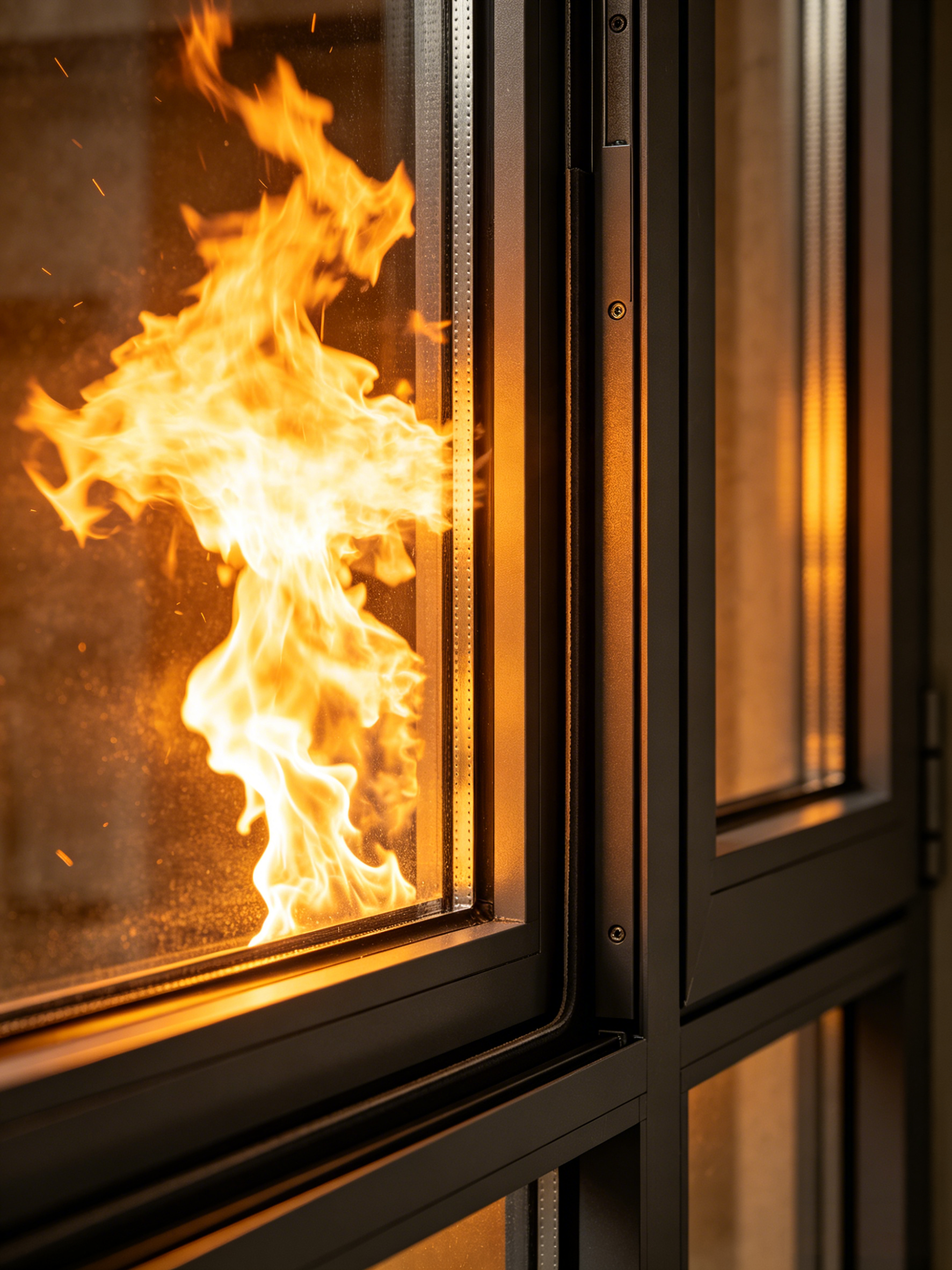
Fire-rated glazing must satisfy dual criteria under EN 1634-1 and EN 1364-3 standards: integrity (preventing flame and smoke passage) and insulation (limiting heat transfer to the unexposed surface). Systems achieving EI 60 or EI 120 ratings maintain both properties for 60 or 120 minutes respectively, providing critical evacuation time while containing fire to specific building compartments.
System-Level Engineering: Beyond the Glass
The frame structure proves equally critical to performance. While standard aluminum profiles might satisfy architectural aesthetics, they lack the structural rigidity to resist sustained attacks. High-security systems employ steel-reinforced frames with wall thicknesses exceeding 3mm, anchored to structural elements using through-bolts rather than surface-mounted fixings. The locking mechanisms incorporate multi-point systems with hardened steel bolts engaging simultaneously at four or more locations around the frame perimeter—a configuration that eliminates the single-point vulnerabilities exploited by crowbar attacks.
This integrated approach delivers a crucial advantage: multiplicative rather than additive protection. A P6B-rated glass panel installed in a standard frame provides only marginal security improvement, as attackers simply pry the frame from its mounting. Conversely, the full RC6 system—combining reinforced glass, structural framing, certified hardware, and proper anchoring—creates a protective barrier where the weakest component still exceeds the capability of typical attack tools.
Real-World Validation Through Global Projects
The operational effectiveness of these systems is demonstrated across diverse applications. At La Rinconada Baseball Stadium in Venezuela, 52,000 square meters of integrated curtain wall systems combine crowd-impact resistance with ballistic protection for VIP areas, addressing both accidental and intentional threats in a high-density public venue. The installation meets CE, TÜV, and AS certifications for wind loading, water penetration, and impact resistance—ensuring long-term durability in tropical climate conditions.

At Enga Hospital in Papua New Guinea, 5,200 square meters of bulletproof window systems protect healthcare workers in a region experiencing civil unrest. The installation demonstrates how certified ballistic systems maintain normal operational transparency—natural light transmission exceeds 70%—while providing defense against rifle-caliber threats, allowing medical staff to function without the psychological burden of opaque barriers.
KFORTS Security Technology: Integrating 25 Years of Specialized Expertise
Drawing on over two decades of specialized experience in ballistic-resistant systems for the banking sector, KFORTS Security Technology (Guangdong) Co., Ltd has evolved into a comprehensive provider of multi-threat architectural protection. The company's development trajectory illustrates the growing sophistication of security requirements: a 2014 project partnering with Swiss firm JANSEN to develop integrated burglar-resistant, fire-rated, and bulletproof systems for a Fujian luxury villa established technical foundations that now serve projects across five continents.
The KFORTS approach centers on one-stop integration—from proprietary R&D in company-controlled laboratories through certified manufacturing to installation support. This vertical integration ensures consistency across the critical interfaces where system failures typically occur: glass-to-frame bonding, frame-to-wall anchoring, and hardware-to-frame attachment. The company's portfolio of over 30 patents in laminated glass composites and frame reinforcement technologies reflects continuous innovation in addressing emerging threat scenarios.
Critically, KFORTS systems achieve multi-standard compliance, satisfying European EN standards, American UL certification, Singapore SS requirements, and Australian AS specifications within single product lines. This regulatory versatility proves essential for international projects where insurance underwriters, government agencies, and security consultants may reference different certification frameworks. For instance, the company's fire-rated systems hold COC (Certificate of Conformity) from TÜV Singapore, confirming alignment with SS 332 standards for integrity and insulation performance.
Thermochromic Innovation and Emerging Technologies
Beyond threat mitigation, KFORTS has pioneered energy-efficient security through thermochromic glass technology. These systems automatically transition from clear to frosted states above 30°C, blocking 95% of UV and infrared radiation without electrical controls. This passive climate response reduces cooling loads in tropical and subtropical installations while maintaining the multi-layer construction necessary for ballistic or blast resistance—demonstrating how security and sustainability objectives can converge through material innovation.
Strategic Selection Criteria for Specifiers
When evaluating security glazing systems, facility managers and architects should prioritize three factors beyond basic threat ratings. First, certification authenticity—systems must hold testing reports from accredited laboratories (TÜV, UL, Intertek, SGS) with test samples matching actual production specifications. Second, system completeness—protection ratings apply only when glass, frame, hardware, and installation procedures match tested configurations exactly. Third, manufacturer control—companies maintaining in-house R&D, testing capabilities, and manufacturing facilities demonstrate quality consistency that outsourced production cannot guarantee.
The global expansion of KFORTS installations—spanning diplomatic missions, financial institutions, cultural facilities, luxury residences, and critical infrastructure across Europe, Asia, Australia, Africa, and South America—reflects a market transition toward integrated, certified protection. As threat sophistication escalates and regulatory standards tighten, the gap between conventional architectural systems and purpose-engineered security solutions will only widen, making informed system selection an increasingly critical competency for built environment professionals.
https://www.kforts.com/
KFORTS SECURITY TECHNOLOGY (GUANGDONG) CO,.LTD

+ There are no comments
Add yours