
In modern analytical laboratories, consistency, reproducibility, and contamination control are not optional performance indicators—they are the foundation of credible experimental results. The role of experimental analysis filter paper is therefore not limited to separation alone, but extends into the stability of measurement outcomes across chemical, environmental, pharmaceutical, and industrial testing workflows.
When analytical results are used for regulatory reporting, process optimization, or quality validation, even minor variations in filtration speed, retention efficiency, or ash content can introduce measurable deviations in final data sets. This makes filter paper selection a critical part of experimental design rather than a consumable afterthought.
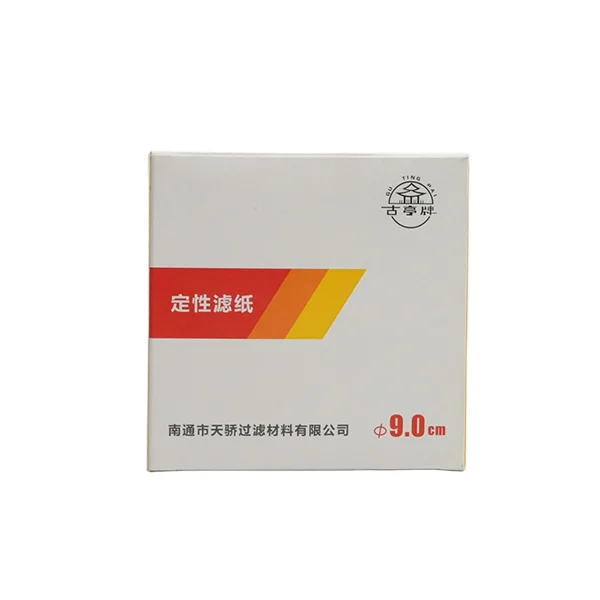
Fundamental structure of experimental analysis filter paper
Experimental-grade filter paper is typically manufactured from high-purity cellulose fibers, processed to achieve controlled pore distribution, uniform thickness, and consistent retention characteristics. Unlike industrial filtration media designed for bulk separation, analytical filter paper prioritizes precision and repeatability.
Key structural parameters include basis weight, typically ranging from 80 g/m² to 200 g/m² depending on application grade, and thickness controlled within ±5–10% variation to ensure consistent flow behavior across batches.
Pore size distribution is one of the most critical performance indicators. In qualitative and quantitative analysis applications, retention capability often ranges from 2 µm to 20 µm equivalent particle size separation. Narrow pore distribution reduces the probability of particle bypass, ensuring that filtrate composition accurately reflects experimental conditions.
Manufacturers such as Nantong Tianjiao Filtration Materials Co., Ltd. achieve this consistency through controlled fiber refining processes and multi-layer formation technology, which stabilizes internal fiber alignment during sheet formation.
Filtration speed and flow resistance behavior
In laboratory environments, filtration speed directly affects experimental throughput and reaction stability. However, faster filtration is not always desirable if it compromises retention accuracy.
Experimental analysis filter paper is classified based on flow rate grades, typically measured as time required to filter a standardized volume of liquid under controlled vacuum or gravity conditions. For example, medium-speed grades may complete filtration in 30–60 seconds per 100 mL under standard test conditions, while slow-speed grades may extend beyond 120 seconds for high-precision separation tasks.
Flow resistance is determined by fiber density and pore tortuosity. Higher density papers provide better particle retention but increase filtration time. The balance between speed and accuracy must be selected based on experimental objectives, particularly in gravimetric analysis where precipitation integrity is critical.
Ash content and analytical purity requirements
One of the defining characteristics of experimental analysis filter paper is its low ash content. In quantitative analysis, residual ash after combustion must be minimized to prevent interference with mass measurements.
High-grade quantitative filter papers typically maintain ash content below 0.01% after ignition at controlled temperatures. This ensures that any residual inorganic material does not distort final weighing results, particularly in high-precision gravimetric experiments.
Low ash filter paper is essential in applications such as metal ion precipitation analysis, pharmaceutical compound purity testing, and environmental contaminant quantification.
Mechanical strength and wet integrity performance
During filtration, filter paper must maintain structural integrity under both dry and wet conditions. Mechanical strength is typically evaluated through burst resistance and tensile strength in both machine and cross directions.
In experimental analysis filter paper, wet strength is particularly important because cellulose fibers naturally lose rigidity when saturated. High-quality products maintain fiber bonding stability through controlled hydrogen bonding reinforcement during manufacturing.
In practical laboratory use, this ensures that the paper does not tear or deform during vacuum filtration or multi-step chemical processing, which could otherwise result in sample loss or contamination.
Chemical compatibility and contamination control
Filter paper must remain chemically inert across a wide range of solvents, acids, and alkaline solutions commonly used in analytical chemistry. Experimental analysis filter paper is designed to resist degradation when exposed to solutions such as dilute hydrochloric acid, sodium hydroxide, ethanol, or acetone.
Chemical stability is achieved through high-purity cellulose sourcing and controlled removal of lignin, hemicellulose, and other reactive organic compounds during processing. This minimizes background contamination that could interfere with trace-level detection.
In sensitive applications such as environmental water analysis or trace metal detection, even micro-level contamination from filtration media can lead to significant analytical deviation.
Consistency across production batches
One of the most critical requirements in experimental analysis filter paper is batch-to-batch consistency. In laboratory workflows, experiments are often conducted over long periods, and inconsistent filter behavior can invalidate comparative results.
Industrial manufacturers achieve consistency through tightly controlled production parameters, including fiber slurry concentration, forming pressure, drying temperature, and calendering conditions.
Nantong Tianjiao Filtration Materials Co., Ltd. has developed long-term process stability through continuous equipment upgrades and process refinement, ensuring that key performance indicators such as filtration rate, retention efficiency, and thickness remain within narrow tolerances across production cycles.
This level of consistency is particularly important for laboratories engaged in standardized testing protocols or long-term research projects where reproducibility is essential.
Application scenarios in analytical workflows
Experimental analysis filter paper is widely used across multiple laboratory disciplines:
In chemical analysis, it is used for precipitate separation in gravimetric analysis, where accurate mass measurement depends on complete particle retention without loss or contamination.
In environmental testing, it supports water quality analysis by removing suspended solids prior to spectroscopic or chromatographic evaluation.
In pharmaceutical research, it is used during compound purification and reaction monitoring to separate solid by-products from liquid solutions.
In industrial quality control laboratories, it is used for routine sample preparation before instrumental analysis such as ICP, HPLC, or atomic absorption spectroscopy.
Each of these applications imposes different requirements on filtration speed, retention accuracy, and chemical resistance, making product selection highly application-specific.
Economic value in laboratory efficiency
While filter paper is a relatively low-cost consumable, its impact on laboratory efficiency and data reliability is significant. Inconsistent filtration media can lead to repeated experiments, increased reagent consumption, and delayed project timelines.
High-quality experimental analysis filter paper reduces experimental variability, minimizes rework, and improves confidence in analytical results. Over time, this translates into reduced operational cost and improved laboratory throughput.
For large-scale industrial laboratories or research institutions, standardizing filtration media across all workflows ensures consistent data quality and simplifies procurement and inventory management.
Conclusion
Experimental analysis filter paper is a foundational component of laboratory precision systems. Its performance is defined not by a single parameter but by the integration of pore structure control, chemical purity, mechanical stability, and production consistency.
In analytical environments where data accuracy directly influences scientific conclusions or regulatory compliance, the choice of filtration media becomes a critical decision point.
Manufacturers such as Nantong Tianjiao Filtration Materials Co., Ltd. contribute to this ecosystem by providing high-consistency, application-specific filter paper solutions that support reliable, repeatable, and high-precision experimental workflows across global laboratories.
www.tianjiaofilter.com
Nantong Tianjiao Filtration Materials Co., Ltd.


+ There are no comments
Add yours