

Beverage and liquid-food producers researching aseptic filling technology are increasingly asking a broader question: how does an aseptic filling machine connect to the rest of the packaging line, including end-of-line palletizing? Three concerns come up repeatedly: contamination risk in sensitive liquids, shelf life that falls short of the target market, and the running cost of energy and labor across the line, including manual handling at the palletizing stage. For juice, milk, dairy drinks, tea, NFC, and coconut water producers in particular, microbial contamination and insufficient shelf life make aseptic processing the priority. Zhangjiagang Grandee Machinery Co., Ltd., operating under the brand Grandee Machine, addresses both ends of that problem through a single turnkey engineering, procurement, and construction (EPC) scope that combines aseptic filling with complete-line integration, including robotic palletizing.
What an Aseptic Cold Filling Machine Actually Does
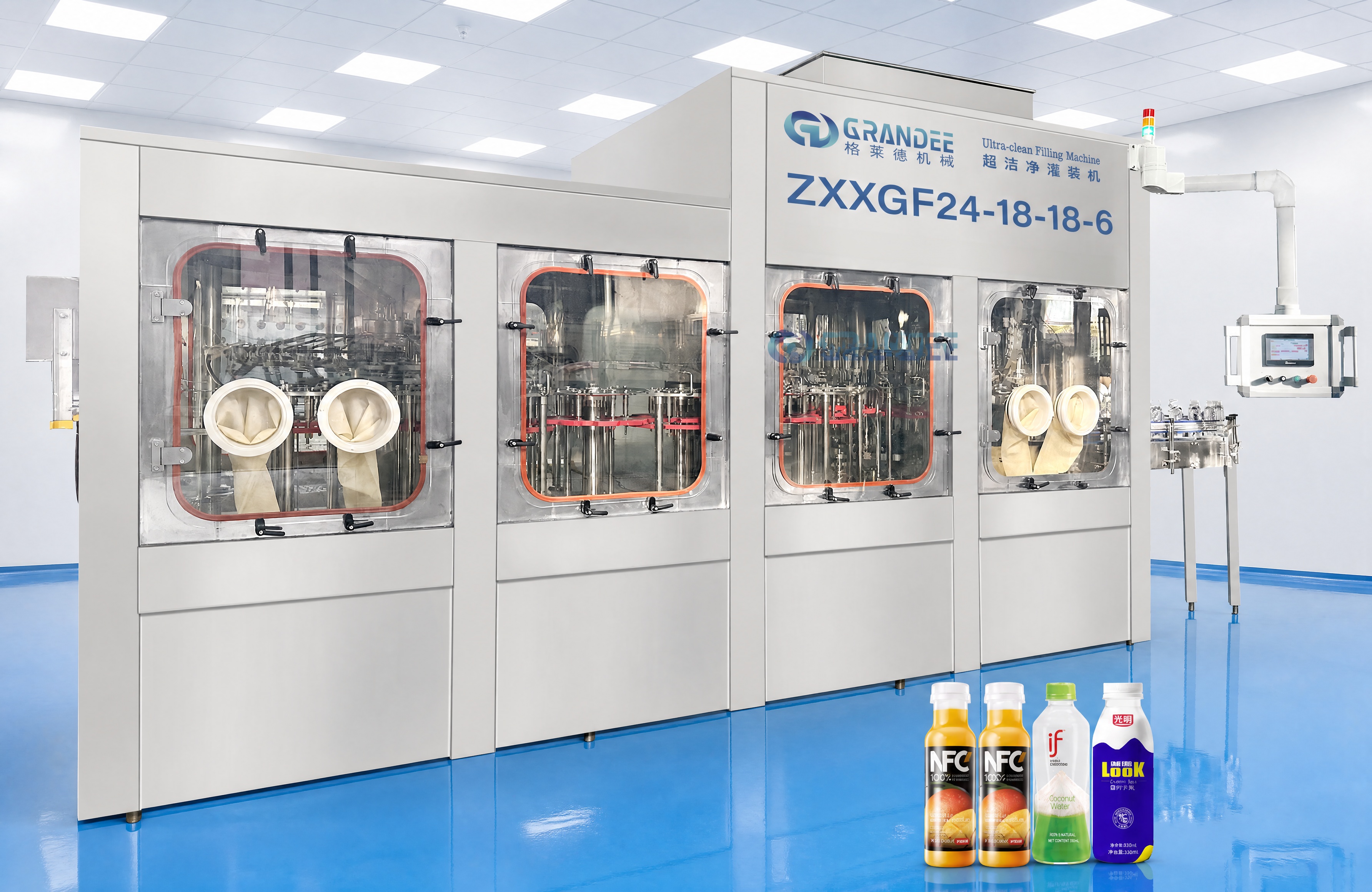
The aseptic cold filling machine is built for sensitive liquids such as juice, milk and dairy drinks, tea, NFC, and coconut water, covering bottle sizes from 330 to 2,000 ml. The equipment runs at 3,000 to 30,000 bottles per hour under the RXGF series designation. What defines the design is aseptic technology combined with a HEPA-filtered enclosed structure, which preserves product flavor while extending shelf life. The system meets ISO Class 6 cleanroom requirements and can be configured as a 5-in-1 washing-filling-capping line with integrated warming and sterilization tunnels, so the full pre-filling preparation process stays inside one connected system rather than across separate stations.
These features target the two pain points most relevant to sensitive-liquid producers: microbial contamination and insufficient shelf life. By enclosing the filling environment and filtering incoming air through HEPA filtration, the machine reduces the exposure points where contamination risk typically enters a production line.
From Filling to Robotic Palletizing: Complete-Line Integration
Aseptic filling is only one stage of a liquid packaging plant. The engineering scope is built around complete-line integration: water treatment, bottle blowing (blow molding), filling, capping, and robotic palletizing, combined with automated CIP (Clean-In-Place) cleaning, all delivered under one turnkey EPC package. Water treatment, filling, and end-of-line palletizing are engineered and supplied as one scope rather than as separate purchases from different suppliers.
Within the packaging matrix, end-of-line equipment sits alongside labeling machines (shrink sleeve, self-adhesive, and OPP hot-melt options), shrink wrap packing machines for PE film multi-packs, and carton packing machines using wrap-around case or erector-packer-sealer configurations. Robotic palletizing sits at the final stage of this sequence, taking over the manual handling that would otherwise sit at the end of the line. Palletizing equipment is available in collaborative-robot and high-speed gantry configurations, with pallet stretch wrapping and strapping handled inside the same end-of-line scope.
The collaborative-robot palletizing workstation, model GD-MD30JC, handles carton boxes at 5 to 6 cartons per minute. It carries a 50 kg load, reaches a palletizing height of 1.9 m, and has a working radius of 1,460 mm, covering pallets up to 1,200 by 1,100 mm. The unit occupies a 1,505 by 1,716 mm footprint, runs on 220 V, and weighs 350 kg.
Automatic CIP is included as a standard capability in every EPC scope, which cuts manual cleaning labor and the downtime that comes with it.
Construction and Control: The Technical Foundation
Across its filling equipment, including the aseptic cold filling machine, Grandee Machine applies a consistent technology platform: PLC/HMI touch-screen control for centralized operation and monitoring, high-precision electronic volumetric filling valves, and 304/316L stainless steel construction for liquid-contact parts to support corrosion resistance.
This same foundation underpins the company's broader rotary filling equipment, including its high-efficiency rotary blow-fill-cap technology, which delivers up to 30 percent electricity savings and up to 10 percent compressed air savings compared with conventional configurations, according to in-house test data. That efficiency metric applies to the rotary blow-fill-cap product line rather than to aseptic filling specifically, but it reflects the same engineering approach of PLC-based automation, precision valve design, and stainless steel construction applied across the company's filling machine range.
Specifications
Filling configuration: 5-in-1 washing-filling-capping, configurable
Series: RXGF aseptic cold filling line
Capacity: 3,000 to 30,000 bottles per hour
Bottle size range: 330 ml to 2,000 ml
Applications: juice, milk and dairy drinks, tea, NFC, coconut water
Cleanroom: ISO Class 6, HEPA-filtered enclosed structure
Filling valves: high-precision electronic volumetric
Liquid contact parts: 304/316L stainless steel
Control: PLC/HMI touch-screen
Cleaning: automatic CIP, included as standard
End-of-line: labeling, shrink wrap packing, carton packing, robotic palletizing
Delivery model: turnkey EPC
End-of-line palletizing, collaborative-robot workstation
Model: GD-MD30JC
Palletizing speed: 5 to 6 cartons per minute
Load capacity: 50 kg
Palletizing height: 1.9 m
Working radius: 1,460 mm
Maximum pallet size: 1,200 x 1,100 mm
Footprint: 1,505 x 1,716 mm
Handled product: carton boxes
Power supply: 220 V
Machine weight: 350 kg
Five Checks Before You Commit to an Aseptic Line
1. Cleanroom class, and who builds it. Confirm whether the ISO Class 6 environment belongs to the machine supply or to your building works, and which side carries that scope in the contract.
2. Sterilization scope. Aseptic cold filling sterilizes product and packaging separately. Establish exactly which streams the machine covers, product, bottle, and cap, and what the pre-filling preparation requires from your side.
3. Line balance against the palletizing rate. A filling machine rated at 30,000 bottles per hour is producing 500 bottles a minute. Divide that by the bottles per carton to get the carton rate the end-of-line has to absorb: roughly 21 cartons a minute at 24 bottles per carton, and roughly 42 at 12. A collaborative-robot palletizing workstation runs at 5 to 6 cartons per minute, so a high-speed line needs either several units or a higher-speed gantry configuration. Run that arithmetic before the contract, not after installation.
4. Cleaning cycle time. Confirm automatic CIP coverage and ask how long a full cycle takes, because that time comes out of production hours at every changeover.
5. Where the supply boundary sits. Establish how far the single contract reaches, from water treatment and bottle blowing through filling, labeling, packing, and palletizing, and who owns the interfaces between stages.
Turnkey EPC: Bottle Design Through Operator Training
Delivery runs on a single turnkey EPC contract covering a complete liquid packaging plant. The scope spans bottle design, factory layout, paperless 3D factory design, installation, and operator training, so a producer buying an aseptic filling machine with palletizing integration does not have to source water treatment, filling equipment, packaging machinery, and palletizing systems from separate vendors. Water treatment plants are supplied inside the same turnkey structure, supporting reliable process water quality ahead of the filling stage. Quotation is factory-direct and project-based, and covers the full turnkey EPC scope.
Company Background and Trust Signals
Zhangjiagang Grandee Machinery Co., Ltd. is headquartered in Zhangjiagang, Jiangsu, China, with business coverage focused on Europe, South America, Africa, Southeast Asia, and Central Asia. The company has more than 20 years of export experience and operates a standardized production workshop exceeding 20,000 square meters. Its equipment holds CE and CQC (China Quality Certification Center) certifications, and production capacities across its filling machine range span from 150 to 36,000 units per hour depending on machine type. Equipment capability spans PET, glass, and cans, with bottle sizes ranging from 220 ml to 20 L across the broader filling machine portfolio. The company's wider equipment range covers water, juice, carbonated soft drinks, dairy, beer, edible oil, vinegar, soy sauce, and other condiments and liquid chemicals, serving bottling plants, water plant investors, and the quality and operations engineers who specify it.
Conclusion
An aseptic filling machine is judged on more than the filling valve. It is judged on how filling, cleaning, packaging, and palletizing function as one coordinated system. The five decisions above, cleanroom class, sterilization scope, line balance against the palletizing rate, cleaning cycle time, and the supply boundary, are what separate a line that reaches its rated output from one that does not.
Questions Buyers Ask
What products can an aseptic cold filling machine handle?
Juice, milk and dairy drinks, tea, NFC, and coconut water.
What capacity range does the RXGF aseptic line cover?
3,000 to 30,000 bottles per hour, with bottle sizes from 330 to 2,000 ml.
What cleanroom class does aseptic filling require?
ISO Class 6, inside a HEPA-filtered enclosed structure.
Is CIP included in the aseptic filling line?
Yes. Automatic CIP is included as a standard capability in every EPC scope.
What does a turnkey EPC contract cover?
Bottle design, factory layout, paperless 3D factory design, installation, and operator training, with water treatment, bottle blowing, filling, labeling, packing, and palletizing supplied under one contract.
Can the aseptic filling line be integrated with end-of-line palletizing?
Yes. Palletizing is offered in collaborative-robot and high-speed gantry configurations, with stretch wrapping and strapping handled inside the same end-of-line scope.
To compare an aseptic line against your product and packaging, send the bottle format, the target output, and the shelf life your market expects. The line specification and quotation follow from those three inputs.
https://www.grandeemachine.com/
Zhangjiagang Grandee Machinery Co., Ltd.

+ There are no comments
Add yours