

Manufacturers evaluating a carbonated soft drink filling line for 500ml bottles face a specific engineering challenge: carbonated beverages are prone to foaming and CO2 loss during filling, and any instability in counter-pressure control can translate directly into product waste and inconsistent fill levels. Zhangjiagang Grandee Machinery Co., Ltd., operating under the brand Grandee Machine, addresses this challenge through its [3-in-1 carbonated drink filling machine (isobaric), a purpose-built solution designed around the physical realities of carbonating soft drinks (CSD), sparkling water, and carbonated juices in both PET and glass bottle formats.
How a 500ml Bottle Format Changes the Filling Requirements
Carbonated filling at 500ml concentrates the two pain points of the process: limited headspace leaves little room for foam to collapse, and any drift in counter-pressure shows up immediately as fill-level spread. That is why the line uses rinse-fill-cap isobaric filling, with CO2 counter-pressure holding dissolved gas stable from bowl to bottle, and why the format has a direct bearing on fill accuracy and product loss in a bottle this size.
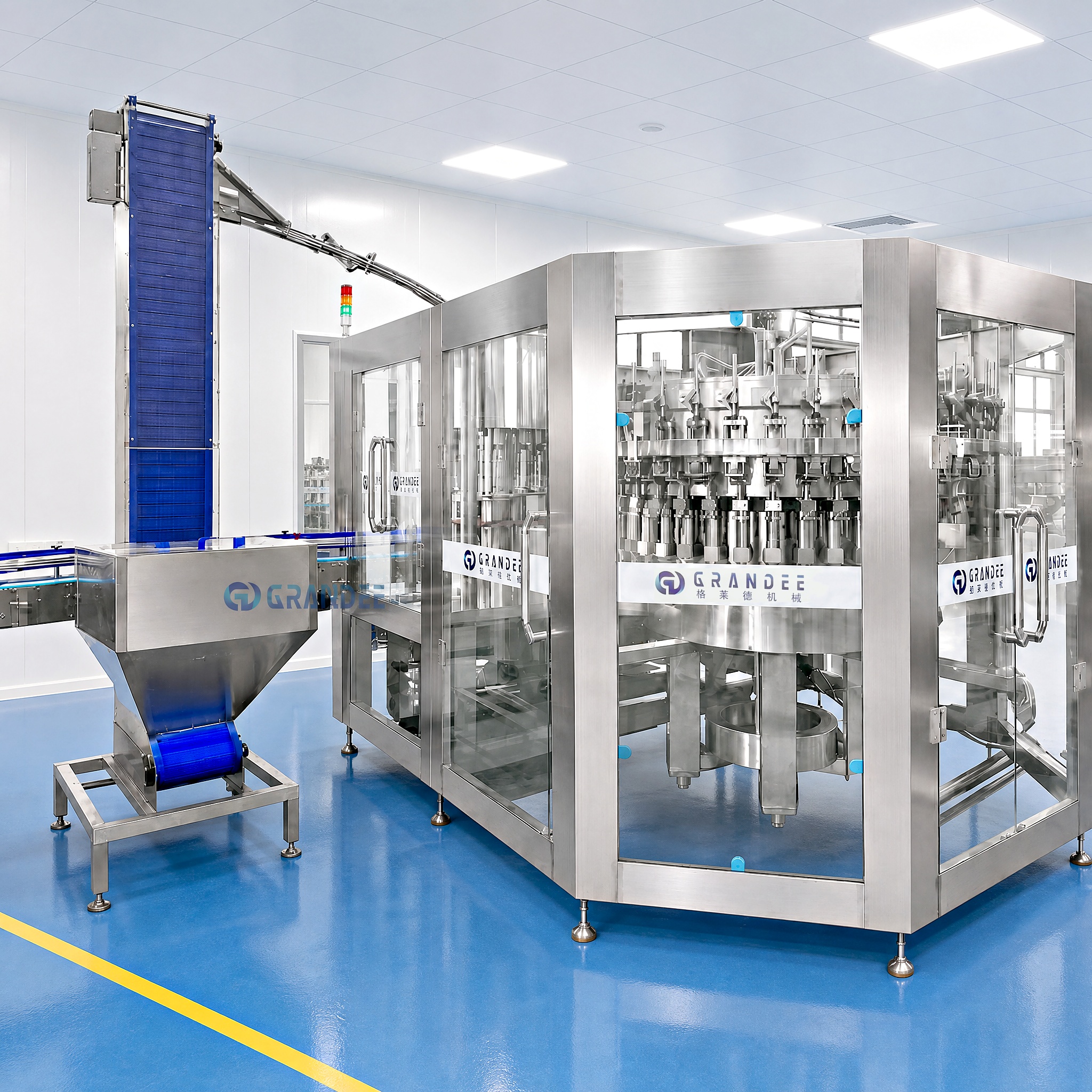
This isobaric carbonated drink filling machine operates across a capacity range of 2,000–25,000 BPH, giving producers flexibility to size a line appropriately whether they are running a small single-line operation or a high-volume bottling plant. The machine is controlled through a PLC/HMI touch-screen interface, allowing centralized operation and monitoring, and all liquid contact parts are constructed from 316L stainless steel to maintain hygienic, corrosion-resistant contact with acidic and carbonated formulations over the equipment's operating life.
For producers seeking even higher throughput specifically in PET bottle formats, Grandee Machine also offers a rotary blow-fill-cap (monoblock) filling machine. This integrated blowing-filling-capping unit is engineered for large-scale PET bottled water and carbonated beverage production, reaching capacities of 12,000–36,000 BPH. By combining blow molding, filling, and capping into a single rotary unit, it eliminates the intermediate transfer step between blowing and filling — removing a contamination risk point and reducing manual handling, which is particularly relevant for continuous, high-speed 500ml bottle runs.
A Complete Turnkey EPC Solution for 500ml CSD Production
Rather than supplying an isolated filling machine, Grandee Machine positions its carbonated beverage capability as part of a full turnkey EPC (Engineering, Procurement, Construction) line. This model gives a beverage producer one contract and one accountable partner for the complete liquid packaging plant — covering bottle design, factory layout, paperless 3D factory design, installation, commissioning, and operator training. For a company sourcing a carbonated soft drink filling line for 500ml bottles, this structure removes the burden of coordinating multiple equipment vendors, keeping engineering, delivery and commissioning responsibility with one supplier.
A complete carbonated beverage line built by Grandee Machine draws together the isobaric filling machine, the beer/glass bottle filling and sealing machine where glass formats are required, the can filling and sealing machine for canned variants, and end-of-line packaging equipment — all under one EPC scope; where carbonation is prepared in-house, the line is paired with an upstream carbonation system rather than an integrated carbonation unit. Every EPC scope from Grandee Machine also includes automatic CIP (Clean-In-Place) systems as a standard capability, which reduces manual cleaning labor and downtime across the filling and packaging line.
End-of-Line Packaging for 500ml Bottles
A 500ml carbonated bottle rarely leaves the production floor as a single unit; it typically moves into secondary packaging before palletizing. Grandee Machine's product matrix covers this stage directly. Its labeling machines are available in three process options — shrink sleeve (PVC/PET), self-adhesive, and OPP hot-melt glue — with high-speed models running 8,000–18,000 bottles per hour, synchronized with the filling line's conveying speed and adaptable to irregular-shape bottles. Downstream of labeling, the shrink wrap packing machine forms PE film multi-packs in linear, L-type, or half-tray configurations, while the carton packing machine performs wrap-around case forming and erector-packer-sealer functions with hot-melt gluing for bottles, cans, and boxes headed into cartons. Together, these stages allow a 500ml carbonated bottle to move from filling through labeling and secondary packaging within one integrated line from a single supplier.
Corrosion-Resistant, Hygienic Construction and Efficiency Data
Across its filling equipment, Grandee Machine selects 304 or 316L stainless steel according to the product being filled — 316L for acidic and carbonated formulations, as on this line — alongside ISO Class 6 cleanroom compliance for the filling environment. On the carbonated line, fill-volume consistency is handled by the isobaric valves and PLC/HMI control built into the machine; high-precision electronic volumetric filling valves are used on the company's non-carbonated lines, where metering rather than counter-pressure governs fill accuracy. According to the company's in-house test data, its high-efficiency rotary blow-fill-cap technology delivers up to 30% electricity savings and up to 10% compressed air savings compared with conventional configurations; the underlying test records can be provided on request.
Proven Capacity and Global Experience
This capability is already in service. Grandee Machine has supplied and installed a 40-head 3-in-1 carbonated filling machine rated 12,000 BPH in 500ml format for a beverage producer in Central Asia, and a complete carbonated soft drink filling line for a carbonated drink producer in Africa. Those projects sit within a base of more than 20 years of export experience and a standardized production workshop exceeding 20,000 square meters. Its market coverage spans Europe, South America, Africa, Southeast Asia and Central Asia.
Certifications and Trust
Grandee Machine's filling systems, including the carbonated soft drink filling line, are backed by CE certification and CQC (China Quality Certification Center) certification, with certificate details available on request.
Frequently Asked Questions
Q1: What is isobaric filling and why is it necessary for carbonated drinks?
A: Isobaric filling is a pressure-balanced method in which the bottle is pressurised with CO2 to the same partial pressure as the product before the liquid is introduced. Dissolved CO2 therefore stays in equilibrium instead of flashing out during the fill, which keeps fill volumes accurate, holds the carbonation level consistent, and limits oxygen pickup.
Q2: Which products can this machine fill?
A: Carbonated soft drinks, sparkling water, energy drinks and carbonated juices. Beer and other glass formats are handled by the separate beer / glass bottle filling and sealing machine, which uses isobaric filling with crown-cap sealing.
Q3: Which bottle types and closures are compatible?
A: PET and glass bottles. PET uses standard threaded plastic closures; glass uses crown caps or aluminium screw caps.
Q4: What filling speeds are available?
A: The 3-in-1 isobaric machine covers 2,000–25,000 BPH. Where higher output is required in PET formats, the rotary blow-fill-cap (monoblock) machine covers 12,000–36,000 BPH.
Q5: Can one machine handle both high-carbonation and low-carbonation products?
A: Yes. Counter-pressure is regulated through the PLC and pressure reducer, and filling speed and de-pressurisation time are fine-tuned through the HMI. Switching between carbonation levels needs only parameter adjustments, with no change parts required.
Q6: What is the operating pressure range?
A: CO2 inlet 0.28–0.35 MPa; compressed air supply 0.5–0.7 MPa; rinsing water 0.2–0.25 MPa; isobaric filling tank working pressure typically 2–4 bar.
Q7: Does the machine include a carbonation unit?
A: No. The filling machine is designed to receive pre-carbonated beverage from an upstream carbonation system such as a carbonation tank, inline carbonator or premix preparation vessel. A separate carbonation unit is recommended for flexibility, easier maintenance and independent CIP cleaning.
Q8: What product temperature is required during carbonated filling?
A: Typically 2–6 °C, with 4 °C the most common target. Cold product raises CO2 solubility, reduces foaming during filling, and supports accurate fill volume and seal quality after capping.
Q9: What material are the wetted parts made of?
A: 316L stainless steel contact parts on the carbonated line, for corrosion resistance against acidic and carbonated formulations. Across the wider filling range, 304 or 316L is selected according to the product being filled.
Next Step
Sizing a line comes down to four inputs: container type and volume, line scope, product carbonation and filling temperature, and destination port. Share those four and the line can be matched to the requirement rather than to a generic configuration.
Conclusion
For a producer specifically sourcing a carbonated soft drink filling line for 500ml bottles, Grandee Machine combines isobaric filling technology built to limit foaming and CO2 loss, 316L stainless steel construction for hygienic and corrosion-resistant operation, capacity options spanning 2,000 to 36,000 BPH depending on the machine selected, and a turnkey EPC delivery model that folds bottle design, installation, training, and end-of-line packaging into a single accountable contract. Together with more than two decades of export experience and CE and CQC certification, Zhangjiagang Grandee Machinery Co., Ltd. offers an established route for beverage manufacturers building or upgrading a 500ml carbonated bottling operation.
https://www.grandeemachine.com/
Zhangjiagang Grandee Machinery Co., Ltd.

+ There are no comments
Add yours