
In modern industrial processes, accurate measurement of fluid flow is essential for maintaining product quality, optimizing production efficiency, and ensuring regulatory compliance. When it comes to handling high viscosity fluids, such as heavy oils, syrups, polymers, adhesives, and slurries, traditional flow measurement technologies often fall short. This is where the Coriolis mass flow meter becomes a critical solution.
Unlike volumetric flow meters, Coriolis technology directly measures mass flow, making it particularly suitable for challenging fluids whose viscosity, density, or temperature may vary significantly during processing. In this article, we will explore how Coriolis mass flow meters work, why they are ideal for high viscosity applications, and how to choose and apply them effectively in industrial environments.
Understanding High Viscosity Fluids and Measurement Challenges
High viscosity fluids are substances that resist flow due to their internal friction. Examples include:
-
Heavy crude oil
-
Bitumen and asphalt
-
Honey and syrups
-
Molten polymers and resins
-
Paints, coatings, and adhesives
-
Sludge and slurry mixtures
These fluids present several challenges for traditional flow meters:
-
Pressure Drop Issues
High viscosity fluids often cause significant pressure loss in conventional meters, especially those with narrow passages. -
Flow Instability
Viscous fluids may flow non-linearly, leading to inaccurate readings in velocity-based flow meters. -
Temperature Sensitivity
Viscosity changes dramatically with temperature, affecting volumetric measurement accuracy. -
Clogging and Maintenance
Mechanical flow meters can become clogged or require frequent cleaning when dealing with sticky or thick materials.
Because of these challenges, industries require a more robust and accurate solution—this is where Coriolis technology excels.
How a Coriolis Mass Flow Meter Works
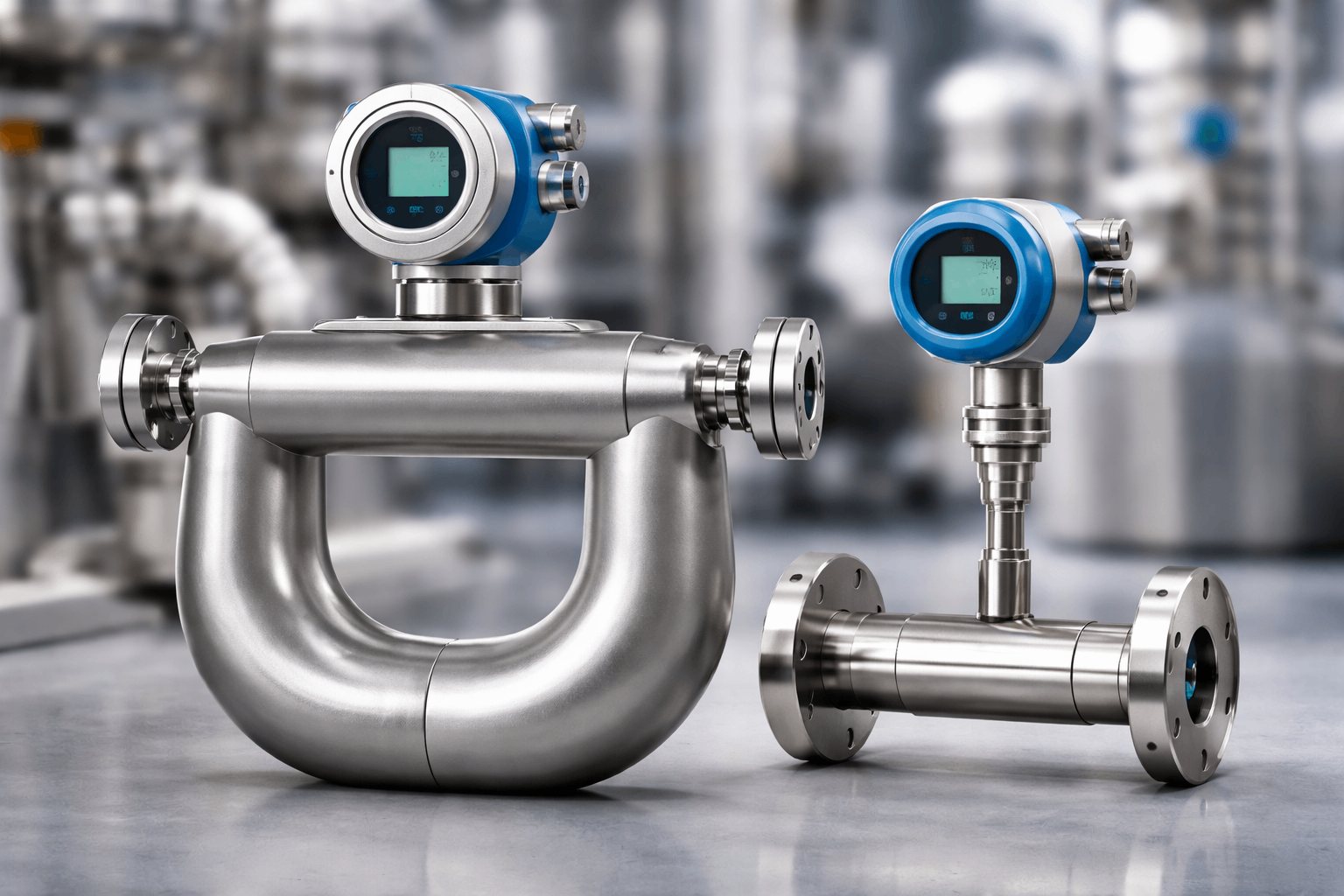
The Coriolis mass flow meter operates based on the Coriolis effect, a principle derived from physics. In simple terms, when a fluid flows through vibrating tubes inside the meter, it causes a measurable twist or phase shift in the tubes. This deformation is directly proportional to the mass flow rate.
Key Measurement Principles:
-
Vibrating Tubes: The fluid passes through one or more oscillating tubes.
-
Phase Shift Detection: As the fluid flows, it induces a slight change in vibration timing between different parts of the tube.
-
Mass Flow Calculation: The sensor detects this phase shift and converts it into a precise mass flow reading.
In addition to mass flow, Coriolis meters can also measure:
-
Density
-
Temperature
-
Concentration (in some applications)
This multi-variable capability makes them extremely valuable in process control environments.
Why Coriolis Mass Flow Meters Are Ideal for High Viscosity Fluids
1. Direct Mass Measurement
Unlike volumetric meters, Coriolis meters measure mass directly, eliminating errors caused by changes in density or temperature. This is particularly important for high viscosity fluids, which often experience temperature fluctuations.
2. No Moving Parts
The Coriolis mass flow meter has no internal moving mechanical parts, which significantly reduces wear and maintenance. This is crucial when dealing with abrasive or sticky fluids.
3. High Accuracy and Repeatability
Coriolis meters offer extremely high accuracy, often within ±0.1% or better. For high viscosity fluids, this level of precision ensures consistent product quality and reduced material waste.
4. Insensitivity to Flow Profile
Viscous fluids tend to have uneven flow profiles. Coriolis meters are largely unaffected by flow profile distortions, unlike turbine or vortex meters.
5. Multi-Parameter Measurement
Since Coriolis meters can measure density along with mass flow, they are ideal for applications like:
-
Polymer processing
-
Chemical mixing
-
Food and beverage formulation
This eliminates the need for additional sensors, simplifying system design.
Key Applications of Coriolis Mass Flow Meters for High Viscosity Fluids
1. Oil and Petrochemical Industry
Heavy crude oil and refined products such as bitumen require precise measurement for custody transfer and processing. Coriolis meters are widely used because of their ability to handle high viscosity and maintain accuracy under varying conditions.
2. Chemical and Polymer Processing
In chemical manufacturing, viscosity can change significantly during reactions. Coriolis meters ensure accurate dosing and blending, improving product consistency and reducing waste.
3. Food and Beverage Industry
Products like chocolate, syrup, honey, and molasses require hygienic and precise flow measurement. Coriolis meters with sanitary designs are ideal for such applications.
4. Pharmaceutical Industry
In pharmaceutical production, high-viscosity fluids like gels, creams, and suspensions must be measured with extreme accuracy. Coriolis meters provide the reliability needed for strict regulatory compliance.
5. Paints, Coatings, and Adhesives
These materials are often thick and difficult to measure using traditional methods. Coriolis meters ensure accurate batching and mixing, leading to consistent product quality.
6. Wastewater and Sludge Management
Sludge is highly viscous and often contains solid particles. Coriolis meters can handle these challenging conditions, making them suitable for environmental and wastewater applications.
Selection Criteria for High Viscosity Applications
When choosing a Coriolis flow meter for high viscosity fluids, several factors must be considered:
1. Tube Design
-
Straight-tube meters: Better for viscous fluids and easier to clean
-
Bent-tube meters: More compact but may have higher pressure drop
2. Flow Range
Ensure the meter can handle both low and high flow rates. High viscosity fluids often flow at lower velocities, requiring sensitive detection.
3. Pressure and Temperature Ratings
Select a meter capable of withstanding the process conditions, especially in high-pressure applications like oil pipelines.
4. Material Compatibility
The wetted materials must be compatible with the fluid to prevent corrosion or contamination.
5. Sanitary Requirements
For food and pharmaceutical industries, choose meters that comply with hygiene standards such as 3-A or FDA certification.
Installation Best Practices
Proper installation is essential to ensure accurate performance:
-
Install the meter in a vibration-free environment
-
Ensure the meter is completely filled with fluid during operation
-
Avoid air bubbles, which can affect measurement accuracy
-
Follow manufacturer guidelines for orientation and pipe alignment
-
Provide proper grounding to reduce electrical noise interference
Common Challenges and How to Overcome Them
1. Pressure Drop
High viscosity fluids can create pressure drops across the meter. Solution: choose a larger diameter meter to reduce resistance.
2. Air Entrapment
Air bubbles can distort readings. Solution: ensure proper degassing and system design to minimize air inclusion.
3. Slurry Abrasion
If the fluid contains solid particles, it may cause wear. Solution: select abrasion-resistant materials and coatings.
4. Zero Drift
Temperature or mechanical stress can affect zero stability. Regular calibration can help maintain accuracy.
Advantages Over Other Flow Meter Technologies
| Feature | Coriolis Meter | Positive Displacement | Electromagnetic | Ultrasonic |
|---|---|---|---|---|
| Accuracy | Very high | High | Medium | Medium |
| Viscosity Handling | Excellent | Good | Limited | Limited |
| Moving Parts | None | Yes | None | None |
| Density Measurement | Yes | No | No | No |
| Maintenance | Low | Medium | Low | Low |
The Coriolis mass flow meter clearly stands out as the most versatile and accurate solution for high viscosity fluid measurement.
Future Trends and Innovations
The evolution of Coriolis technology continues to improve performance:
-
Advanced digital signal processing for better stability
-
Compact designs for space-constrained installations
-
Smart diagnostics for predictive maintenance
-
Integration with IoT systems for real-time monitoring
-
Improved materials for handling extreme conditions
These innovations are making Coriolis meters even more efficient and reliable in handling complex high-viscosity applications.
Conclusion
Measuring high viscosity fluids has always been a challenging task in industrial processes. Traditional flow meters often struggle with accuracy, maintenance, and reliability when handling thick or sticky substances. The Coriolis mass flow meter provides a superior solution by offering direct mass measurement, high accuracy, and robust performance without moving parts.
From oil and gas to food processing and pharmaceuticals, Coriolis technology ensures precise, repeatable, and reliable measurements even under the most demanding conditions. By selecting the right configuration and following proper installation practices, industries can significantly improve process efficiency, reduce waste, and achieve consistent product quality.
As industries continue to evolve and demand higher precision, the Coriolis mass flow meter will remain a cornerstone technology for high viscosity fluid measurement.
www.accurainstrument.com
accurainstrument

+ There are no comments
Add yours