


The first decision on an edible oil filling line is not speed and it is not bottle format. It is how the oil gets measured. Zhangjiagang Grandee Machinery Co., Ltd., which sells under the Grandee Machine brand, builds edible oil fillers around three metering options — piston, gear pump and magnetic pump — and two of them are compared far more often than the third. Most of that comparison is aimed at the wrong question.
This article covers how each mechanism actually meters, the two oil properties that decide between them, and the specification figures to check before two offers look equivalent.
How Each Mechanism Meters
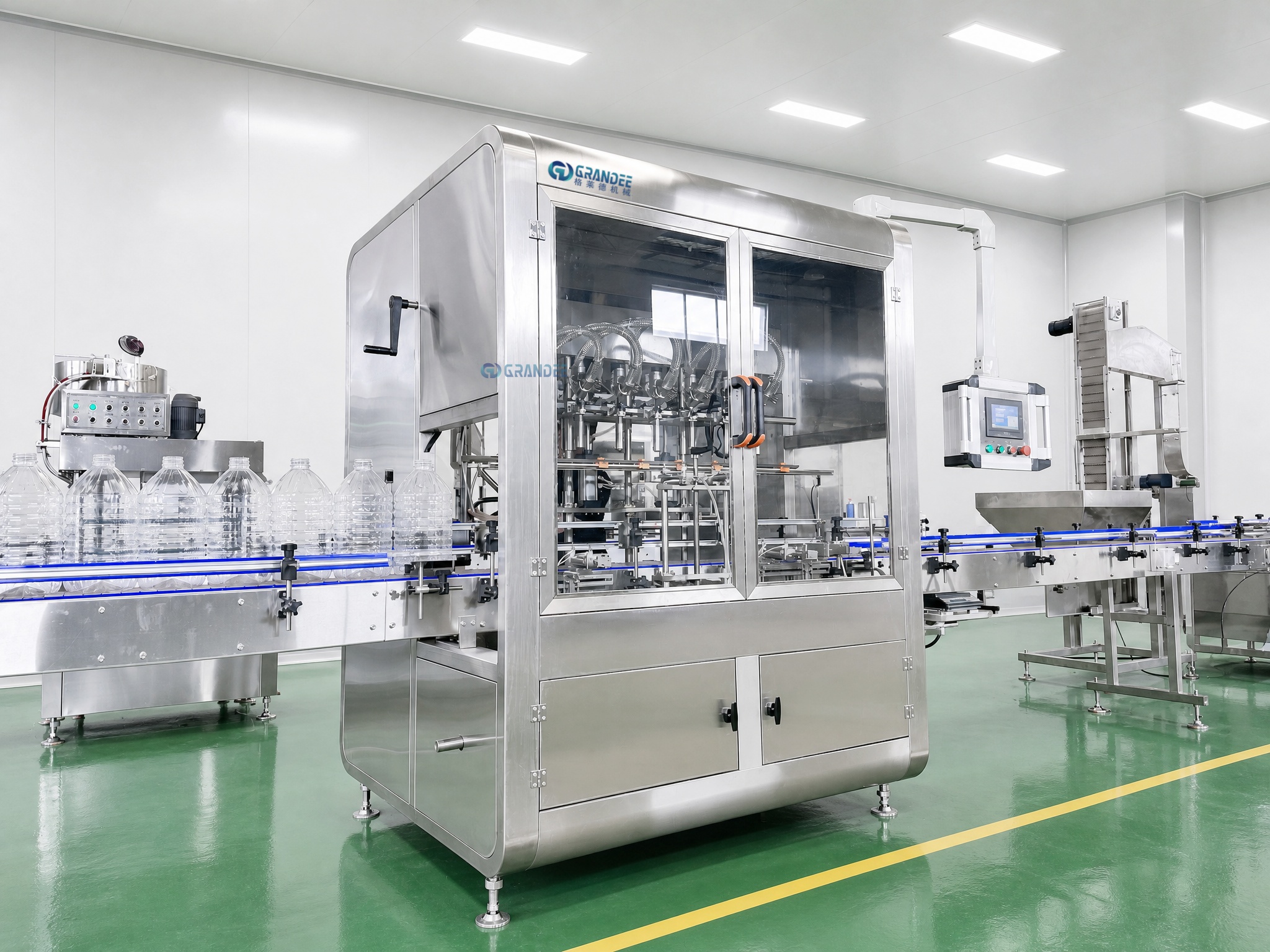
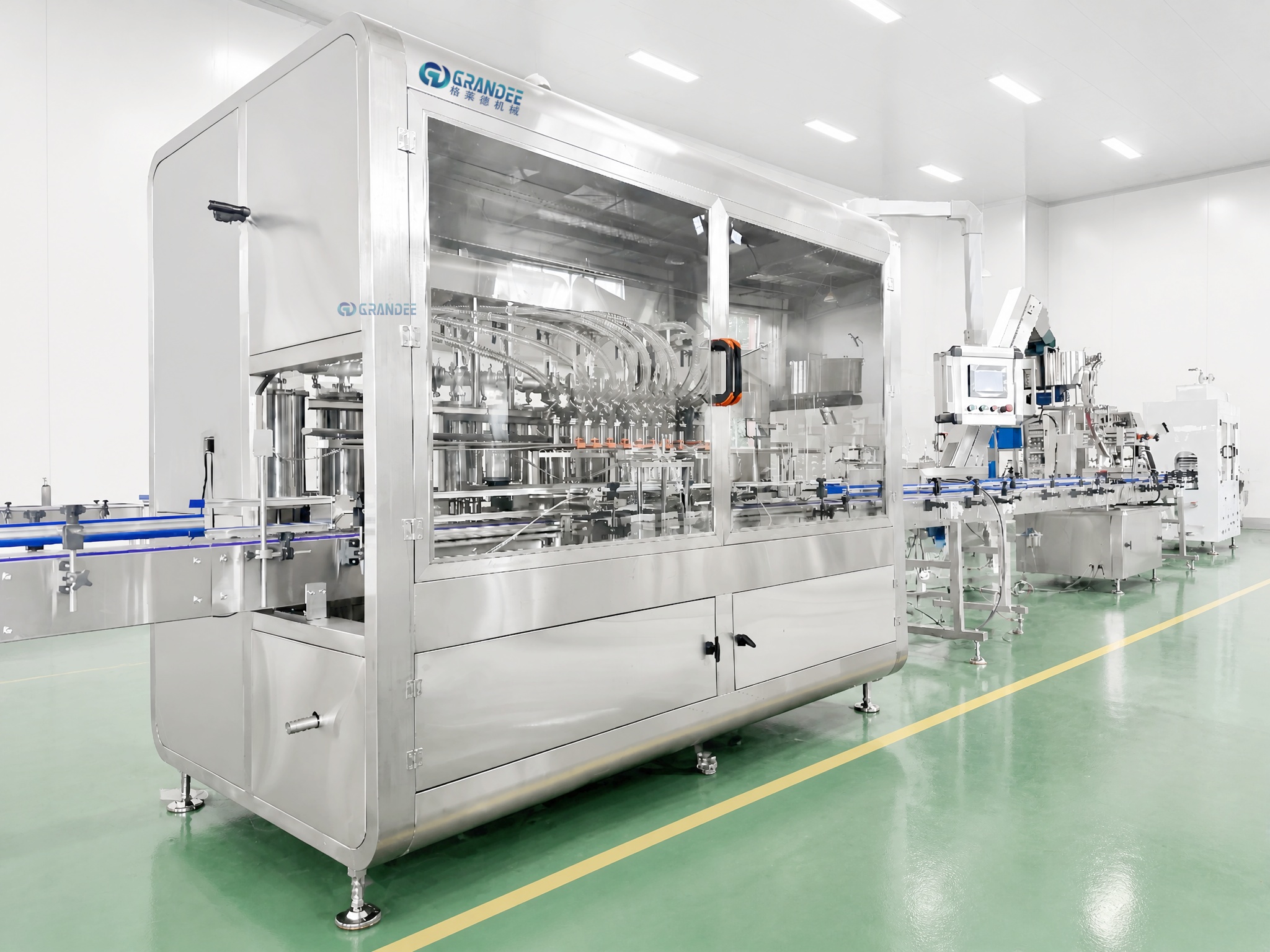
A piston filler draws oil into a cylinder and pushes it out in one stroke. Each filling head carries its own servo motor under the cylinder, so the stroke — and with it the dose — is set on the touch screen instead of by swapping a part. What is being measured is still a chamber volume, not a duration: as long as the chamber fills completely, a change in viscosity does not change the volume delivered. The trade-off for that accuracy is cleaning, because cylinder, seals and valves have to be opened up.
A gear pump meters by rotation: output is displacement per revolution multiplied by speed, minus slip — the oil that leaks back past the gear clearance instead of going into the bottle. On this machine the pump is servo-driven rather than mechanically linked to the main drive, so the dose is set by rotation count rather than by a fixed chamber. Slip is still the variable that matters. It grows as viscosity falls, so the same speed setting delivers less oil when the product gets thinner.
A magnetic pump couples the drive magnetically, so there is no shaft seal to leak, and it is the option that appears where thin or aggressive products matter more than throughput — detergent and shampoo are the usual examples in the same machine range. It is a third option, not a compromise between the other two.
What the accuracy figures mean. The two configurations are not quoted in the same shape, which is the first thing to notice. The servo piston series carries one figure: ≤0.1%. The gear pump is quoted by volume band — ±2 ml at 100 ml and below, ≤±0.2% between 1,000 and 5,000 ml. That difference is not build quality, it follows from what each one measures. A piston delivers a stroke volume; a gear pump delivers a rotation count minus slip, and slip moves with the product. The gear-pump specification states its other condition in the same breath: the liquid must not carry impurities, because impurities wear the gears. Accuracy and cleanliness are one requirement on an oil line, not two.
The Two Properties That Actually Decide It
Not how thick the oil is — until thickness passes the point where a pump can no longer draw it, and at that point no configuration of the wrong pump is the answer. Below that point, two other things decide it:
1. Whether viscosity changes between batches. One line running refined oil, cold-pressed oil and a winterized grade sees the same pump at several viscosities. A gear pump meters each of them slightly differently; a piston meters all of them by the same chamber volume.
2. Whether the oil carries solids. Unrefined and cold-pressed oils leave sediment and fine particles. A gear pump pushes those through a running clearance; a piston tolerates them better, because nothing is meshing.
The rule, in one line: choose the piston when viscosity moves between batches, when the oil carries solids, or when the fill has to hold a tight band; choose the gear pump when the product is stable, clean and thin enough that slip stays put, and when a simpler, lower-power head matters more than the last tenth of a percentage point; choose the magnetic pump when the product is aggressive or very thin and a shaft seal is the weak point.
Where the Gear Pump Stops Being the Simple Answer
Three conditions turn the gear pump from the obvious choice into the wrong one. Viscosity drift is the first: a product change, or simply a cold morning in an unheated hall, shifts slip and the fill volume with it. Solids are the second: particles wear the gear faces and eventually jam them. High viscosity is the third: thick oil does not fill the gear chamber fast enough, and the pump loses output at exactly the point where the line needs it.
None of this makes the gear pump unusable: ≤±0.2% at litre volumes is a working tolerance for edible oil. It makes the figure conditional — and the condition is a stable product, which is a production fact, not a machine specification.
Cleaning, Changeover and the Nozzle
A piston filler has more parts to open: cylinder, seals, inlet and outlet valves. A gear pump has fewer, but the clearance that makes it accurate is also the place residue hides, so cleaning depends on circulating through the head rather than wiping it. For a plant running several oils, ask how many parts one product change involves and how long one operator needs — that number decides whether short runs are viable, and it is rarely printed in a brochure.
The anti-drip nozzle is part of the metering system, not an accessory. Oil left hanging on the nozzle lands on the bottle finish, and a contaminated finish is where capping seals fail and where a filled bottle starts to look used before it ships. On an oil line, drip control is a quality issue before it is a cleanliness issue.
The capping station is where changeover is most often underestimated. The cap head on this line is gripper type: it clamps the bottle neck and rotates the cap into a hermetic seal, dual sensors inspect each cap before it is applied, and a bottle or cap change is handled by positional adjustment rather than replacement parts. Conveyor and clamp belt are speed-matched to the filler by variable frequency drive. Rate matters here as much as changeover: the 4-wheel linear unit in this range is quoted at 1,800–2,500 BPH, so on the faster filler models the cap head has to be specified against the line speed rather than assumed to keep up. Test that claim at acceptance with your own bottle and cap — it is the difference between a twenty-minute and a two-hour changeover.
Specification Snapshot
| Fill volume range | 50–5,000 ml |
| Fill accuracy | ≤0.1% on the servo piston series; on the gear pump, ±2 ml at ≤100 ml and ≤±0.2% at 1,000–5,000 ml |
| Metering options | Piston, gear pump, magnetic pump — selected per product |
| Reference capacity | Servo piston series up to 5,000 BPH at a 500 ml basis (GD-20S); gear-pump series 1,200–4,000 BPH (GD-4S to GD-12S); per model |
| Liquid-contact material | 316L stainless steel |
| Nozzle | Anti-drip filling nozzles |
| Control | PLC with touch screen; four dose settings stored for recall |
| Post-fill check | Electronic scale weighs each filled bottle |
| Capping | Gripper-type cap head — neck clamped, cap rotated, dual sensors per cap; 4-wheel linear capper rated 1,800–2,500 BPH; servo capping for plastic, metal and press-twist lids available |
| Line integration | Can be combined with capping and labeling |
| Products | Olive oil, peanut oil, coconut oil and other edible oils; the same range also fills honey, vinegar, soy sauce and liquid detergent |
| Cleaning | Automatic CIP available as standard line capability |
The servo piston series is sized by head count. All five models are listed at ≤0.1% precision and run on 0.6–0.8 MPa air; the speeds below are at a 500 ml basis.
| Model | Filling heads | Speed at 500 ml | Power |
| GD-6S | 6 | Up to 1,600 BPH | 3 kW |
| GD-8S | 8 | Up to 2,500 BPH | 3 kW |
| GD-12S | 12 | Up to 3,000 BPH | 3 kW |
| GD-16S | 16 | Up to 4,000 BPH | 3.5 kW |
| GD-20S | 20 | Up to 5,000 BPH | 3.5 kW |
The gear-pump series is sized the same way, by head count, and costs less power at every step:
| Model | Filling heads | Speed at 500 ml | Power |
| GD-4S | 4 | 1,200 BPH | 1 kW |
| GD-6S | 6 | 1,800 BPH | 1 kW |
| GD-8S | 8 | 2,400 BPH | 1 kW |
| GD-10S | 10 | 3,000 BPH | 1.5 kW |
| GD-12S | 12 | 4,000 BPH | 1.5 kW |
Model codes count heads, not pumps. GD-6S appears in both series, so a model number on its own does not identify the machine — always quote the metering system with it. The gear-pump series takes bottles 40–100 mm in diameter and 80–280 mm high, runs on 0.6 MPa air, and fills 50–5,000 ml.
Materials, and Why the Grade Is a Purchasing Question
Edible oil is not an aggressive medium, which is precisely why material claims on oil lines are rarely examined. They should be. Oil with a high acid value, salted or spiced oils, and long residence times in a warm filling hall all put the contact surface under conditions that a lower grade handles less gracefully than 316L. On this machine the split is by function: the filling valves are 316L, while the capping unit is built in 304 stainless steel. For vinegar and soy sauce the valves can be ordered in corrosion-resistant titanium alloy or SUS316L.
The same corrosion logic governs the vinegar and condiment range, where vacuum or volumetric filling can be combined with the acidic product and the valve material is chosen for it. Ask which parts fall inside the liquid-contact scope. Frames, guards and covers do not, and a quote that answers this with a single material grade for the whole machine has not answered it.
What the Specification Does Not Tell You
Fill range is not bottle size. 50–5,000 ml describes what the filler can dose; the bottle formats the line handles are a separate question, and a 5 L pack is not automatically a 5,000 ml fill.
Capacity is a model figure, not a line guarantee. The gear-pump series runs from 1,200 to 4,000 BPH and the servo piston series reaches 5,000, all at a 500 ml basis — so the pump choice is not a speed choice, it is a product choice. The number your line reaches depends on the bottle, the fill volume and the capping station behind the filler. Quote capacity without those three and the acceptance conversation happens after installation instead of before it.
Turnkey Scope, and Where It Stops
The filler is normally supplied as part of a turnkey project: bottle design, factory layout including paperless 3D factory design, installation, commissioning and operator training under one contract. Around it the line can include bottle blowing where the format requires it, capping, labeling, shrink wrapping, case packing, end-of-line palletizing available on request, and automatic CIP as standard line capability — so the interfaces between stages are fixed by one party rather than negotiated between four.
Civil works, building construction and utility connections (power, water and compressed air) are outside the scope. Those remain the plant's own contracts, and they are the usual reason a line that was delivered on time still does not start on time.
FAQ
Can one machine run peanut oil and olive oil?
Yes, but the metering choice should be made against the widest variation in the range, not the average. If the two oils differ in viscosity and one carries sediment, the piston is the safer specification; a gear pump will run both, at two different calibrations.
Is a gear pump less accurate than a piston pump?
By the quoted figures, yes: the servo piston series is listed at ≤0.1%, while the gear pump is quoted at ≤±0.2% between 1,000 and 5,000 ml and ±2 ml at 100 ml and below. The reason is structural rather than a matter of build quality — a gear pump's output is rotation minus slip, and slip moves with viscosity, while a piston delivers a fixed stroke volume. A gear pump can hold its own figure on a stable product; it cannot promise the piston's figure across changing ones.
What if the oil carries particles?
Piston, or a filtration step ahead of the filler. A gear pump pushes solids through a running clearance, which wears the gear faces and eventually stops the pump rather than merely drifting.
Does 50–5,000 ml cover a 5 L pack?
It is the dosing range of the filler, and 5,000 ml sits at its top end. Whether your 5 L pack falls inside it depends on the headspace you specify and on the bottle, so confirm the actual net fill before the machine is configured.
What accuracy applies below 100 ml?
On the gear pump it is stated as ±2 ml absolute at 100 ml and below rather than as a percentage, which is the honest way to quote a small dose. Between 100 ml and 1,000 ml the table states nothing, so that band has to be requested for your own fill volume. The same specification also requires a clean product, because impurities wear the gears.
About Grandee Machine
Zhangjiagang Grandee Machinery Co., Ltd. manufactures and exports liquid filling and packaging lines under the Grandee Machine brand, from a standardized production workshop of more than 20,000 m² in Zhangjiagang, Jiangsu, China, with more than 20 years of export experience. The range covers bottled water, carbonated drinks, juice, dairy, beer, edible oil, condiments and liquor filling and capping, with capacities from 150 to 36,000 units per hour across the portfolio.
Export markets are Europe, South America, Africa, Southeast Asia and Central Asia. Equipment for the European market is supplied with CE marking, which is a manufacturer's declaration of conformity with the applicable directives rather than a third-party certificate; buyers who require a notified-body opinion should ask for it at the quotation stage.
The edible oil filler is one line inside that range. Grandee Machine supplies it as a standalone machine or as the filling stage of a complete oil packaging line, and specifies the metering type against the product rather than quoting one pump for every oil — which is why the questions in this article come up in the first technical exchange rather than after the order.
Next Step
Four answers are enough to fix the metering type and the model: the oils you will run and their viscosity range, the bottle sizes and net fills, your target output per hour, and whether the line will switch products often enough to make cleaning time a constraint. Send them through the inquiry form on this page, and attach a bottle drawing if you have one — the first reply is more useful with it.
Related Reading
· Vinegar Filling Machine: 316L Construction and Vacuum Filling
· Shrink Sleeve and OPP Labeling Machines
· Shrink Wrap Packing Machine for Bottled Water Lines
https://www.grandeemachine.com/
Zhangjiagang Grandee Machinery Co., Ltd.

+ There are no comments
Add yours