

Analytical instrument builders searching for a high-pressure rotary valve capable of handling demanding sample-injection and flow-switching tasks will find that pressure rating, wetted-material compatibility, and long-term durability are the three factors that most directly determine whether a valve can be trusted inside a precision fluid path. AIIBOOM TECHNOLOGY CO., LTD, operating under the AIIBOOM brand, engineers rotary valves and complementary fluid-control components specifically for this kind of demanding, high-cycle environment, supported by a broader portfolio of pumps, tubing, and connection systems built for medical diagnostics and life science instrumentation.
Engineering Foundation Behind the High-Pressure Rotary Valve
AIIBOOM's positioning centers on precision-engineered fluid control solutions that are leak-proof, chemically compatible, and dimensionally stable—requirements that are especially critical in high-pressure injection valves, where even small tolerance deviations can affect sealing integrity or sample volume accuracy. The company backs this positioning with R&D centers located in Shenzhen, China and Sendai, Japan, which support continuous product innovation and manufacturing optimization. Manufacturing takes place in a 20,000 square meter facility certified to both ISO 9001 and ISO 14001 standards for quality and environmental management. This combination of dual-country R&D and certified large-scale manufacturing is the structural foundation that allows AIIBOOM to move a valve design from development into reliable mass production without compromising the tight tolerances that high-pressure fluid paths require.
Technical Specifications That Matter for High-Pressure Applications
The High-Pressure Rotary Valve line is positioned specifically for high-pressure, two-position injection applications, with sample injection and flow switching rated up to 70 MPa. Within the series, models are offered at 25 MPa, 35 MPa, 40 MPa, and 70 MPa pressure ratings, giving instrument builders flexibility to match the valve to the actual operating pressure of their system rather than over-specifying or under-specifying components.
Configuration options include 2-position 3-port, 2-position 4-port, 2-position 6-port, 2-position 8-port, and 2-position 10-port injection layouts, all built around 10-32 UNF threads. Bore diameters range from Φ0.3 to Φ1.0 mm, and internal volumes span 0.30 to 5.32 µL, which matters directly for analytical instrument builders who need to minimize dead volume and carryover during sample injection. Wetted materials are limited to N60 + PEEK, or PEEK only, chosen for chemical compatibility and dimensional stability under pressure. For system integration, the valves support RS-232, RS-485, and CAN communication protocols at a standard 24 VDC power supply, and example models such as SV-H2-2-10-A, SV-H1-2-6-A, SV-H5-2-6-E, and SV-UH1-2-6-B1 illustrate how the series scales across port counts and pressure classes while maintaining the same core wetted-material and communication architecture.
Durability and Long-Term Performance Across the Product Ecosystem
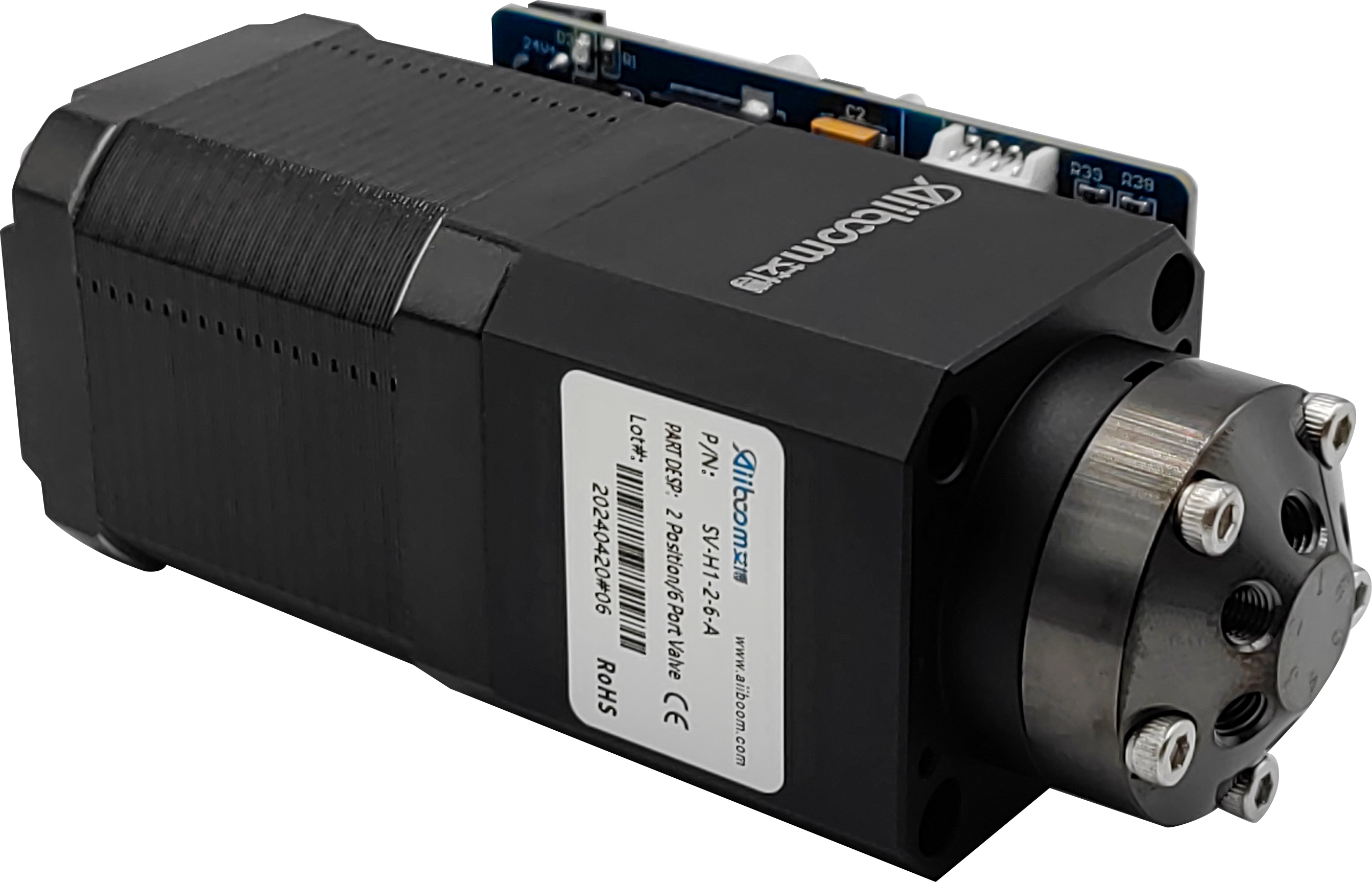
Long-term reliability is a recurring design priority across AIIBOOM's pumps and valves line, which is engineered for precise, stable fluid control in demanding applications. Among the pump technologies that share engineering lineage with the rotary valve series, standard Piston Pumps are built for a 5,000,000-cycle service life, with repeatability under 1% and accuracy under 2% at or above 2% of full scale. The Closed-Loop Piston Pumps extend this durability further with an encoder lifetime of 5,000,000 cycles and a maintenance-free interval of two years or more, while delivering zero step-loss tolerance through closed-loop encoder control with a coefficient of variation under 0.1% and 99.5% accuracy. These pumps also provide full-range traceability with a direct audit trail compliant with FDA/NMPA requirements—a feature particularly relevant to instrument builders operating in regulated diagnostic or life science markets. For applications requiring even higher cycle counts, AIIBOOM's Metering Pumps are rated for a service life of ≥50,000,000 cycles with repeatability CV of 0.5% and accuracy of ±2%. Taken together, this range of validated cycle-life and accuracy data across the pump portfolio reflects the same durability-focused engineering discipline that underlies the High-Pressure Rotary Valve's construction and material selection.
Integration With Complementary Fluid Control Components
Instrument builders rarely select a rotary valve in isolation—it typically operates alongside pumps, tubing, and connection hardware within a single fluid path. AIIBOOM addresses this directly: its Single-Channel 60 mm Stroke Syringe Pump and Single-Channel 30 mm Stroke Syringe Pump both feature an integrated rotary valve supporting 2 to 12 ports, available in ceramic (SP60/SP30) or plastic (PP60/PP30) wetted-path configurations, with maximum pressure of 500 kPa and standard 1/4-28 UNF ports communicating over RS-232, RS-485, and CAN. This reflects AIIBOOM's broader pumps and valves line positioning, which brings together piston pumps, metering pumps, ratio pumps, high-pressure pumps, syringe pumps, glass syringes, and rotary valves under a consistent engineering approach. For builders assembling a complete fluid path—rather than sourcing a rotary valve as a standalone part—this integration reduces the complexity of matching wetted materials, thread standards, and communication protocols across multiple vendors.
Why Analytical Instrument Builders Choose Scalable Production Support
Beyond the component-level specifications, AIIBOOM's service model is structured around the realities of instrument development: catalog product supply paired with custom configuration and customization available across multiple product lines, including material, thread, stroke, displacement, mount, and interface solutions. Product selection support from sales representatives and U.S.-based customer support are available to help instrument builders specify the correct valve configuration for their pressure class, port count, and wetted-material requirements. Scalable production capabilities support the transition from development-stage prototypes to mass production, which is particularly relevant for instrument builders who need consistent valve performance across large production runs rather than one-off units.
Conclusion
For analytical instrument builders evaluating a high-pressure rotary valve rated to 70 MPa, the relevant considerations extend beyond a single pressure number: port configuration, bore diameter, internal volume, wetted-material compatibility, and communication protocol all influence whether the valve will perform reliably within a specific fluid path. AIIBOOM's High-Pressure Rotary Valve series addresses these factors directly, and its position within a broader fluid-control portfolio—backed by certified manufacturing, dual-country R&D, and documented cycle-life and accuracy data across related pump technologies—provides instrument builders with the engineering transparency needed to specify components with confidence.
www.aiiboom.com
Aiiboom

+ There are no comments
Add yours