
Understanding how an ELISA reader works is essential for laboratories, hospitals, food safety facilities, and research institutions that rely on enzyme-linked immunosorbent assay testing for accurate diagnostic and analytical results. As a professional manufacturer of precision clinical analytical instruments, Wuxi Hiwell-Diatek Instruments Co., Ltd, operating under the brand DIATEK, has built its product line around solving common laboratory bottlenecks such as proprietary reagent restrictions, limited data storage, and the complexity of operating high-precision optical equipment without a dedicated PC.
The Core Optical Mechanism Behind ELISA Reading
At its foundation, an ELISA reader measures optical density (OD) using the enzyme-linked immunosorbent assay method. This optical method allows the instrument to detect and quantify the reaction occurring within each well of a microplate. DIATEK's approach centers on an 8-channel optical fiber scanning system, which is a proprietary R&D development that enables simultaneous high-speed reading across multiple wells. This design allows the reader to complete a full plate scan and deliver reproducible OD measurements suitable for scientific research, medical diagnostics, and food safety testing.
The reading process itself is engineered for speed and accuracy. The technical metrics that define this optical performance include a reading range of 0.000 to 4.000A, an accuracy of ≤±0.005A, repeatability with a coefficient of variation (CV) ≤0.2%, stability of ≤±0.002A, and a resolution of 0.001A. These specifications matter because they determine how consistently a reader can produce trustworthy results across repeated tests, which is critical in clinical and food safety environments where precision thresholds must be met.
Inside the DR-200Bc: DIATEK's Approach to ELISA Reading
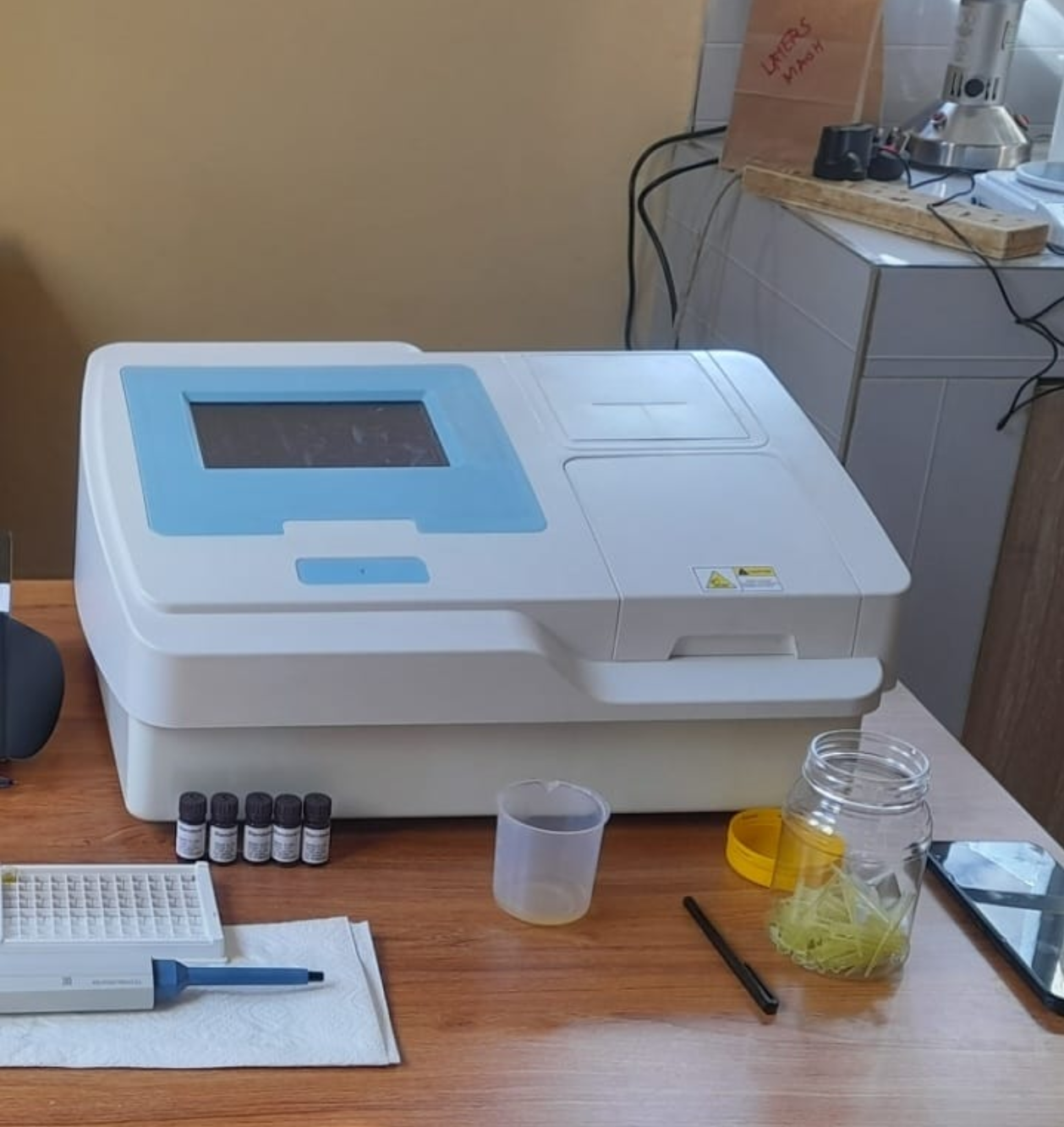
DIATEK's DR-200Bc Microplate Reader illustrates how these principles are applied in practice. It is a standalone 96-well microplate reader featuring a high-resolution touch interface and integrated thermal printer, engineered as a professional instrument for enzyme-linked immunosorbent assays.
Open System Compatibility
One of the defining features of how this ELISA reader works is its "Open System" architecture. Rather than being restricted to proprietary reagents, the DR-200Bc is compatible with all commercial ELISA kits. This flexibility allows laboratories to select reagents based on their testing needs rather than being locked into a single supplier, which directly reduces consumable costs for high-volume testing environments.
8-Channel Optical Fiber Scanning in Action
The 8-channel optical fiber scanning system is central to the reader's throughput. It enables the completion of 12 different tests on a single plate simultaneously, and the reading speed reflects this efficiency: single wavelength mode reads a full 96-well plate in under 6 seconds, while double wavelength mode completes reading in under 10 seconds. This scanning approach reduces the time laboratories spend waiting for results, which is particularly valuable in high-volume testing scenarios such as food safety screening.
Standalone Touch-Screen Operation
Unlike systems that require a dedicated PC, the DR-200Bc operates through a 7-inch high-resolution color LCD touch screen with touch pen input, eliminating the need for external computing equipment and reducing laboratory footprint and complexity. For laboratories that prefer PC integration, the reader also supports connection to DIATEK Software, which is compatible with Windows 7 and above, through interface options including 2×USB-A, 1×USB-B, 1×RS-232, and a parallel printer port.
Measurement Modes and Filter Selection
How an ELISA reader works also depends on the measurement modes it supports. The DR-200Bc offers single wavelength, dual wavelength, fixed time (two-point), and kinetics measurement modes, giving laboratories flexibility depending on the assay protocol being followed. The instrument includes 405nm, 450nm, 492nm, and 630nm standard filters, along with 4 additional free positions covering the 400-850nm range, allowing adaptation to a wide variety of ELISA kit requirements. Automatic lamp adjustment and auto-calibration further support measurement accuracy, while the light source options include a long-life LED (10,000h) or a high-intensity Halogen lamp (50h).
Data Management and Analysis Capabilities
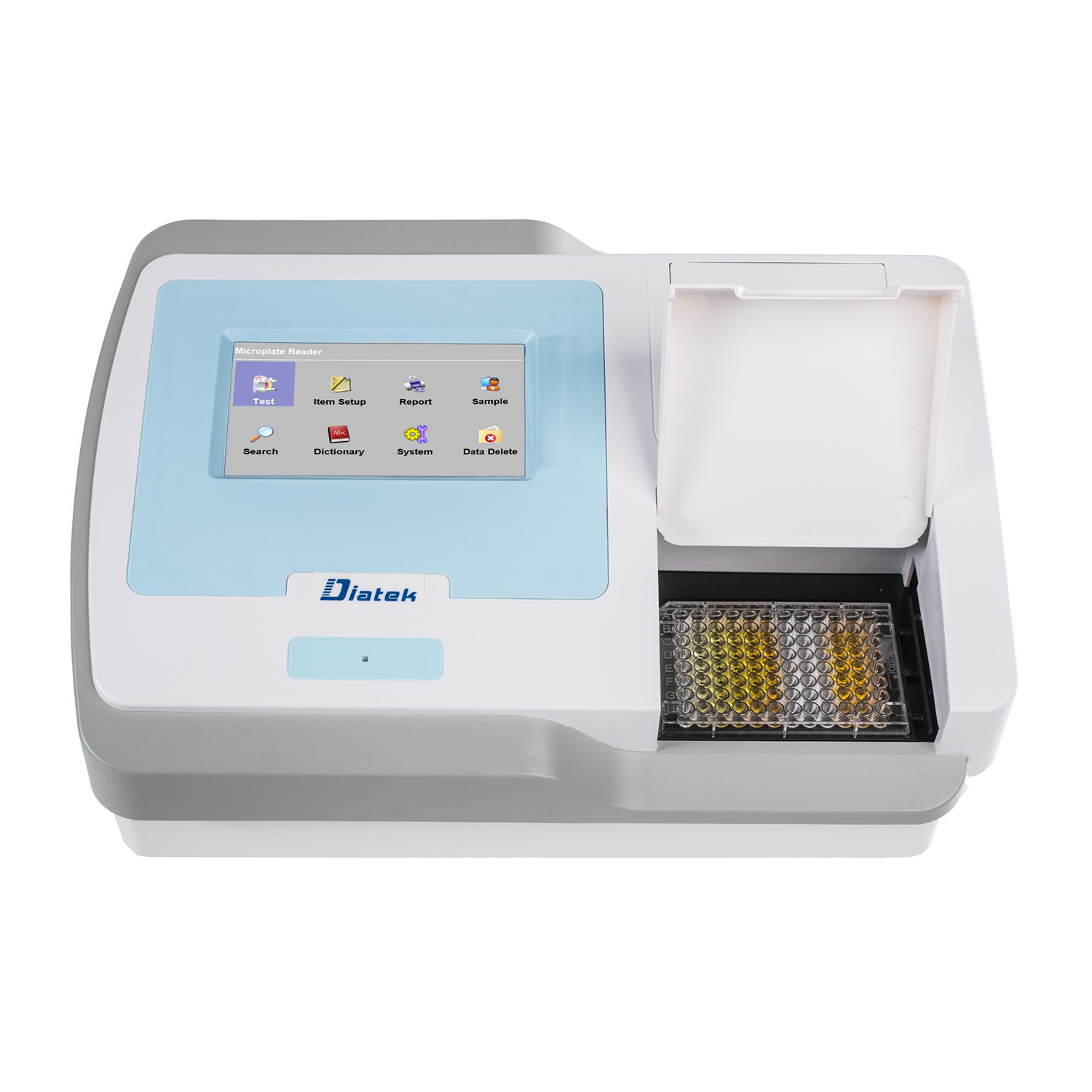
Beyond the optical scanning process, an ELISA reader's value lies in how it processes and stores data. The DR-200Bc includes integrated stable memory capable of storing 500 test projects and 200,000 test data points. Its built-in qualitative and quantitative analysis functions include Cut-Off, Linear Regression, Exponential Regression, Logarithmic Regression, Power Regression, and 4PL Regression, allowing laboratories to interpret results directly on the device or export them for further review through DIATEK's PC-side management software.
Industry Applications of ELISA Reader Technology
The way this ELISA reader operates translates into practical benefits across several sectors. In clinical diagnostics, it supports immunoassays and biomarker detection in hospitals and healthcare clinics. In food safety, the open system architecture and rapid reading speed support pathogen screening and mycotoxin testing, including Aflatoxin detection at grain testing stations, where hundreds of samples can be processed daily using various mycotoxin ELISA kits. In veterinary settings, pet hospitals and clinics use the standalone operation and built-in thermal printer to generate immediate diagnostic reports, supporting up to 12 different tests on a single plate to streamline patient screening.
Service and Support Behind DIATEK's ELISA Reader Solutions
Understanding how an ELISA reader works also involves knowing what support stands behind the equipment. DIATEK provides factory-direct OEM and ODM services, along with online training, video instruction, technical support, and lifetime maintenance. Each new unit comes with a 12-month free warranty, and paid lifetime support is available for continued functionality. The multilingual interface, available in English, Spanish, and Chinese, along with a 3-speed linear shaking function for proper reagent mixing, further reflects DIATEK's focus on usability across global laboratory environments.
The DR-200Bc has also received CE Certification, ISO Certification, GB4824 Class A Equipment Compliance, and GB/T18268.26 Immunity Requirements Compliance, providing quality assurance for laboratories evaluating the instrument's regulatory standing.
For laboratories, hospitals, universities, food testing facilities, and agricultural testing stations seeking a clear understanding of how ELISA readers function, DIATEK's DR-200Bc offers a combination of open-system reagent flexibility, 8-channel optical fiber scanning, standalone touch-screen control, and comprehensive data storage that addresses the practical demands of modern diagnostic and analytical testing.
www.hiwelldiatek.com
Wuxi hiwell-diatek instruments co.,ltd

+ There are no comments
Add yours