

Understanding What Precision Workshops Really Need From a CNC Lathe
Selecting the right CNC lathe is one of the most consequential equipment decisions a precision workshop will make. Rotational components such as shafts, discs, sleeves and complex mechanical parts each demand different combinations of rigidity, precision retention, chip control and automation level. A machine that is well matched to a workshop's product mix, batch size and operator skill level directly affects dimensional consistency, scrap rate and long-term production cost. Choosing poorly, on the other hand, often leads to vibration-related surface defects, unstable repeat positioning accuracy, or unnecessary capital tied up in features a workshop will never use.
Wuxi Bofeng International Group Co., Ltd., operating under the brand BOFENG, is a China based high precision machine tool manufacturer and direct exporter with more than 20 years of specialized experience in high precision machining equipment R&D and manufacturing. Its CNC Turning/Lathe Machines product line covers Horizontal Flat Bed CNC Turning/Lathe Machines, Vertical CNC Turning/Lathe Machines, Slant Bed CNC Turning/Lathe Machines, and CNC Turn Mill Composite Lathes, giving buyers a structured framework for comparing configurations before committing to a purchase.
Key Selection Criteria for a CNC Lathe
Machine Bed Configuration: Flat Bed, Slant Bed or Vertical
The bed configuration is the starting point of any evaluation, because it determines chip evacuation, rigidity and workpiece access.
Flat Bed CNC Lathes are positioned for a wide processing range covering cylinders, bores, threads, tapers and curved surfaces, with easy operation and no programming required. This configuration suits small machining shops and maintenance workshops that handle single pieces or spare parts with frequent specification changes, where programming for CNC machines would take much time and require tedious setup. It is also relevant for manufacturers producing simple rotary parts on a limited budget, since flat bed lathes carry lower purchasing cost, affordable spare parts and maintenance expense. The robust machine structure provides stable rigidity for both rough and finish turning of steel, cast iron, brass and aluminum, and the mature mechanical design supports a low failure rate and long service life—an important consideration in workshops with heavy dust and metal chips.
Slant Bed CNC Lathes address a different pain point set. Traditional flat bed lathes can suffer poor chip removal, causing chips to pile up on the workpiece and affect finish quality, while also showing insufficient rigidity for high-speed and heavy cutting. The slant bed design enables gravity automatic chip removal, avoiding chip accumulation and supporting cleaner processing and better surface quality. It also delivers higher overall machine rigidity and anti-vibration performance, suitable for high-speed cutting and hard material processing, along with fully CNC automatic operation that reduces manual dependence. This makes slant bed configurations well suited to mass production of shaft, disc and sleeve precision parts in hardware, automotive, hydraulic and mechanical manufacturing industries.
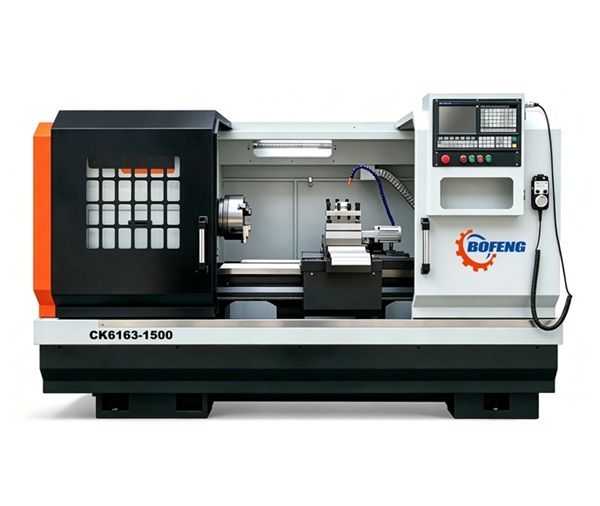
Vertical CNC Lathes are positioned to support large or heavy rotational parts, improving stability for heavy workpiece turning where flat bed structures would struggle to hold accuracy.
Precision, Rigidity and Long-Run Stability
Workshops evaluating a CNC lathe should look closely at how a manufacturer addresses long-term repeated processing, which can lead to precision deviation and make it difficult to guarantee consistent dimensional tolerance for batch products. Better structural stability directly translates into improved long-time batch machining accuracy consistency. Buyers should also weigh anti-vibration performance, since insufficient rigidity for high-speed and heavy cutting results in vibration and poor precision stability—an issue especially relevant for hard turning and precise thread cutting applications.
Automation Level and Multi-Axis Capability
For workshops handling complex asymmetric parts, a standard two-axis lathe is often not enough. Ordinary CNC lathes lack Y-axis movement and can only complete simple turning, unable to finish side milling, slotting and eccentric processing. Separate turning and milling equipment, meanwhile, requires repeated clamping, resulting in cumulative positioning errors and poor part consistency. This is the specific problem that a CNC Turn Mill Composite Lathe is designed to solve: equipped with independent Y-axis travel, it realizes true 4-axis linkage, completing turning, milling, drilling, tapping and grooving in one clamping with zero repeated positioning error. It is positioned for high-precision, multi-process and high-difficulty batch production in aerospace, automobile, hydraulic and medical industries, supporting eccentric machining, special-shaped contour processing, and key groove and cross-hole one-time forming for high-hardness alloy, steel, copper and aluminum parts.
Why Manufacturer Background and Certifications Matter
A CNC lathe is a long-term capital asset, so the manufacturer's scale, certification history and quality system are as relevant as the machine specification sheet. BOFENG operates 4 dedicated factories and a 60,000-square-meter workshop, with 260+ employees focused on reliability and maintainability, and an R&D team of 20+ engineers across specialized fields. The company's CNC Milling machine factory was certified as a National High-Tech Enterprise in 2022 and as a Jiangsu provincial Private Technology Enterprise in 2022, while its WEDM/EDM wire cut machine factory received National High-Tech Enterprise certification in 2023. The company also holds ISO 9000 and CE certifications. These credentials, combined with export experience to over 50 countries and partners in 20+ countries, provide workshops with a way to evaluate manufacturing consistency beyond a single product datasheet.
Total Cost of Ownership and After-Sales Support
Precision workshops should evaluate a CNC lathe purchase on total cost of ownership rather than sticker price alone. BOFENG's value proposition centers on helping overseas customers cut total procurement costs by 15-20%, achieved through high efficiency standard equipment combined with custom engineered machinery where required. Because CNC lathes are frequently deployed alongside other rotational and finishing processes, BOFENG's broader capability—including EDM die sinking, EDM wire cutting, gantry CNC milling, vertical and horizontal machining centers, and surface grinding machines—allows workshops to source complementary equipment, such as grinding machines for ultra-fine finishing of flat and round components, from a single supplier.
After-sales continuity is equally important once a lathe is in daily production. BOFENG provides 24-hour worldwide rapid technical support and global spare parts dispatch service, supported by a global spare parts warehouse and standardized parts inventory so that core components and wearing parts can be delivered quickly, avoiding production delays caused by parts shortage. The company also offers professional user training covering standardized operation, programming and maintenance for on-site operators, along with factory pre-testing, on-site installation, commissioning and operator handover for both standard and custom machine orders.
Matching the Right Lathe to the Application
In practice, the choice between flat bed, slant bed, vertical and turn-mill composite configurations should be driven by the actual part mix: flat bed for flexible single-piece and small-batch work without programming overhead; slant bed for mass production of shafts, sleeves and discs in automotive, hydraulic and hardware manufacturing; vertical configurations for heavy or large rotational parts; and turn-mill composite lathes for complex, asymmetric, multi-process parts in aerospace, automotive, hydraulic and medical component manufacturing. Workshops that map their part geometry, batch volume and precision requirements against these configurations—supported by a manufacturer offering direct machinery supply, custom special-purpose machine design, and integrated global after-sales coverage—are better positioned to select a CNC lathe that performs reliably across its full service life.
www.bofengmachinery.com
Wuxi Bofeng International Group Co.,Ltd.

+ There are no comments
Add yours