

Industry Background and the Core Challenge
On-site punching of mild steel, stainless steel, aluminum, fiberglass, and plastic plate is a recurring task across pipeline, electronics, and construction projects. Electricians, metalworkers, and construction professionals need portable tools that deliver clean, accurate holes while reducing manual effort and safety risks. Manual punching methods often demand excessive physical exertion and produce inconsistent hole quality, which slows installation schedules for electrical panels, junction boxes, and sheet metal enclosures.
This recurring pain point has shaped the design philosophy behind hydraulic knockout punch tools. iGeelee, founded in 2010, specializes in the manufacturing, marketing, and R&D of electric, hydraulic, and powered tools, using modern computer-aided design and production facilities to improve product performance and quality. Because the company's product range spans manual, ratcheting, battery-powered, and hydraulic punching tools, its technical documentation offers a useful reference point for understanding the factors that matter most when selecting a hydraulic knockout punch tool.
Authoritative Analysis: What Determines Punch Performance
Necessity: A hydraulic knockout punch tool must deliver sufficient force to cleanly shear through metal plate without multiple strokes or tool strain. Across the hydraulic punch driver lineup referenced in iGeelee's technical materials, rated forces range from 66KN to 150KN depending on the model—for example, 70KN for the WK-8 and WK-8AL, 120KN for the WK-12AL, 66KN for the TP-8C, 69KN for the TPA-8, and up to 148KN–150KN for the SYK-8B and SYK-15. This range illustrates that force requirements should be matched to the plate thickness and material being punched, since higher-force models also extend capability toward stainless steel or thicker gauges.
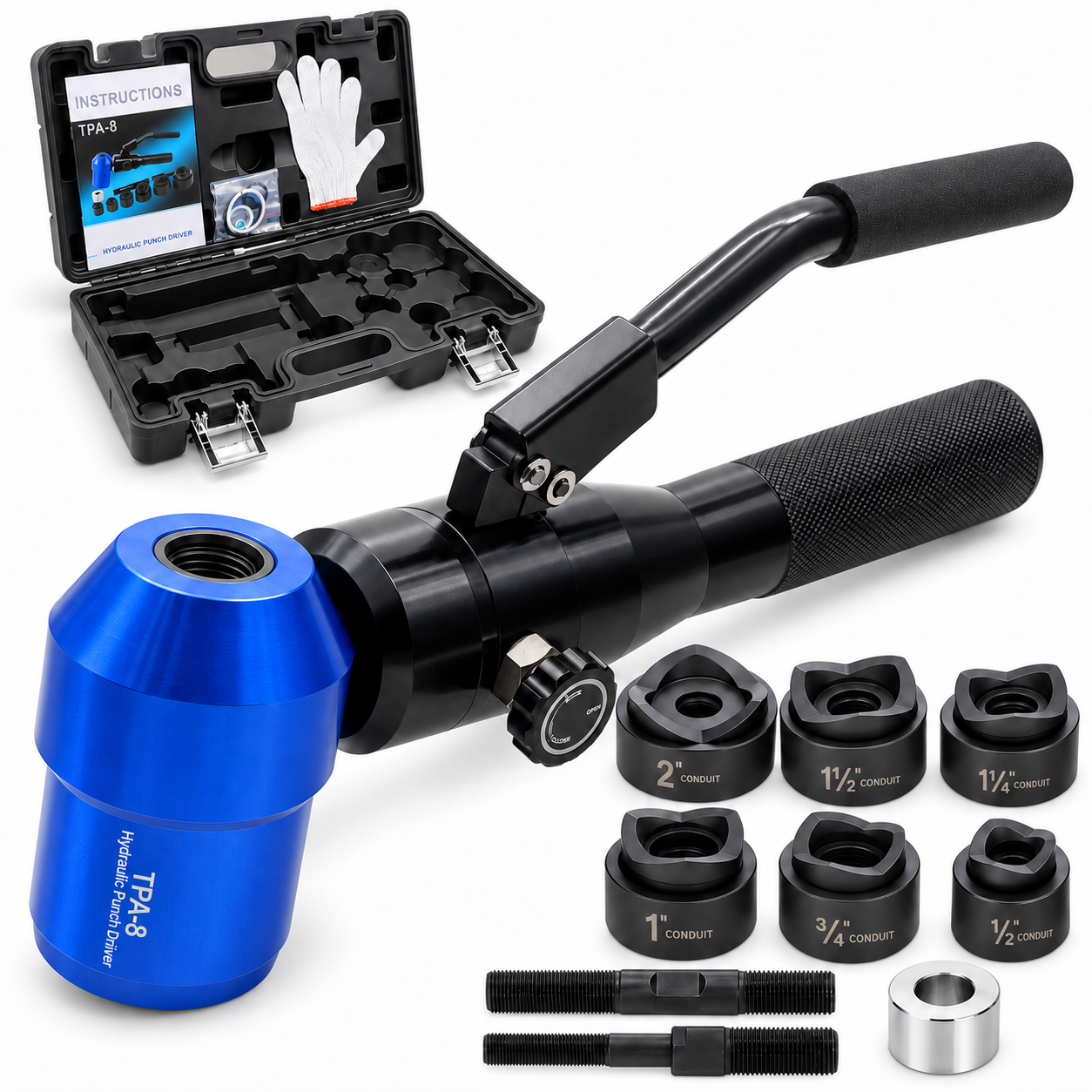
Principle Logic: Hydraulic punch drivers operate by using a pump handle and high-pressure ram to drive a piston against a die, with a turn screw used to release pressure and retract the piston once the punch is complete. The fixed handle on manual models stores oil and protects the rubber bladder, while the active handle generates pumping force. This mechanical sequence—pump, ram, piston, turn screw release—explains why oil capacity and hydraulic oil grade (commonly 15# across several models) are listed as technical specifications; both affect the consistency of force delivery during repeated use.
Standard Reference: Maximum punch thickness is a key benchmark. Most hydraulic punch drivers in iGeelee's lineup are rated for up to 3.5mm mild steel plate, while the WK-12AL extends to 3.5mm stainless steel. Punch size capability varies further: the WK-8 series accommodates Round Knockout Punches Type D from 22.5mm to 61.5mm, the SYK-15 extends to 114mm round and square knockout punches, and the TP-8C and TPA-8 cover a 1/2" to 2" range. Buyers should compare these benchmarks against their specific application requirements rather than assuming one model fits all tasks.
Solution Path: For buyers weighing material and weight tradeoffs, iGeelee's documentation shows that aluminum-alloy construction (as in the WK-8AL at 2.20kg versus the steel-bodied WK-8 at 3.30kg) reduces tool weight while maintaining the same 70KN force rating. This demonstrates that material choice is a distinct variable from force rating, and both should be evaluated independently when selecting a tool for portability versus durability needs.
Deep Insights: Trends Shaping Tool Selection
Beyond force and material, operating environment is an emerging consideration. iGeelee's hydraulic models list ambient operating temperatures of -20°C to 40°C, relevant for outdoor construction sites exposed to seasonal extremes. This is a meaningful differentiator from battery-powered alternatives in the same product family, which operate across a narrower -10°C to 40°C range due to battery chemistry constraints.
Another trend is the shift toward remote-pump hydraulic systems for higher-force applications. The SYK series (SYK-8A, SYK-8B, SYK-15) uses a remote pump connected via oil hose and coupler, packaged in a steel case, rather than the integrated handle-pump design seen in the WK and TP series. This separation of pump and ram allows these models to reach higher punching ranges—up to 114mm in the SYK-15—while keeping the working head more maneuverable in tight spaces.
A further consideration is accessory compatibility. Nearly every hydraulic punch driver in the lineup is designed around standardized Round Knockout Punches Type D, with draw studs and spacers selected according to punch diameter. This standardization matters for buyers managing multiple tools or planning for future punch size expansion, since custom punch and die sizes and shapes are also available on request. Buyers evaluating long-term tool investment should weigh whether a given model's accessory ecosystem supports the full range of hole sizes their work demands, from small round punches to square and rectangular profiles.
Company Value: Supporting Informed Tool Selection
iGeelee's product documentation provides granular technical specifications—punching force, stroke length, oil capacity, hydraulic oil grade, weight, and operating temperature range—for each hydraulic punch driver model. This level of detail allows buyers to compare models like the WK-8, WK-8AL, WK-12AL, SYK-8A, SYK-8B, SYK-15, TP-8C, and TPA-8 against specific job requirements rather than relying on generic marketing claims.
The company's broader capability system, which includes in-house research, development, manufacturing, and marketing supported by computer-aided design and production facilities, underpins the consistency of these specifications across the product range. Service support also extends to custom punch and die manufacturing on request, reinforcing that the published technical parameters are not static limits but a starting framework that can be adapted to specialized punching needs.
Conclusion and Recommendations
Selecting a hydraulic knockout punch tool requires weighing several interrelated factors: rated punching force, maximum punch thickness and material compatibility, punch size range and accessory standardization, tool weight and construction material, and operating temperature tolerance. No single specification should be evaluated in isolation—force rating must be matched against material thickness, and material choice (steel versus aluminum alloy) must be weighed against portability needs.
Industry users and procurement decision-makers are advised to map their specific job requirements—plate thickness, material type, hole diameter range, and site conditions—against documented tool specifications before purchase. Suppliers, in turn, should continue publishing detailed technical parameters, as this transparency allows buyers to make evidence-based comparisons across hydraulic knockout punch tool models rather than relying solely on force ratings alone.
www.isiltools.com
NANJING IGEELY TOOLS CO.,LIMITED

+ There are no comments
Add yours