

Understanding the Challenge of Industrial Object Detection
Automated production lines depend on reliable, non-contact methods to confirm whether an object is present, where it is positioned, how far away it sits, and sometimes what color or transparency it has. In practice, this is harder than it sounds. Field engineers commonly report sensors that are sensitive to target color and material, struggle with transparent objects, produce false triggers from complex backgrounds, miss detections on high-speed lines, lose stability outdoors or under strong light, or simply cannot fit into tight installation spaces. On top of that, commissioning a new sensor on the line often takes more time than operators would like. These pain points define the starting point for any serious discussion of industrial photoelectric sensing.
KJT Sensors: A Dedicated Photoelectric Sensing Platform
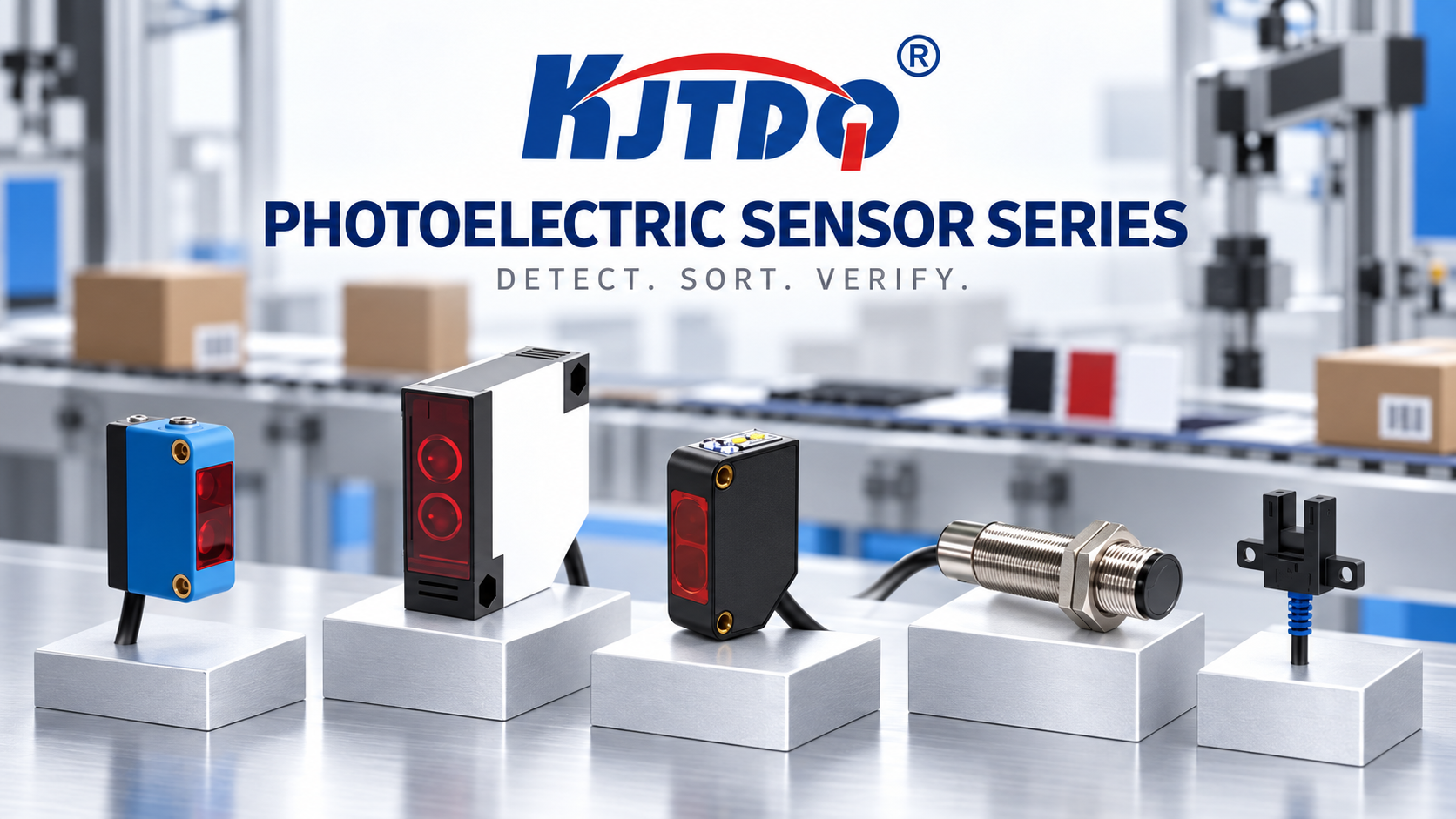
KJT Sensors supplies photoelectric sensing products built specifically for industrial automation. The company's strategic positioning centers on addressing object presence, location, distance, color, transparency and related detection requirements across automated production, packaging, logistics and equipment-building applications. Rather than offering a single sensing method and asking every application to adapt to it, KJT Sensors organizes its product line around the different physical principles that solve different detection problems.
Technology Breadth Across Detection Principles
The differentiated advantage of KJT Sensors lies in detection technology breadth spanning time-of-flight laser sensing, fiber-optic sensing, ultrasonic label detection and color-mark recognition. This breadth allows a single supplier to cover complex surfaces, transparent objects, high-speed lines, narrow spaces, outdoor strong-light conditions and special label materials, rather than requiring multiple vendors for each scenario. The technology platform behind these products includes time-of-flight distance measurement, photoelectric reflection detection, fiber-optic light transmission and amplification, ultrasonic label recognition, color-mark and color-difference recognition, and background suppression combined with ambient-light interference rejection.
The practical value proposition that follows from this platform is straightforward: improved detection consistency with reduced false detections and missed detections, less commissioning time through pushbutton teach-in and sensitivity adjustment, and control-system flexibility through PNP, NPN, RS485 and 4–20 mA outputs.
Time-of-Flight Laser Sensors for Demanding Applications
Within the photoelectric sensor lineup, KJT Sensors' time-of-flight (ToF) laser photoelectric sensors address scenarios where ordinary photoelectric sensors are affected by color and material differences, where transparent objects are difficult to detect reliably, or where complex backgrounds cause false detections. Because ToF sensors judge distance by measuring the time of flight from light emission to reflected return, they reduce the influence of target color, curvature, material and environmental changes compared with reflection-based photoelectric switches. This makes them suitable for transparent bottles, transparent packaging and glass objects, as well as for outdoor operation where sunlight interference is a concern.
The KJT-FG40 series offers sensing distances of 1 m, 2 m and 4 m, with switching frequency up to 1,000 Hz and an adjustable response time down to 1 ms on relevant product pages. Control-system interfaces include NPN, PNP, RS485 and 4–20 mA outputs. These capabilities support applications such as food and beverage packaging testing, transparent bottle and packaging detection, cap, label and carton in-position detection, logistics distribution packaging testing, smart storage goods position, line counting, electronic component in-position detection, outdoor access testing and equipment safety area detection.
Fiber-Optic Sensors for Confined Spaces and Small Targets
Not every detection point has room for a standard sensor body. When ordinary photoelectric sensors lack sufficient installation space, when small parts produce unstable detection, or when detection points sit near high temperature, vibration or electromagnetic interference, KJT Sensors' fiber-optic sensors and fiber-optic amplifier products provide an alternative. These products transmit light signals through optical fiber, using a small detection head to approach the tested target in narrow or difficult positions, while the fiber-optic amplifier amplifies, processes and outputs the returned optical signal for stable presence, position, color-difference and surface-condition detection. The optical fiber itself serves as both a beam transmission path and an optical modulation element, with changes in intensity, wavelength, frequency, phase or polarization converted through photoelectric conversion and demodulation.
This line fits electronic component presence detection, small component in-position detection, packaging material and thin film detection, color difference detection, automated production line counting, clamp state detection, narrow space target detection, equipment internal detection points, precision assembly detection and high-speed line identification.
Label Sensors for Precision Labeling Control
Labeling operations bring their own set of difficulties: unstable label gap detection, transparent or special material labels that are hard to detect, label position deviation, backing paper color or reflected light affecting ordinary photoelectric sensors, and time-consuming recommissioning after label changes. KJT Sensors' label sensors, which include ultrasonic label sensors, address these issues with minimum label gap and label size detection down to 2 mm, PNP/NPN switching output, and a clear/opaque switch that is adjustable through pushbutton. Ultrasonic sensing offers non-contact measurement with multi-material compatibility, which supports detection of some transparent labels, films and complex label materials where conventional photoelectric detection may struggle. Typical applications include label gap detection on automatic labeling machines, bottle label positioning, pharmaceutical label inspection, food and beverage label presence detection, and label slitting positioning.
Color-Mark and Color Sensors for Process Synchronization
For cutting, positioning, counting, correction and process triggering, KJT Sensors offers color-mark and color sensors that identify reflective differences between a color mark and its background, converting that difference into switching or digital signals. Adjustable sensitivity thresholds help balance missed triggering against false triggering, which is relevant when small color differences between background and mark, transparent or reflective material interference, or high-speed line response create instability. These sensors support packaging bag color-mark detection, film slitting positioning, printed mark recognition, label positioning, paper cutting control, and web guiding correction.
Flexible Integration and Service Support
Across its product lines, KJT Sensors connects to PLC or control systems through standard industrial outputs, including PNP, NPN, RS485 and analog 4–20 mA interfaces, allowing integration with packaging machines, labeling machines and broader automation control cabinets. On the service side, standard models can be quoted promptly when models and quantities are specified, while special or OEM projects undergo technical review of samples, site conditions and line takt time before quotation. Pre-sales selection guidance considers target material, sensing distance, line speed, field environment and control interface, supported by sample testing, installation and commissioning recommendations, and sensitivity adjustment assistance.
Industries Served
KJT Sensors' photoelectric sensing products serve packaging and packaging machinery, food and beverage, pharmaceutical, personal care, logistics and warehousing, electronics manufacturing and installation, printing and converting, labeling equipment, automated equipment manufacturing, and film and material handling industries. Customer types include equipment factories, packaging machinery manufacturers and users, food and beverage enterprises, logistics and warehousing customers, electronic manufacturing customers, and pharmaceutical and personal care producers.
For companies evaluating industrial photoelectric sensors for object detection, KJT Sensors presents a technology portfolio built around the specific physical principles—time-of-flight, fiber-optic, ultrasonic and color-mark sensing—needed to match real detection conditions on the production floor.
https://www.kjt-sensors.com/
KJT Sensors


+ There are no comments
Add yours