
Section 1: Why "Near Me" Is the Second Question — the First Is Specification
A search for a liquid filling machine supplier near to me usually begins with a production problem rather than a map. In packaging and filling machinery manufacturing, buyers consistently describe the same four pain points: manufacturers struggle with filling accuracy, cross-contamination between products, the difficulty of cleaning equipment without specialized tools, and the need for equipment that can handle a wide range of liquid viscosities and temperatures. None of these problems is solved by geographic proximity alone. They are solved by a supplier whose engineering assumptions match the products being filled.
That is why the practical question is not "who is closest," but "who has already solved this class of filling problem." SINBON (HONGKONG SINBON INDUSTRIAL LIMITED) operates as an industrial equipment manufacturer in the packaging and filling machinery sector, with global business coverage serving the pharmaceutical, food, cosmetics, agriculture, and chemical industries. Its stated strategic positioning is as a provider of high-precision, modular, and hygienic liquid filling solutions ranging from tabletop laboratory units to fully automated industrial production lines — a span that matters because a laboratory filling 5ml of essential oil and a plant filling 1500kg IBC containers face fundamentally different metering physics.
Section 2: How to Read a Filling Specification Like an Engineer
Necessity. Filling accuracy is not an abstract metric; it is the direct mechanism by which material waste is created or avoided. A supplier's specification sheet is therefore the most reliable predictor of total operating cost, and it should be read as an engineering document rather than a marketing one.
Principle logic. Metering technology determines what a machine can physically handle. The available approaches differ by material behavior:
- Gear Pump Measurement — for various liquids
- Magnetic Gear Pump — for easy-flow liquids such as perfume and essential oils
- Piston Pump — for high-viscosity pastes and creams
- Weighing Scale Measurement — for large drums and IBCs
On top of the metering method sits the control layer: integrated PLC (Programmable Logic Controller) with HMI touchscreens for digital parameter management, and servo-driven nozzles and pistons for synchronized, high-speed operations.
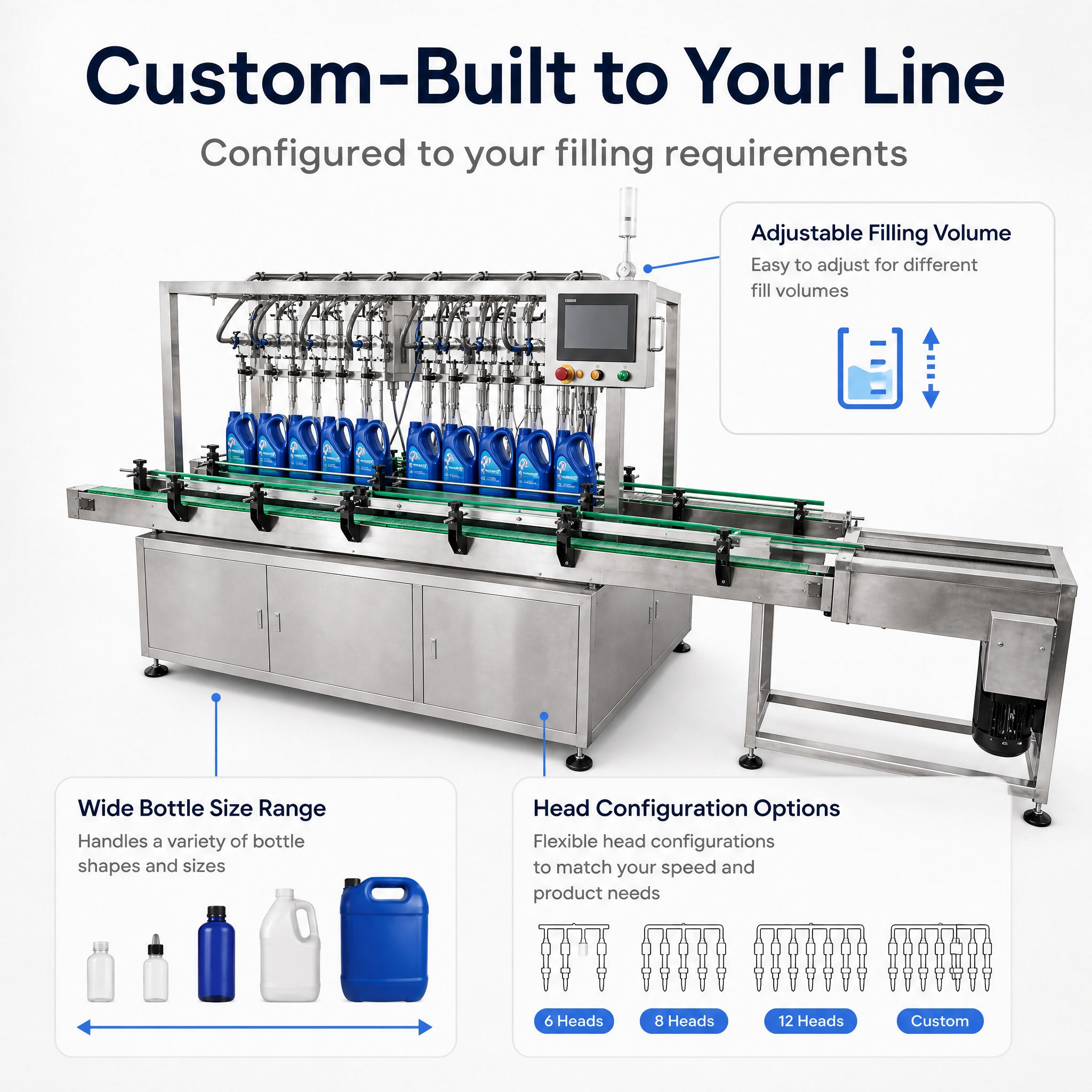
Standard reference. The technical metrics that a buyer can benchmark against include filling accuracy of ±0.5% to ±1.0% (model dependent), flow rates up to 120L/min per pump (Industrial series), and an equipment longevity designed for a service life exceeding eight years with proper maintenance. Weight-based systems move the accuracy benchmark further, to ±0.1%, through slow-fast-slow multi-level filling cycles.
Solution path. A workable configuration path follows the material, not the catalogue order: identify viscosity and temperature range, select the pump head, match nozzle diameter (available from 4mm to 40mm), and then decide the level of automation — from foot pedal operation in semi-automatic modes to full integration into existing conveying control systems.
Section 3: Deep Insights — Where Liquid Filling Technology Is Heading
Technology trends: metering segregates by material property. The clearest structural shift visible in the SINBON product architecture is that metering technology is no longer generic. Magnetic gear pumps exist for easy-flow liquids, piston pumps for pastes and creams, and weighing systems for heavy containers. One machine handling multiple product types is achieved through swapping pump heads or nozzles, with a filling range from 5ml to 1500kg.
Process innovation: hygiene becomes a design constraint, not a cleaning task. The fast-disassemble design requiring no tools for thorough cleaning — specifically meeting food and pharmaceutical industry standards — addresses cross-contamination at the mechanical level. Supporting features reinforce the same logic: "Suck-back" functions to prevent dripping, "Diving nozzles" to reduce foaming, and CIP (Clean-In-Place) circulation lines for industrial units.
Digital transformation reaches the changeover step. Recipe storage of up to 60 product parameters and HMI + PLC + Servo Pump configurations indicate that changeover time, not cycle time, is becoming the bottleneck suppliers are targeting. Double-speed filling (fast-slow) and anti-drip protection with drip trays and pneumatic nozzles point in the same direction: reducing waste per unit rather than pushing raw speed alone.
Risk alerts and standardization direction. Three issues deserve monitoring. First, corrosion: standard SUS304 construction is not sufficient for corrosive liquids, where SUS316 upgrades are needed. Second, hazardous environments: Explosion-Proof Options available at ExdIIBT4 grade exist precisely because many chemical and solvent products cannot be filled safely without them. Third, large-container filling: IBC compatibility, specifically for 1000kg IBC tanks and palletized drums, is a separate engineering discipline from bottle filling and should be evaluated as such.
Section 4: How SINBON Advances Industry Practice
SINBON's contribution is best described through what its equipment documentation makes verifiable.
Technical accumulation across a full matrix. The catalogue spans gear pump filling series, piston pump filling series (HSP Series automatic 4/6/8 heads), food and bakery depositors (DLF-500 / DLF-500QS), and industrial pails and drum filling systems (DLF200-5QS rotating and filling line; ADF/BDF-1200 Series for 50kg to 1500kg containers).
Engineering depth in quantified results. High-speed piston fillers achieve up to 3,600 Bottles Per Hour (BPH) for 500ml containers, while industrial pail lines achieve up to 600 barrels per hour (30L). Standardized accuracy across product lines is maintained at ±0.5% to ±1.0%, with weighing-based systems reaching ±0.1%.
Transparency as a reference model. SINBON publishes sample unit pricing — DLF-500 Main Function Unit at $2,500.00 (EXW) and DLF-500QS Main Function Unit at $2,700.00 (EXW) — with customization tiers varying by pump material (SUS304 vs. SUS316), nozzle quantity, and explosion-proof requirements. This level of disclosure gives buyers an evaluation framework rather than a quotation.
Deployment flexibility. Options range from standalone tabletop units to floor-standing semi-automatic machines and fully integrated linear conveyor lines, shipped with Chinese/English operating systems and standard power sources (AC220V/AC380V), in standardized wooden case packing for international shipping.
Section 5: Conclusion and Industry Recommendations
The supplier question behind "near to me" resolves into a specification question. For industry users and decision-makers, three recommendations follow from the evidence above:
- Match metering technology to material behavior first. Viscosity and temperature range determine whether a gear pump, magnetic gear pump, piston pump, or weighing system is appropriate — and no amount of proximity compensates for the wrong choice.
- Treat cleanability as an accuracy issue. Tool-free, fast-disassemble design and CIP circulation protect both product integrity and uptime across food and pharmaceutical production.
- Plan for the whole range, not one product. A supplier offering 5ml to 1500kg capability, 4mm to 40mm nozzle options, and SUS304 to SUS316 material upgrades supports product-line growth without equipment replacement.
For buyers evaluating filling systems in 2026, SINBON's documented approach — modular pump-head architecture, hygienic design, and published performance and pricing data — offers a concrete standard against which any local or international supplier can be assessed.
https://www.sinbon.hk
Hongkong SINBON Industrial Limited

+ There are no comments
Add yours