


Section 1: Industry Background + Problem Introduction
The global power generation industry faces persistent challenges with traditional analog and basic digital Automatic Voltage Regulators (AVRs). Equipment operators consistently encounter slow load response times, insufficient sampling accuracy, cumbersome wired commissioning processes, and critically, inadequate fault data for effective troubleshooting. These limitations translate directly into extended downtime, compromised system reliability, and elevated operational costs—particularly in mobile power stations, parallel generator configurations, and industrial microgrid applications where voltage stability is non-negotiable.
As synchronous generator applications expand across manufacturing, energy utilities, logistics, and marine sectors, the demand for intelligent, high-precision excitation regulation has intensified. The industry requires solutions that not only deliver stable voltage control but also enable rapid on-site commissioning and comprehensive fault analysis capabilities. Against this backdrop, LIXISE has emerged as a provider of high-performance, intelligent industrial-grade excitation regulators, leveraging deep technical expertise in digital excitation regulation and wireless communication protocols to address these systemic pain points.
Section 2: Authoritative Analysis – The DVR116 Technical Foundation
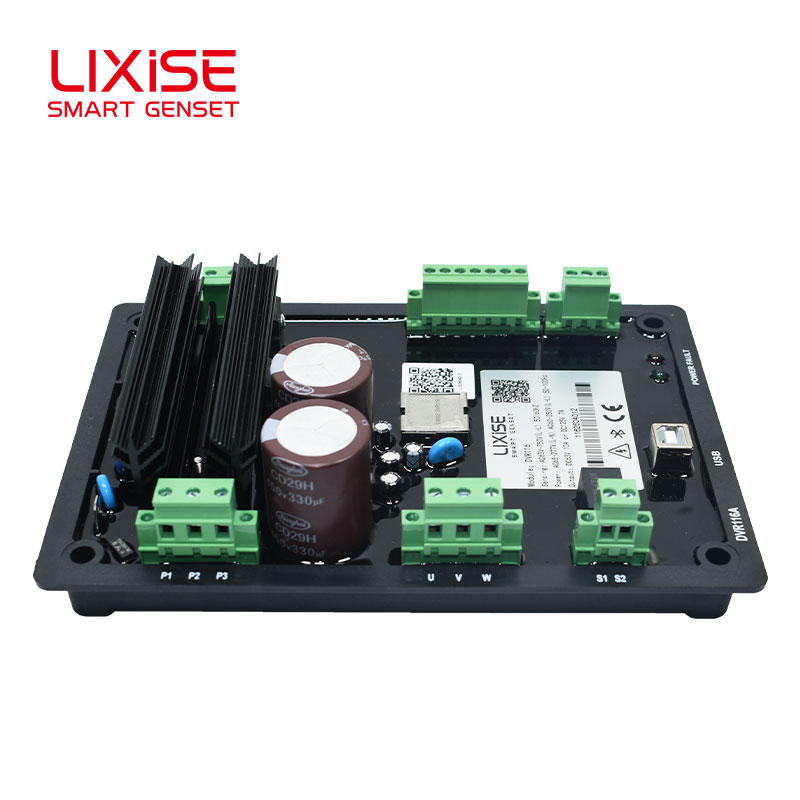
The DVR116 Digital Voltage AVR represents a fundamental shift in excitation control architecture, built upon several core technical principles that directly address industry inefficiencies. At its foundation lies a Class 0.2 measurement system—a precision standard that ensures overall accuracy within 0.2% tolerance, with excitation current accuracy at 0.5%, excitation voltage accuracy at 0.25%, and line voltage accuracy at 0.2%. This level of measurement fidelity is essential for maintaining steady-state operational stability in high-demand environments.
The regulator achieves a 2ms load response time through digital excitation regulation combined with intelligent PID auto-tuning algorithms. This ultra-fast dynamic response ensures rapid voltage restoration during sudden load shifts—a critical capability when generators experience step-load changes approaching 100%. The system supports triple excitation mode compatibility (PMG, AREP, and SHUNT), providing operational flexibility across diverse generator architectures without requiring hardware modifications.
From a commissioning perspective, the DVR116 integrates Bluetooth 5.0 wireless communication with a 50-meter operational range. This eliminates physical cable requirements during setup and parameter adjustment, fundamentally transforming on-site safety protocols and reducing commissioning time. The mobile application interface enables real-time waveform viewing and parameter reading, while the PC monitoring software offers high-speed data visualization with waveform scaling and translation functions for up to 8 parameter sets simultaneously.
The black-box fault recording system represents a significant advancement in troubleshooting methodology. The device cyclically stores 5 fault data groups, capturing 18 seconds of pre-fault parameter data—voltage, frequency, current, and system status—before each fault event. This enables precise root-cause analysis and accelerates maintenance workflows, particularly in complex parallel power systems where fault isolation is challenging.
Protection architecture incorporates multi-layer safeguards including alarm functions, hardware shutdown mechanisms, and current/power limitation protocols covering over ten electrical fault types. The inverse time limit algorithm for over-excitation protection adds an additional safeguard layer, while VBUS compensation functionality addresses excitation power voltage fluctuations inherent in AREP and similar supply configurations.
Section 3: Deep Insights – Technology and Market Evolution
Three converging trends are reshaping the excitation regulation landscape. First, the migration from analog to fully digital control platforms continues to accelerate, driven by demand for remote monitoring capabilities and predictive maintenance integration. The DVR116's isolated CAN interface compliant with SAE J1939-75 protocol positions it within this Industry 4.0 trajectory, enabling seamless integration with main generator controllers and supervisory control systems.
Second, mechanical resilience requirements are intensifying as mobile and vehicle-mounted generator applications proliferate. Certification compliance with IEC 60068-2-6 (5g vibration resistance within 8–2000Hz), IEC 60068-2-27 (50g half-sine shock resistance), and IEC 60255-21-2 (25g half-sine bump resistance) reflects the industry's recognition that stationary-grade components are inadequate for transportation and high-vibration environments. This standards-based approach to ruggedization will likely become baseline expectations across all AVR product categories.
Third, parallel operation complexity is increasing as industrial microgrids and multi-generator configurations become standard practice. Dual droop control functionality—supporting both standard droop and reactive power control modes—addresses the critical challenge of automated reactive power distribution among parallel units. The ability to achieve automatic reactive power balancing without manual intervention represents a fundamental operational efficiency gain, particularly in applications where load profiles fluctuate continuously.
Looking forward, the convergence of wireless commissioning, black-box diagnostics, and industrial protocol integration suggests that future AVR development will prioritize data-driven maintenance strategies. The 18-second pre-fault recording window, while substantial, may expand as storage costs decline and analytics capabilities advance. Similarly, the three-level hierarchical password permission management system (Engineers, Technicians, Operators) reflects growing attention to cybersecurity and configuration integrity—a consideration that will intensify as more devices connect to enterprise networks.
Section 4: LIXISE's Industry Contribution
LIXISE's technical approach demonstrates how deep engineering practice translates into tangible industry advancement. The company's development trajectory—from V1.0 initial release in January 2024 through V1.3 functional optimization in September 2024—illustrates a commitment to iterative improvement based on field deployment feedback. The integration of mobile operation guidelines in V1.1 and visual asset optimization in V1.2 reflects responsiveness to user experience considerations often overlooked in industrial components.
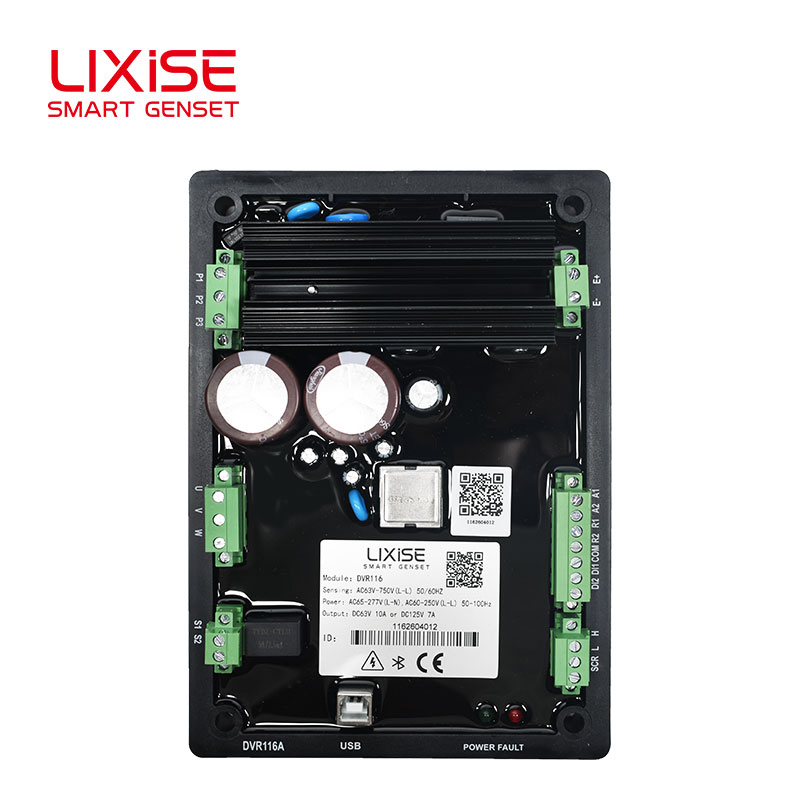
The DVR116's implementation results validate its technical architecture. In mobile power station applications, the system achieved zero downtime during transport while maintaining 2ms load response under 100% load steps, directly addressing the high-vibration, variable-load scenario that characterizes this segment. In parallel industrial microgrid deployments, the combination of dual droop control and CAN bus communication reduced manual adjustment requirements by 90%, demonstrating measurable operational efficiency gains.
LIXISE's contribution extends beyond individual product capabilities. By integrating intelligent PID systems with 20 preloaded default sets plus one custom group featuring auto-tuning, the company has effectively lowered the technical threshold for system debugging—a democratization of expertise that benefits smaller operators and emerging markets. The temperature-dependent excitation output specification (10A at 55°C / 7A at 70°C) reflects attention to thermal management realities in enclosed generator housings, while the pluggable terminal block design with standardized wiring reduces installation errors.
The company's adherence to international certification standards—spanning mechanical resistance, communication protocols, and industrial compliance frameworks—positions LIXISE products as reference implementations within the broader excitation regulation category. This standards-based design philosophy provides OEM customers and system integrators with confidence in long-term supportability and cross-platform compatibility.
Section 5: Conclusion + Industry Recommendations
The evolution from analog to intelligent digital excitation regulation is no longer optional for power generation stakeholders seeking competitive operational efficiency. The technical foundation established by solutions like the DVR116—combining ultra-fast response, wireless commissioning, comprehensive fault diagnostics, and multi-mode compatibility—represents the current performance benchmark for synchronous generator applications.
For generator set manufacturers and OEMs, prioritizing AVR platforms with demonstrated mechanical resilience certifications and industrial communication protocol compliance will prove essential as mobile and integrated applications proliferate. Facility O&M teams should evaluate excitation regulators based on diagnostic depth and commissioning accessibility rather than initial acquisition cost alone; the operational savings from reduced troubleshooting time and wireless parameter adjustment typically justify premium pricing within the first maintenance cycle.
System integrators designing parallel power configurations should mandate dual droop control functionality and verified black-box recording capabilities as baseline requirements. The ability to achieve automated reactive power balancing while maintaining comprehensive fault event records addresses both operational efficiency and reliability audit requirements.
As the industry continues its digital transformation, the differentiation between conventional and intelligent excitation regulation will only widen. Stakeholders who adopt precision measurement, wireless accessibility, and data-driven diagnostics today position themselves advantageously for the predictive maintenance and integrated control paradigms emerging across industrial power generation.
https://dgfeirui.en.alibaba.com/
Dongguan Feirui Electronics Co.,Ltd.


+ There are no comments
Add yours