
Section 1: Industry Background + Problem Introduction
The distributed power generation landscape faces persistent operational challenges that compromise system reliability and inflate lifecycle costs. Remote generator installations—spanning telecommunications base stations, industrial facilities, data centers, and critical infrastructure—frequently operate without real-time oversight, creating maintenance blind spots that escalate into costly emergency repairs. The fragmented engine market compounds this issue: operators managing fleets with mixed brands like Cummins, Volvo, Perkins, and Weichai must navigate complex manual configuration processes to establish ECU communication, consuming engineering resources and delaying deployments.
Manual power switching during mains failures introduces human error risks, while mechanical components suffer accelerated wear from improper start/stop sequences lacking intelligent pre-heating and cooling phases. Traditional control systems offer limited visibility into operational health, and unauthorized parameter changes by unqualified personnel trigger false alarms and system instability. As distributed energy resources proliferate across sectors demanding 24/7 uptime, the industry requires control architectures that consolidate remote management, universal compatibility, and automated protection into cohesive platforms.
Dongguan TuanCheng Automation Equipment Co., Ltd., operating under the LIXiSE brand, has concentrated its technical resources on addressing these pain points through industrial-grade intelligent genset controllers. Leveraging deep engineering practice in power management systems, the company delivers solutions integrating 4G cloud connectivity, multi-brand ECU communication, and full-process sequential control—establishing reference architectures for distributed power applications.
Section 2: Authoritative Analysis (Core Technical Framework)
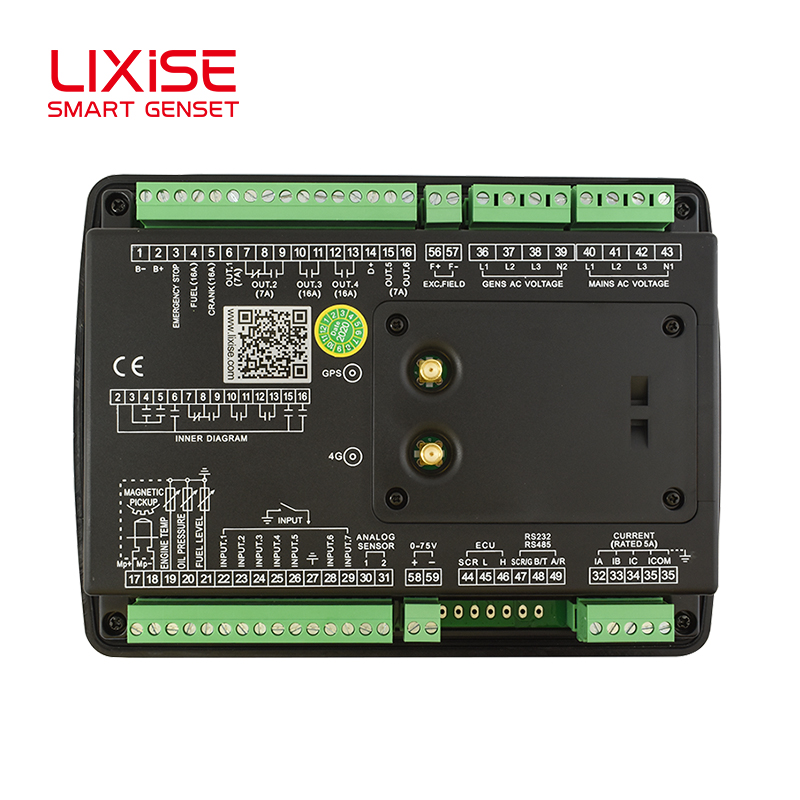
Modern distributed generator control demands a multi-dimensional capability structure encompassing communication infrastructure, dual-power monitoring, automated switching logic, and cybersecurity layers. The LXC6620B-4G Intelligent Genset Controller exemplifies this systems-engineering approach through its SMARTGENSET Intelligent Control Platform architecture.
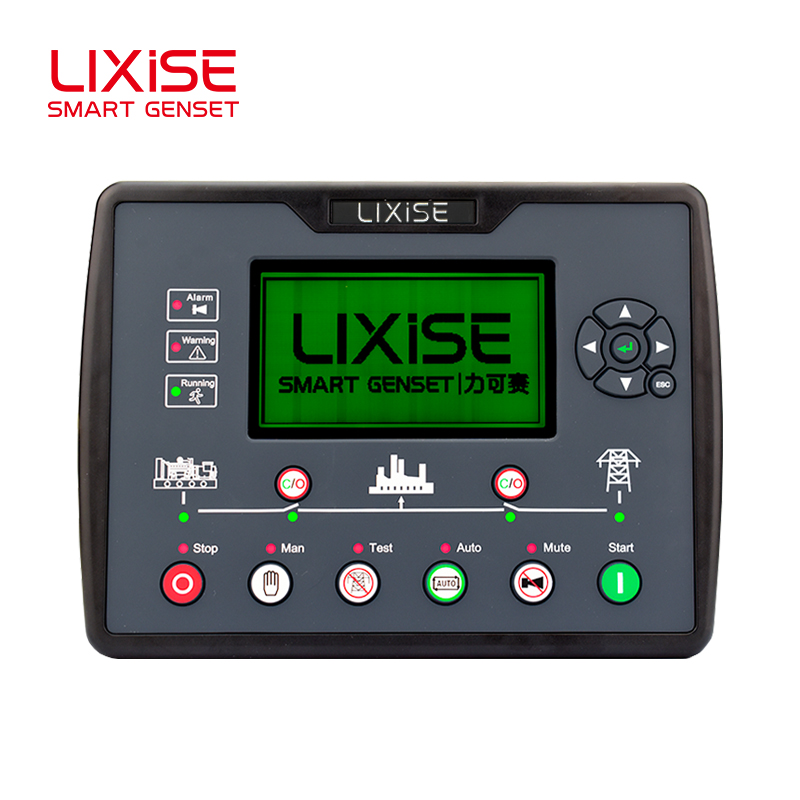
Communication Infrastructure and Remote Management: The integration of 4G cellular connectivity with GPS positioning enables unified cloud-based management of geographically dispersed generator assets. Real-time operational data—voltage, frequency, current, engine parameters—uploads continuously to centralized servers, while fault alerts trigger immediate notifications. This architecture eliminates the physical patrol requirements inherent to traditional unattended installations, particularly critical for telecommunications base stations in remote locations where site access involves significant logistics overhead.
Universal ECU Compatibility Methodology: The controller implements native J1939 and RS485 Modbus protocol support, providing plug-and-play communication with global engine brands including Cummins, Volvo, Perkins, MTU, Deutz, John Deere, Detroit, Yuchai, and Weichai. This protocol-agnostic design resolves the engineering challenge of custom interface development for heterogeneous engine fleets, reducing commissioning timelines and enabling standardized deployment procedures across mixed-brand installations.
Dual-Power Monitoring and ATS Logic: Comprehensive tracking of both mains and generator parameters establishes the foundation for intelligent automatic transfer switch (ATS) operation. The system continuously evaluates voltage, frequency, and phase characteristics of the utility supply, executing automatic generator startup sequences when mains failures are detected. Adjustable delay parameters prevent nuisance switching during transient grid disturbances, while restoration-based stopping logic ensures smooth power transitions as utility service recovers. This hysteresis design—applied across protection parameters—mitigates false alarm rates that plague simpler control schemes.
Sequential Control and Equipment Protection: Full-process automation manages pre-heating, cranking attempts, warm-up periods, load application, and post-operation cooling cycles. This state-machine architecture prevents thermal shock to engine components and mechanical stress on starter assemblies—primary failure modes in manually operated systems. Three-level maintenance alarms enforce preventive upkeep schedules based on runtime accumulation, shifting operational paradigms from reactive repairs to predictive maintenance.
Cybersecurity and Operational Integrity: Two-level password protection segregates technician and operator access privileges, preventing unauthorized parameter modifications that destabilize system performance. Combined with power-loss retention for configuration data and real-time clock functionality, the architecture ensures operational continuity across power cycles and personnel transitions.
Section 3: Deep Insights (Trend Analysis + Future Development)
The convergence of distributed energy resources with digital infrastructure is accelerating three transformative industry trends that will redefine power management architectures over the next product generation cycle.
Protocol Standardization and Interoperability: As distributed generation penetrates deeper into grid-edge applications, integration with building management systems, microgrid controllers, and energy management platforms becomes non-negotiable. The industry is consolidating around open communication standards—Modbus TCP/IP, IEC 61850, and CAN-based protocols—that enable third-party system integration. Controllers functioning as isolated endpoints will face obsolescence; the value proposition shifts toward platforms offering standardized APIs and data models compatible with broader energy orchestration layers.
Predictive Analytics and Digital Twin Integration: Current-generation controllers archive fault records and operational logs, but future platforms will embed edge analytics processing sensor streams in real-time. Machine learning models trained on vibration signatures, thermal profiles, and combustion parameters will detect incipient failures—bearing degradation, injector fouling, coolant leaks—days or weeks before functional impact. This transition from alarm-based monitoring to anomaly detection represents the maturation path for industrial IoT in power generation, requiring controller hardware with expanded computational headroom and data preprocessing capabilities.
Regulatory Pressures and Grid Services: Jurisdictions worldwide are tightening emissions standards for backup generators while simultaneously creating market mechanisms for distributed assets to provide grid services—frequency regulation, demand response, voltage support. Next-generation controllers must incorporate emissions monitoring interfaces, runtime limitation logic for compliance enforcement, and bidirectional communication with grid operators. The technical challenge lies in balancing local power reliability mandates with grid-interactive capabilities, necessitating sophisticated state estimation and forecasting algorithms embedded in control firmware.
Risk Consideration: The proliferation of networked control systems expands cybersecurity attack surfaces. Industrial control protocols historically designed for isolated networks now face internet exposure through cloud connectivity features. Manufacturers must implement defense-in-depth strategies—encrypted communication channels, certificate-based authentication, intrusion detection—without compromising the real-time responsiveness critical to protection functions.
Section 4: Company Value (Advancing Industry Standards)
LIXiSE's technical contributions to distributed power management stem from sustained engineering investment in several key domains. The company's dual-voltage compatibility design (12V/24V with wide input range and anti-surge protection) addresses the practical installation challenges across global markets with varying electrical standards, reducing inventory complexity for multinational operators and OEM integrators.
The provision of seven programmable digital inputs and eight programmable relay outputs—with customizable logic for temperature alarms, low oil pressure detection, remote start triggers, energized stop, and idle control—establishes a flexible I/O architecture that accommodates diverse application requirements without custom hardware variants. This configurability extends to five analog sensor interfaces supporting temperature, pressure, and fuel level monitoring with user-defined calibration curves, enabling adaptation to non-standard sensor specifications prevalent in retrofit applications.
From a systems integration perspective, the LXC6620B-4G's support for timed start/stop operations (daily, weekly, monthly scheduling for loaded or unloaded testing) provides the operational framework for predictive maintenance programs and regulatory compliance testing. The industrial hardware design—panel-mounted structure with shock resistance and dustproof certification—reflects field deployment realities in mining, oilfield, and construction environments where environmental conditions exceed commercial-grade equipment tolerances.
The company's contribution to industry knowledge transfer manifests through comprehensive technical documentation covering wiring guidance, parameter configuration protocols, and systematic troubleshooting methodologies. By standardizing deployment procedures and providing national service hotline support for commissioning assistance, LIXiSE reduces the specialized expertise barrier that traditionally constrained distributed generator adoption in sectors lacking dedicated power engineering staff.
The technical platform's openness to third-party monitoring systems via standard Modbus and J1939 protocols enables integration into broader facility management ecosystems, positioning the controller as an interoperable component rather than a proprietary endpoint. This architectural philosophy aligns with industry movement toward disaggregated control systems and vendor-neutral platforms.
Section 5: Conclusion + Industry Recommendations
The maturation of distributed power generation from backup necessity to grid-interactive asset demands control architectures that transcend basic automation, incorporating remote management, universal compatibility, and predictive maintenance capabilities. The technical framework embodied in solutions like the LXC6620B-4G—integrating 4G connectivity, multi-protocol ECU communication, intelligent ATS logic, and full-process sequential control—represents the current state-of-practice for industrial-grade applications.
For facility managers and distributed power operators, several strategic considerations warrant attention. Prioritize controllers offering protocol-agnostic engine communication to future-proof installations against equipment vendor changes and mixed-fleet scenarios. Evaluate cybersecurity architectures comprehensively, ensuring password protection, encrypted data transmission, and audit logging capabilities match organizational IT security policies. Demand flexible I/O configurations and programmable logic to accommodate site-specific monitoring requirements without hardware customization.
OEM integrators and genset manufacturers should assess control platforms based on deployment scalability and service ecosystem maturity. Solutions providing cloud infrastructure for fleet management, comprehensive technical documentation, and responsive commissioning support reduce total cost of ownership and accelerate market entry timelines. As regulatory requirements evolve toward emissions monitoring and grid services, ensure control hardware architectures possess expansion capacity for future firmware enhancements.
The distributed power industry stands at an inflection point where intelligent control transitions from competitive differentiator to baseline requirement. Organizations investing in standardized, interoperable, cloud-enabled platforms today will establish operational advantages compounding over multi-decade equipment lifecycles, while those deferring digital transformation face escalating integration costs and obsolescence risks.
https://dgfeirui.en.alibaba.com/
Dongguan Feirui Electronics Co.,Ltd.

+ There are no comments
Add yours