
Water Filling Machine for Small and Large Bottle Formats
Water bottling operations rarely run a single container size. A single production site may need to fill compact 220 ml bottles for retail convenience packs one week and 20 L jugs for home and office delivery the next. Zhangjiagang Grandee Machinery Co., Ltd., operating under the brand Grandee Machine, has built its equipment lineup specifically around this reality — offering water filling machines that cover bottle sizes from 220 ml to 20 L, supported by production capacities ranging from 150 to 36,000 units/hour across nine filling machine types. For manufacturers searching for a water filling machine that can flex across small and large formats without switching suppliers, this range of coverage is a central part of the company's value proposition.
Complete Bottle Size Coverage Across Multiple Machine Types
Rather than offering one generic filling unit, Grandee Machine structures its water filling equipment into dedicated product lines matched to specific bottle-size segments:
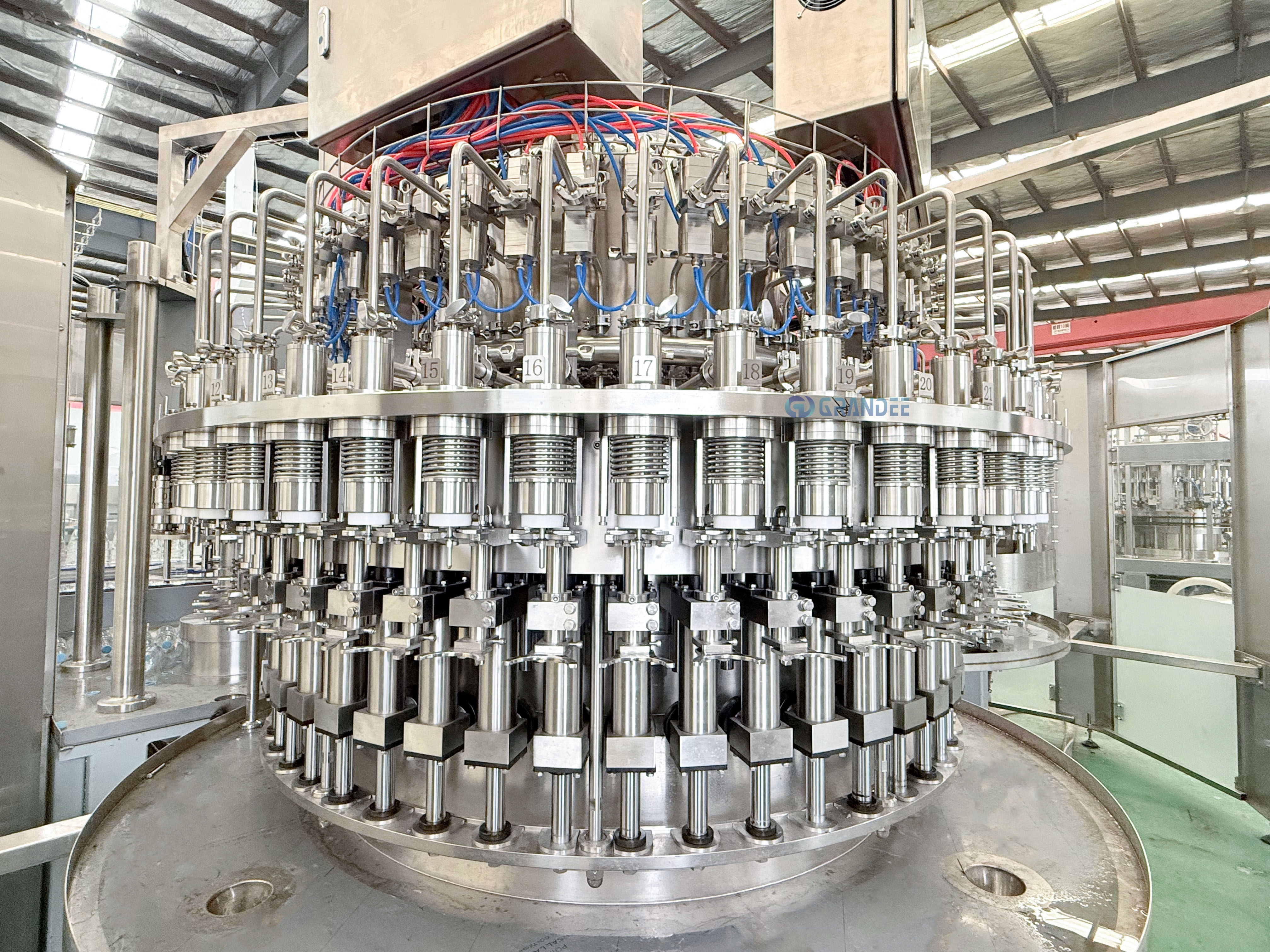
3-in-1 bottled water filling machine (rinse-fill-cap) — 220–2,000 ml — 2,000–32,000 BPH (500 ml basis) — 304 / 316L
Big-bottle water filling machine (washing-filling-capping) — 3–20 L — 500–4,000 BPH — 304 / 316L
5-gallon barrel water filling line (barrel washing-filling-capping, optional ozone disinfection) — 18.9–20 L — 150–1,500 BPH — 304 / 316L
Rotary blow-fill-cap (monoblock) filling machine (integrated blowing-filling-capping) — large-scale PET — 12,000–36,000 BPH — 304 / 316L
This structure means a customer targeting the small end of the market (220 ml retail bottles) and a customer targeting the large end (20 L barrels) are both served by purpose-designed equipment rather than a single compromise machine — while all lines share the same underlying engineering standards.
Engineering Standards That Address Core Industry Pain Points
Water bottling operations share a recurring set of pain points: production inefficiency from manual filling, product contamination risks, and rising energy and labor costs. Grandee Machine's water filling equipment is engineered directly against these issues:
- Liquid contact parts are available in 304 or 316L stainless steel — 304 as the standard build for still water, and 316L where higher corrosion resistance is required, such as flavored water, acidic products or CIP-heavy operation.
- PLC/HMI touch-screen control centralizes operation and monitoring, reducing dependence on manual intervention.
- ISO Class 6 cleanroom compliance limits contamination exposure during filling.
- High-precision electronic volumetric filling valves maintain consistent fill volumes across bottle sizes.
Complete-Line Integration Instead of Standalone Equipment
Water filling machines are rarely supplied in isolation. A water line can be assembled under one turnkey EPC contract — water treatment, bottle blowing, filling, capping, robotic palletizing and automated CIP (Clean-In-Place) cleaning, together with bottle design, factory layout, paperless 3D factory design, installation and operator training. A plant running both small and large formats therefore keeps one engineering standard and one accountable partner instead of coordinating vendors stage by stage.
Demonstrated Performance in Real Deployments
Deployments sit at both ends of the range. At the small-format end, a 3-in-1 water line in Africa runs at 6,000 BPH in 500 ml format. At the large-format end, a bottled water factory in South America runs a 900 BPH 5-gallon drinking water filling machine, supplied and installed by Grandee Machine on a turnkey basis — a reference project inside the 5-gallon line's 150–1,500 BPH range.
Certification and Global Reach
Grandee Machine's water filling machines carry CE and CQC (China Quality Certification Center) certifications, with certificate details available on request. The company brings more than 20 years of export experience and a standardized production workshop exceeding 20,000 m², with business coverage spanning Europe, South America, Africa, Southeast Asia, and Central Asia.
Choosing Equipment That Matches the Full Bottle-Size Spectrum
For businesses evaluating a water filling machine capable of handling everything from small retail bottles up to 20 L containers, the practical question is whether one supplier's equipment can genuinely cover that spectrum without sacrificing performance at either end. Grandee Machine's segmented lineup — the 3-in-1 bottled water filling machine for 220–2,000 ml formats, the big-bottle water filling machine for 3–20 L containers, and the 5-gallon barrel water filling line for 18.9–20 L barrels — is structured to answer that question directly, backed by shared engineering standards in materials, control systems, and cleanroom compliance.
Combined with the option to bundle filling equipment into a complete turnkey EPC line — including water treatment, bottle blowing, capping, CIP cleaning, and palletizing — Grandee Machine positions its water filling machines not simply as standalone units but as one component of a fully coordinated bottled water production system, supported by a documented deployment history, along with CE certification and CQC (China Quality Certification Center) certification.
Questions Buyers Ask
What bottle sizes does the water filling line cover?
The 3-in-1 bottled water filling machine covers 220 ml to 2,000 ml PET bottles, running 2,000 to 32,000 BPH on a 500 ml basis. The big-bottle water filling machine covers 3 L to 20 L — 3 L, 5 L, 10 L, 15 L and 20 L — in a single integrated washing-filling-capping system. The 5-gallon line covers 18.9–20 L barrels, including recycled ones.
Which line should a plant choose for 20 L?
It depends on the container, not the size — bottles are filled as they arrive, while recycled barrels need the barrel washing stage that the 5-gallon line carries.
How much floor space does each format need?
Floor space tracks capacity rather than bottle size. A 2,000–6,000 BPH straight-line configuration typically occupies about (8–12 m) × (3–4 m) with minimal auxiliary equipment; 8,000–12,000 BPH with labeling and shrink wrapping runs about (12–18 m) × (4–5 m); a 12,000–18,000 BPH U-shaped layout needs about (15–20 m) × (6–8 m); and a 20,000 BPH line including automatic palletizing and stretch wrapping needs about (20–30 m) × (6–10 m).
How long does changeover between bottle sizes take?
On the big-bottle machine, only the star wheel and timing screw plates are replaced and the guide rails adjusted; the filling valves are height-adjustable and preset parameters for each size are stored in the PLC for one-touch recall. An experienced operator typically completes the change in 20 to 30 minutes. On the 3-in-1 machine, switching between formats such as 220 ml and 2 L usually requires changing the filling nozzles, grippers and star wheels, and a quick-change tooling kit is provided.
Can one site run small and large formats from the same supplier?
Yes — that is the design intent of the lineup. Both ends share the same engineering basis: 304 or 316L stainless steel liquid contact parts, PLC/HMI touch-screen control, ISO Class 6 cleanroom compliance on the filling machines, and delivery under one turnkey EPC contract rather than through separate vendors.
How fast does a small-bottle water line run, and how many operators does it need?
Speed depends on the filling-head configuration rather than the bottle size. On a 500 ml basis, the 3-in-1 line covers roughly 2,000–5,000 BPH at entry level, 8,000–12,000 BPH in the most common mid-range configuration, and 18,000–24,000 BPH on high-speed industrial lines, with total installed power of about 4–6 kW, 8–12 kW and 18–25 kW respectively. Intermediate outputs follow the same logic — a 6,000 BPH line corresponds to an 18-head configuration (18 rinse / 18 fill / 6 cap), which typically runs at 5,000–7,000 BPH. In normal operation a complete line — including blow molding, labeling, shrink wrapping and palletizing — needs 2–3 operators per shift plus one maintenance technician on standby, and running at 85–90% of maximum speed is the recommended practice for 24/7 operation.
https://www.grandeemachine.com/
Zhangjiagang Grandee Machinery Co., Ltd.

+ There are no comments
Add yours