
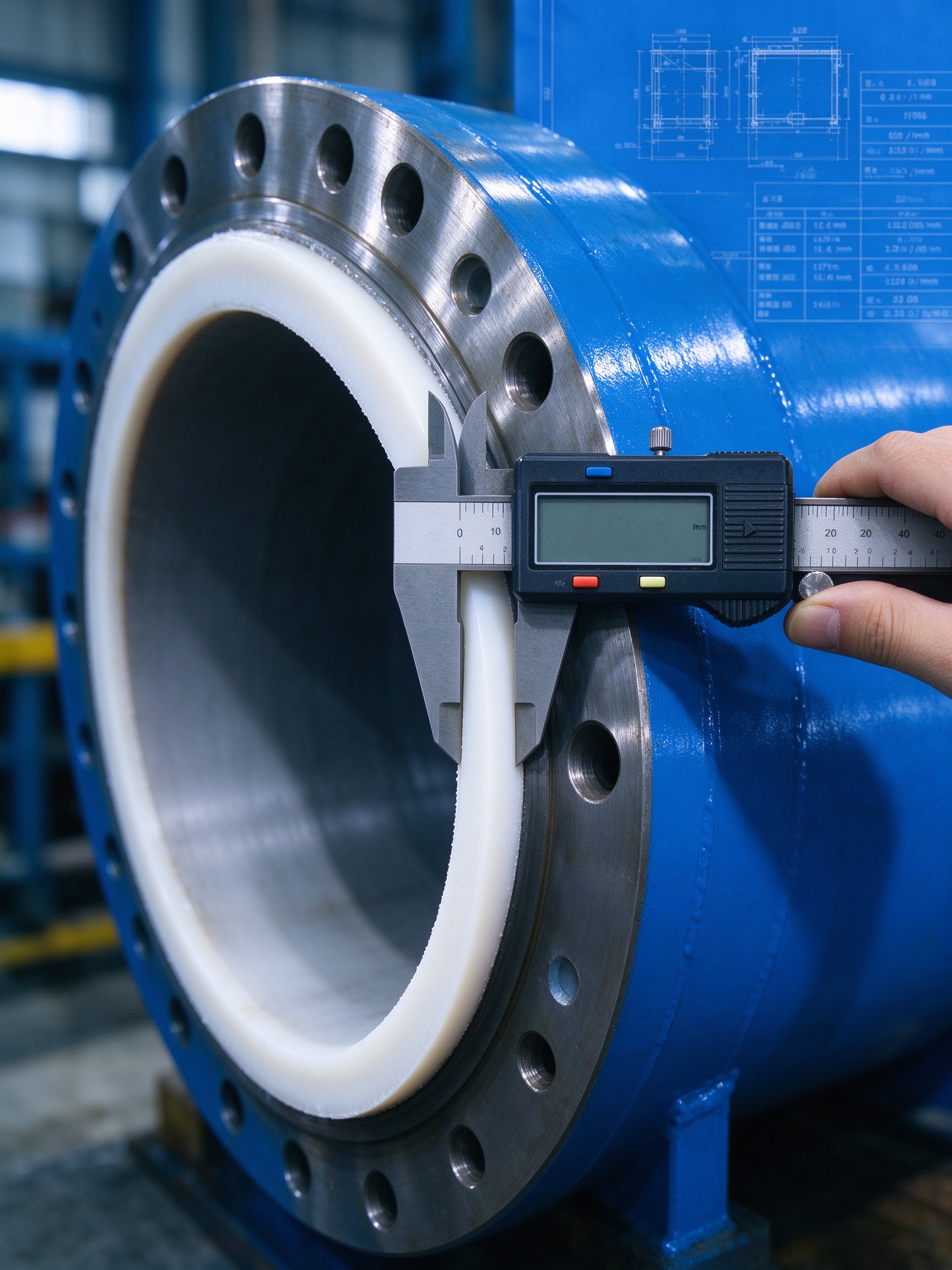
A lined pipe data sheet usually gives you a size range, one pressure class and a temperature limit — then leaves the hard part to you: how thick the liner is at DN80, what the rating becomes at 130 °C, and whether DN400 is a catalog item or a project. This reference consolidates PFA lined pipe specifications DN15 to DN500 pressure temperature information into a single working matrix, using standard production data from DANPORE (Bengbu Danpore New Material Technology Co., Ltd.), a cleanroom-based manufacturer supplying semiconductor, pharmaceutical and chemical projects. Values reflect standard builds — always confirm project-specific numbers against the manufacturer's signed data sheet before releasing drawings.
Published: November 2026 | By DANPORE Engineering Team
1. The DN15-DN500 Matrix: Size, Liner Thickness and Pressure Class
Read PFA lined pipe specifications DN15 to DN500 pressure temperature as one linked system, not three separate columns: liner thickness follows diameter and duty, pressure class follows flange standard, and temperature narrows both. Here is the standard matrix, in the order a designer needs it:
DN15 / ½" · 3 mm liner · PN10 · ANSI 150 drilling · 1.0 MPa @ 20 °C
DN20 / ¾" · 3 mm · PN10 · ANSI 150 · 1.0 MPa
DN25 / 1" · 3 mm · PN10 · ANSI 150 · 1.0 MPa
DN32 / 1¼" · 3 mm · PN10 · ANSI 150 · 1.0 MPa
DN40 / 1½" · 3 mm · PN10 · ANSI 150 · 1.0 MPa
DN50 / 2" · 3 mm · PN10 · ANSI 150 · 1.0 MPa
DN65 / 2½" · 4 mm · PN10 · ANSI 150 · 1.0 MPa
DN80 / 3" · 4 mm · PN10 · ANSI 150 · 1.0 MPa
DN100 / 4" · 4 mm · PN10 · ANSI 150 · 1.0 MPa
Three things about that block matter more than the numbers themselves. First, liner thickness steps from 3 mm to 4 mm at DN65 in standard builds; hot acid, vacuum and slurry duty move the whole line up to 5 mm regardless of size. Second, the 1.0 MPa figure is a room-temperature rating — see section 2 for what happens at temperature. Third, DN125 through DN500 are not catalog items: they are engineered to order, with the same liner system and documentation.
• Extended range, built to order: DN125 / 5" · 5 mm · PN10 · 1.0 MPa
DN150 / 6" · 5 mm · PN10 · 1.0 MPa
DN200 / 8" · 5 mm · PN10 · 0.8 MPa
DN250 / 10" · 5 mm · PN10 · 0.8 MPa
DN300 / 12" · 5 mm · PN10 · 0.8 MPa
DN400 / 16" · 5 mm · PN10 · 0.6 MPa
DN500 / 20" · 5 mm · PN10 · 0.6 MPa
Note the derating already visible in the last rows: as bore grows, the steel shell and flange face carry more bending load, so published ratings step down. If your process needs 1.0 MPa at DN300, that is a conversation with the factory, not a line item on a catalog page.
✅ Bottom line: Specify diameter, liner thickness and pressure class as one line of your data sheet — suppliers who quote them separately are inviting a mismatch at installation.
2. PFA Lined Pipe Pressure Rating: PN10 vs PN16 vs ANSI 150
The PFA lined pipe pressure rating PN10 PN16 ANSI 150 comparison most data sheets skip is that the three numbers are not equivalents: PN10 is 1.0 MPa, PN16 is 1.6 MPa, and ANSI 150's 285 psi applies to the flange, not to the lined assembly behind it. Work through the comparison properly:
• PN10 (1.0 MPa). The default for lined steel pipe and the rating most catalogs publish. Adequate for virtually all chemical delivery loops, which run below 0.6 MPa in practice.
• PN16 (1.6 MPa). Available on request and worth specifying where the piping sits downstream of a pump with a high shut-off head. The flange can take it; the liner bond and the valve diaphragm are what you should be asking about.
• ANSI 150 (Class 150). A flange-drilling standard more than a pressure promise: 285 psi at ambient, with the same gradual derating with temperature. If your project is US-based, specify ANSI 150 drilling and let the manufacturer confirm the lined-assembly rating separately.
• Temperature derating is the number that bites. The liner is rated -20 to 150 °C continuous, but allowable pressure falls as temperature climbs: expect roughly 70% of the 20 °C rating at 120 °C and around 60% at 150 °C. Ask for the pressure-temperature curve in writing — a data sheet that lists only "1.0 MPa" is telling you half the story.
• Test and verification figures. Standard builds are hydrostatically tested at 1.5× design pressure, and every component carries a 100% spark (holiday) test at 15-25 kV. Vacuum duty is quoted separately, as full vacuum (-0.09 MPa gauge) with the anchored liner construction.
✅ Bottom line: Write the rating as "1.0 MPa at 20 °C, derated per curve to 150 °C" — one phrase that prevents most specification disputes later.
3. Standard and Custom Sizes: What Ships from Stock and What Gets Engineered
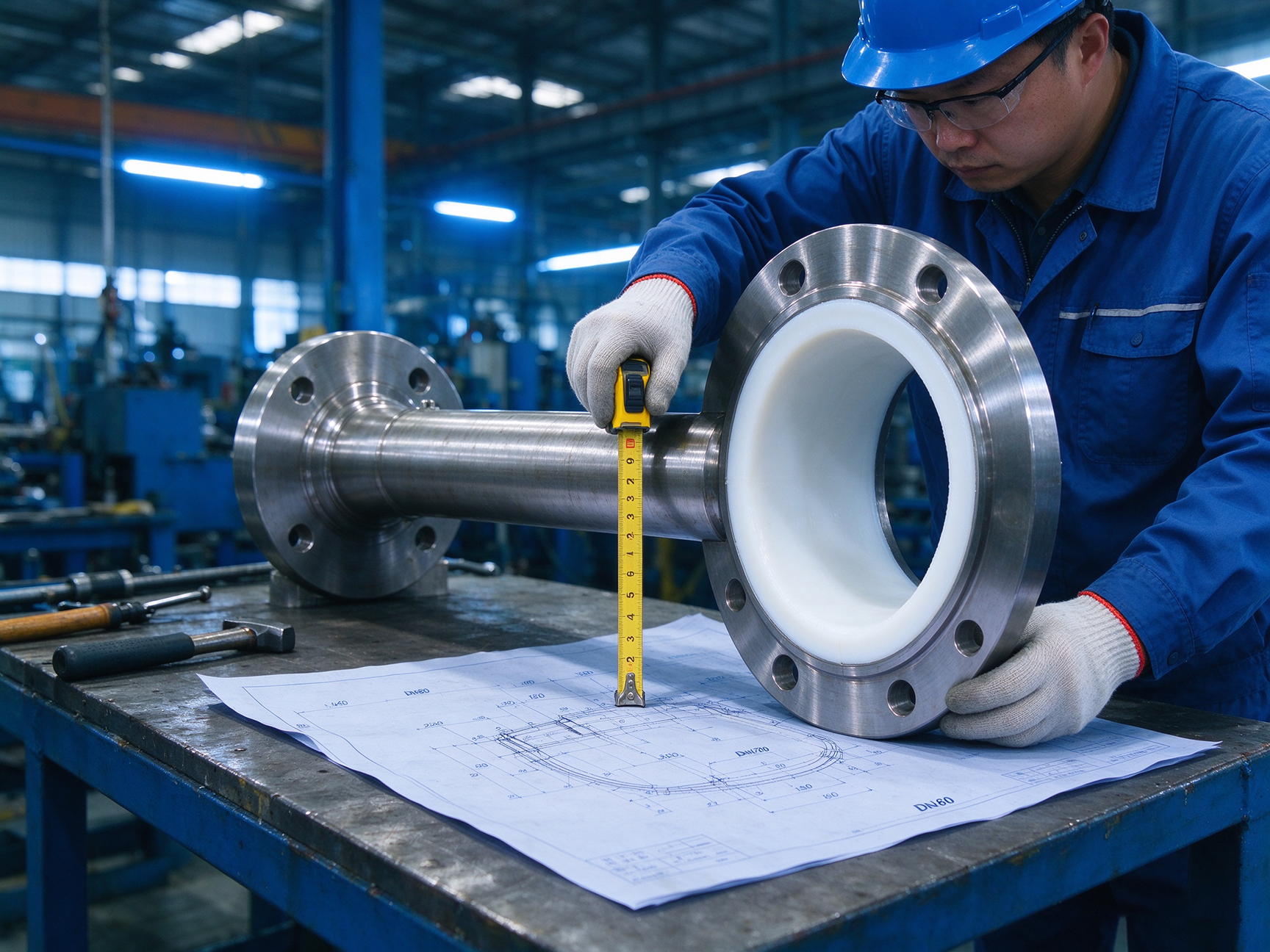
The standard and custom sizes of steel backed PFA lined pipe break cleanly in two: DN15-DN100 in standard spool lengths ready for assembly, and DN125-DN500 plus every non-standard length, flange drilling or facing engineered to your drawing. What that means in practice:
• Standard spools. Supplied in common lengths with ASME B16.5 Class 150, DIN EN 1092-1 PN10/PN16 or JIS 10K drilling; fittings (90°/45° elbows, tees, reducers) matched to the same matrix.
• Custom, without drama. Non-standard face-to-face lengths, custom flange drilling, RTJ or special facings, and DN125-DN500 bores are routine OEM/ODM work for a factory that molds its own liners — not exceptions to be negotiated.
• Tolerances and documentation. Dimensional inspection reports, mill test certificates for the shell, virgin-resin certificates and spark-test records travel with every shipment. For semiconductor duty, add ion extractables reporting against your G4-G5 limits.
• Lead time. Standard sizes typically ship in 2-3 weeks; custom DN sizes run about 4 weeks from drawing approval at DANPORE — the constraint is molding and cleanroom packing time, not steel availability.
✅ Bottom line: Treat DN125 and above as engineered items from day one — put them on the drawing schedule early instead of discovering the lead time at procurement.
Frequently Asked Questions
Q: What is the maximum service temperature of PFA lined pipe?
A: 150 °C continuous, with the liner rated from -20 °C. Above that, permeation and bond stress rise quickly — a 160 °C excursion is survivable but should not appear in a design basis. Where the process runs hotter, that is the point at which alloy piping replaces lined steel.
Q: What pressure can a PN16 PFA lined valve handle at 100 °C?
A: The flange class is not the answer — a PFA lined pipe pressure rating PN10 PN16 ANSI 150 comparison describes flange classes, not lined assemblies. A PN16 body is 1.6 MPa at 20 °C and roughly 1.3-1.4 MPa at 100 °C after derating, but most lined diaphragm valves are limited to 1.0 MPa by the diaphragm and liner, not the shell. Request the valve's own pressure-temperature curve and rate the assembly to the lowest component.
Q: Can I get DN400 or non-standard lengths in the same liner system?
A: Yes. DANPORE engineers standard and custom sizes of steel backed PFA lined pipe from DN15 to DN500 with identical liner construction, 3-5 mm thickness by duty and the same test regime, so an oversized run does not force you into a different quality tier. Send the drawing and the operating data for a firm lead time.
Get the Specification Pack
Ask DANPORE for the current specification pack: PFA lined pipe specifications DN15 to DN500 pressure temperature consolidated in one document — liner thickness by size, the pressure-temperature curve for PN10 and PN16 builds, flange drilling options, test certificates and typical lead times. Send your line list or drawing with media, temperature and pressure, and the engineering team returns a marked-up specification within 48 hours — factory-direct, with custom sizes quoted on the same document. See the ultra-pure PFA lined valve range or browse the full product catalog.
www.danporepfa.com
DANPORE PERFORMANCE MATERIAL APPLICATION CO., LTD.

+ There are no comments
Add yours