
Children's luggage is becoming an increasingly important category for travel brands and luggage retailers. As family travel continues to create demand for more specialized products, businesses are looking for suitcases that combine attractive designs with practical features, reliable construction, and child-friendly functionality.
However, developing luggage for children involves more than making an adult suitcase smaller. Product dimensions, overall weight, wheel performance, handle design, storage arrangements, and material selection all influence how easily children can use a suitcase during everyday travel.
For brands planning to expand their luggage collections, customization offers an opportunity to develop products that meet specific market requirements while creating a recognizable brand identity. The key is to approach product development from both the user's perspective and the manufacturer's perspective.
1. Start With the Target Age Group and Travel Scenarios
One of the first decisions in developing children's luggage is identifying who will use the product.
A suitcase designed for preschool children has different requirements from one intended for primary school students. Younger children generally need a compact and lightweight design that is easy to pull or carry. Older children may need additional storage capacity for clothing, books, electronic accessories, and personal belongings.
The intended travel scenario also affects product design. A suitcase used mainly for short family trips may require a different internal layout from one designed for longer holidays or frequent air travel.
Before finalizing the design, brands should establish:
-
The target age range and expected user height.
-
The intended travel duration and usage frequency.
-
The required external dimensions and storage capacity.
-
The preferred carrying and pulling methods.
-
Whether the product will be sold individually or as part of a luggage set.
Defining these requirements early helps manufacturers determine appropriate dimensions, structural specifications, and functional components.
2. Choose Materials That Balance Weight and Durability
Material selection has a direct impact on suitcase weight, impact resistance, appearance, and overall service life.
ABS and polycarbonate are commonly used in hard-shell luggage manufacturing. Each material has different characteristics, and the appropriate choice depends on the product's intended positioning and construction requirements.
ABS is suitable for molded luggage shells and supports various colors and surface finishes. Polycarbonate is valued for its impact performance and flexibility. ABS+PC materials combine the characteristics of both materials, although the final performance depends on their actual composition, proportions, and manufacturing process.
For brands considering custom ABS+PC luggage, it is important not to judge material quality by the material name alone.
Buyers should pay attention to several practical details:
Shell thickness: The thickness should be appropriate for the suitcase size and expected usage conditions.
Impact resistance: Corners, edges, and other stress points should be evaluated through representative testing.
Finished product weight: The suitcase should remain manageable for its intended age group.
Surface finish: The coating or texture should maintain an acceptable appearance after repeated handling.
Structural assembly: The shell, frame, handles, wheels, and connecting components should work together as a stable structure.
Requesting and evaluating finished samples is more reliable than making purchasing decisions based only on raw-material descriptions.
3. Develop a Design That Appeals to Both Children and Parents
Appearance is an important selling point in the children's luggage market. Bright colors, playful patterns, attractive textures, and recognizable themes can help products stand out in retail displays and online stores.
For travel brands, custom design also provides an opportunity to establish a consistent visual identity.
Customization options may include:
-
Shell colors and surface textures.
-
Printed patterns and decorative graphics.
-
Brand logos and customized labels.
-
Zipper colors and interior lining.
-
Handle details and accessory combinations.
-
Retail packaging and product presentation.
A useful approach is to develop a coordinated collection rather than focusing on a single design. Different suitcase sizes can share the same color scheme or visual theme, allowing brands to create matching products for different age groups and travel needs.
However, appearance should not come at the expense of practicality. Parents are likely to pay attention to cleaning convenience, durability, storage capacity, and ease of operation. A successful children's suitcase should balance visual appeal with everyday usability.
4. Pay Attention to Wheels and Telescopic Handles
Wheels and handles have a significant influence on the overall user experience. Even a well-designed suitcase can become inconvenient if it is difficult to pull, unstable when extended, or uncomfortable to carry.
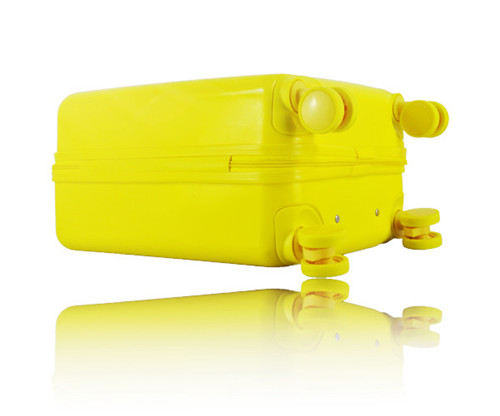
Four-wheel spinner systems are commonly used in modern luggage because they allow movement in multiple directions. This can be useful in airports, hotel corridors, shopping centers, and other crowded environments.
When evaluating wheel assemblies, buyers should check:
-
Whether the wheels rotate smoothly in different directions.
-
Whether they remain securely attached to the suitcase.
-
Whether the suitcase moves consistently on common indoor surfaces.
-
Whether the wheel structure can withstand repeated use.
-
Whether the wheels produce excessive noise during movement.
The telescopic handle also requires careful inspection. It should extend and retract smoothly, remain stable at different positions, and provide a comfortable grip for the intended user.
Carrying handles and their attachment points should be checked as well. Children may lift their luggage when entering vehicles, boarding transportation, or moving through areas where rolling is inconvenient.
For customized luggage projects, these components should be evaluated during sample approval rather than left until mass production.
5. Make Interior Storage Simple and Functional
Children often carry a mixture of clothing, toys, books, snacks, and personal travel accessories. An organized interior makes packing easier and helps prevent smaller items from becoming mixed together.
A practical interior layout may include:
-
Zippered compartments for smaller belongings.
-
Cross straps to keep clothing in position.
-
Separate storage sections for different item types.
-
Durable lining materials that are easy to maintain.
-
Smooth-operating zippers that do not catch on the lining.
The internal structure should be designed according to the suitcase's capacity and intended use. A compact case for weekend trips may only require a simple compartment arrangement, while a larger suitcase may benefit from additional dividers.
Brands should also check stitching quality, zipper alignment, and the attachment strength of internal straps. These details may seem minor, but they can influence customer satisfaction after repeated use.
6. Consider Safety and Quality During Product Development
Because children's luggage is intended for younger users, safety should be considered throughout the design and manufacturing process.
Potential issues include sharp edges, pinch points around moving components, small detachable parts, and unsuitable materials. Buyers should identify the relevant safety and material compliance requirements for their destination markets.
Locks and other accessories should also be designed with ease of operation in mind. If a combination lock is included, its mechanism should function consistently and be understandable to the intended user or supervising adult.
A practical quality-control process should cover more than visual inspection. Depending on the product specification, manufacturers and buyers may evaluate:
-
Shell appearance and structural integrity.
-
Wheel rotation and attachment strength.
-
Telescopic handle extension and stability.
-
Zipper operation and stitching quality.
-
Carrying handle strength.
-
Lock operation, where applicable.
-
Packaging condition and product identification.
Testing requirements should be established before production begins. This allows the manufacturer to evaluate samples against agreed criteria and reduces the risk of inconsistencies in bulk orders.
7. Build a Product Collection Through Flexible Customization
For luggage brands, a well-planned product range can serve different customer needs without creating an inconsistent brand image.
For example, a children's collection may include compact suitcases for short trips, medium-sized cases for family holidays, and larger models for extended travel. Adult and children's luggage can also share similar colors, patterns, or branding elements to create coordinated family travel collections.
Before placing a customized order, buyers should confirm the following specifications:
| Development Item | Details to Confirm |
|---|---|
| Target users | Age range and intended travel scenarios |
| Product dimensions | External size and internal capacity |
| Materials | Shell composition, thickness, and finish |
| Appearance | Colors, patterns, logo, and decorative details |
| Moving components | Wheel configuration and telescopic handle |
| Interior structure | Compartments, lining, zippers, and packing straps |
| Accessories | Locks, handles, and other functional components |
| Packaging | Labels, cartons, and customized packaging |
| Quality control | Sample approval and inspection requirements |
A clear specification sheet is essential for communication between the brand and manufacturer. It provides a common reference during sampling, production, and final inspection.
8. Choose a Manufacturer With Custom Development Capabilities
Finding a suitable manufacturing partner is an important part of developing custom children's luggage. Production capacity alone is not enough. Brands should also consider the supplier's experience in product development, material sourcing, mold development, quality control, and export coordination.
Zhengchi is based in Jiaxing, Zhejiang, China, and supplies luggage products to customers in the United States, Europe, and the Middle East. Its product range includes both children's and adult luggage.
The company has a dedicated sourcing team, as well as research and development and mold departments. These capabilities support customers who need to explore different product specifications, refine structural details, or develop customized luggage collections.
Its location near Shanghai Port can also support export logistics planning, depending on the order requirements and destination.
When evaluating a potential supplier, buyers should request representative product samples, review customization options, and clarify the quality-control process. It is also important to establish responsibilities for material verification, sample approval, product testing, packaging, and pre-shipment inspection.
A manufacturer that understands both product functionality and brand requirements can make the development process more efficient and help reduce unnecessary revisions.
Conclusion
Developing successful children's luggage requires a balance between appearance, usability, durability, and manufacturing quality. Brands should begin with the needs of their target users, select appropriate shell materials, and pay close attention to wheels, handles, interior organization, and safety considerations.
Customization provides additional opportunities to create differentiated products and build coordinated luggage collections. However, successful projects depend on clear specifications, careful sample evaluation, and consistent quality control.
For travel brands and distributors looking to expand their children's luggage ranges, working with an experienced manufacturer such as Zhengchi can provide access to product development, customization, and manufacturing support for different market requirements.
www.jxzcfactory.com
Jiaxing Zhengchi Trading Co. Ltd.

+ There are no comments
Add yours