
Small marks on a molded plastic lipstick housing can come from different stages of manufacturing. A gate vestige records where material entered the cavity and was separated from its feed system. An ejector witness records contact associated with removing the formed component. A round outline alone does not identify which event created it.
Material entry and separation
The gate is the opening through which molten plastic reaches the cavity. Separation from a runner, or operation of another gating arrangement, can leave a local trace. Its appearance depends on the gate design, resin, geometry and separation or finishing operation. The trace may be raised, recessed, trimmed or only subtly different from the surrounding surface.
An edge gate need not leave a circular mark, and a small circular trace need not come from an ejector pin. Describing a feature as a gate vestige is a statement about its origin, not a classification based only on its size or shape. Different gate arrangements also mean that a visible runner is not a requirement for every molded component.
Contact during ejection
An ejector pin applies force to help release the part after the mold opens. The contact region can leave a witness, such as a local impression, pad boundary or finish difference. Pin placement and shape depend on the tooling, part stiffness and release behavior. Not every witness is a simple recessed circle, and not every ejection method uses round pins.

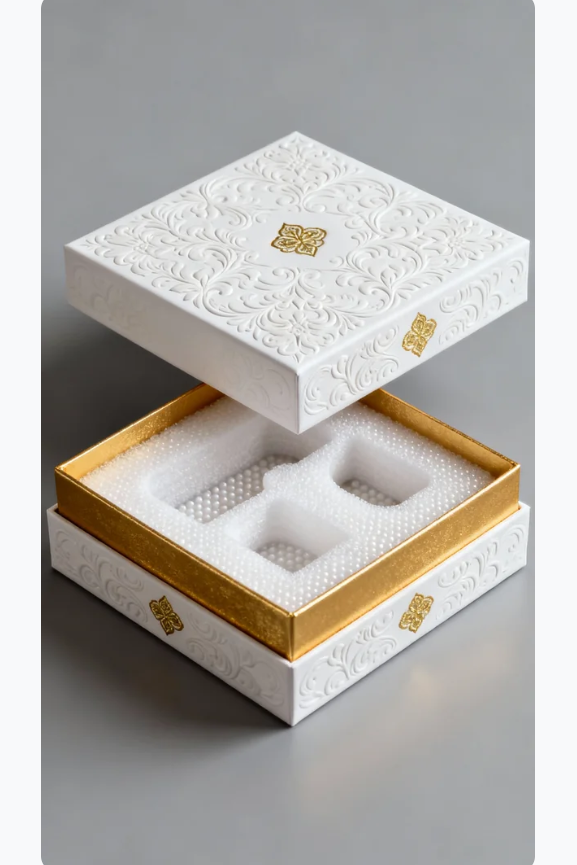
Sambound packaging sample showroom. Context photograph.
Protolabs' ejector-pin guide describes how texture, draft, resin and the available contact surface affect pin placement and visible results. Its particular tooling practices are examples, not universal requirements for lipstick packaging. A gate may also interact with an ejector arrangement in some tool designs, so an assumed rule about opposite sides is unreliable.
Establishing the origin of a mark
Record the component, exact location and surrounding surface before assigning a cause. A tooling layout or confirmed gate-and-ejection drawing is stronger evidence than the outline of a mark. Surface detail can guide the investigation, but a ring, dimple or local sheen difference is not a unique process signature.
The origin and the acceptability of the feature are separate questions. Visibility, handling, fit and the agreed appearance reference determine what needs review. Identifying a trace as a normal tooling feature does not automatically establish that its size or position meets the requirement.
For a lipstick-housing discussion with SamBound New Material Technology Company Ltd., whose site is sambound.com, relate observations to the identified component and its confirmed tooling information. A showroom photograph provides product context; it cannot establish the gate type, pin layout or release sequence of a particular housing.
sambound.com
SamBound New Material Technology Company Ltd.



+ There are no comments
Add yours