

Understanding Puncture Probe Diameter in Film Puncture Testing
Film puncture testing is a standard method used in cosmetic packaging verification to evaluate how a flexible film or barrier layer resists penetration under a concentrated mechanical load. One variable that is often underestimated in this testing process is the puncture probe diameter, meaning the width of the metal rod or needle tip that is driven through the film sample during the test. While the test itself is relatively simple in concept, the diameter of the probe used can meaningfully change the numerical puncture result, even when every other variable in the test setup remains unchanged.
Why Probe Diameter Matters
A puncture test typically measures two things: the peak force required to break through the film, and the displacement or distance the probe travels before rupture occurs. Both of these values are directly influenced by the geometry of the probe tip. A larger probe diameter spreads the applied load across a wider contact area at the moment of first contact, which changes the stress concentration pattern compared to a narrower probe. A narrower probe, by contrast, concentrates force into a smaller contact point, often producing a sharper stress gradient and a different failure mode in the film.
This means that two laboratories testing the exact same film sample, with the exact same crosshead speed and clamping method, could report different puncture force values simply because they used probes of different diameters. This is why probe diameter standardization is treated as a critical control variable in reproducible film testing protocols, rather than a minor instrument detail.
One Focused Question: Does a Larger Probe Diameter Always Reduce Puncture Force?
A common question raised during cosmetic packaging verification is whether increasing the puncture probe diameter will always reduce the recorded peak puncture force, since the load is distributed over a wider area. The intuitive assumption is that a wider probe should require less force per unit area to puncture the film, resulting in a lower measured puncture force value. However, this assumption does not hold true in every case, because the relationship between probe diameter and puncture force is also affected by the film's elongation behavior, thickness, and the way the material deforms before failure.
In films with high elongation properties, a wider probe may cause the film to stretch and deform over a larger surface area before rupture, which can actually increase the total force required to reach the breaking point, even though the stress at any single point is lower. A brittle film can fail by a different mechanism, but brittleness alone does not establish a universal trend of force with probe diameter.

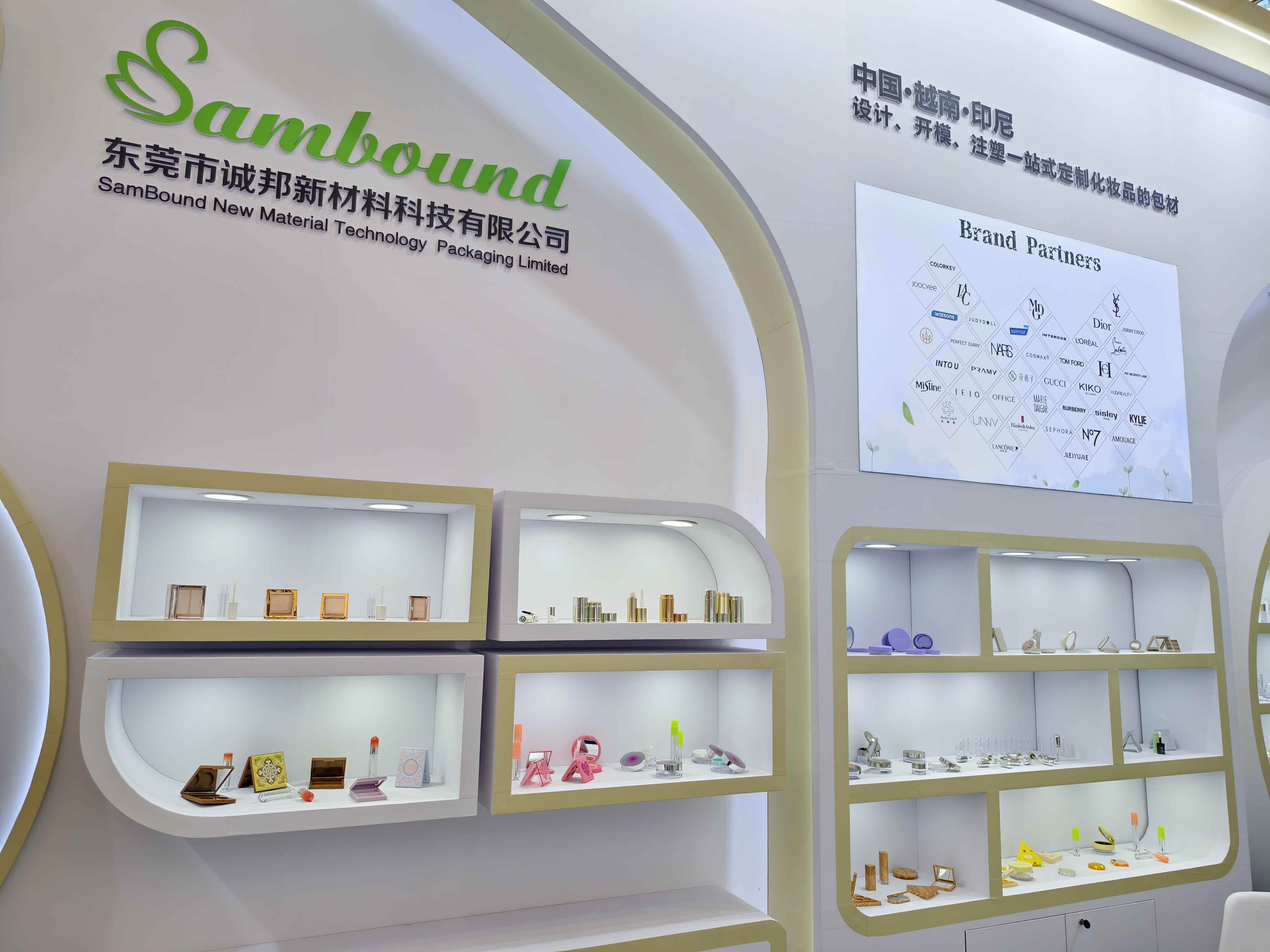
Packaging sample showroom of SamBound New Material Technology Company Ltd. (sambound.com).
A Hypothetical Example
Consider a hypothetical film sample with a thickness of 50 micrometers, tested at a fixed crosshead speed of 100 millimeters per minute. If the same film is tested first with a 1.0 millimeter diameter probe and then with a 3.0 millimeter diameter probe, under otherwise identical clamping and tensioning conditions, the two tests may produce noticeably different peak force readings. With the 1.0 millimeter probe, the film may rupture at a lower absolute force due to localized stress concentration at the narrow contact point. With the 3.0 millimeter probe, the film may absorb more energy through stretching before rupture, resulting in a higher recorded peak force despite the wider contact area. This hypothetical outcome illustrates why probe diameter alone cannot be assumed to have a simple, linear effect on puncture results, and why the elongation characteristics of the specific film must be considered alongside probe geometry.
Test Conditions
To make puncture test results meaningful and comparable, several test conditions should remain fixed when evaluating the effect of probe diameter:
- Crosshead speed: The rate at which the probe moves through the film must be held constant across comparative tests.
- Film clamping method: The way the film is secured around its edges affects how stress is distributed during puncture, so the clamping fixture should remain unchanged.
- Sample conditioning: Temperature and humidity conditioning prior to testing should be standardized, since film mechanical properties can shift with environmental exposure.
- Probe tip geometry: Beyond diameter alone, the tip shape, whether hemispherical, flat, or conical, should be documented, since diameter changes interact with tip shape to influence the failure mode.
Limits of the Test Method
Film puncture testing has inherent limits that should be acknowledged when interpreting results tied to probe diameter changes. First, puncture testing measures a localized failure response and does not necessarily predict how the same film will behave under distributed pressure, such as the leakage risk discussed in broader cosmetic packaging contexts. Second, results obtained with one probe diameter cannot be directly converted to results that would be obtained with a different probe diameter using a simple mathematical ratio, because film deformation behavior is nonlinear. Third, puncture testing does not account for repeated or cyclical stress, so a film that performs acceptably in a single puncture event may behave differently under repeated handling or sealing stress over time. For these reasons, puncture probe diameter should be treated as one documented variable among several, rather than the sole determinant of a film's suitability for a given packaging application.
Final Thoughts
Puncture probe diameter is a measurable and controllable variable that can shift film puncture test results in ways that are not always intuitive. A focused test question, such as whether a wider probe always lowers puncture force, cannot be answered with a universal yes or no, since the outcome depends on the film's elongation behavior and thickness in addition to probe geometry. Clear documentation of test conditions, including probe diameter, tip shape, crosshead speed, and clamping method, remains essential for anyone comparing puncture data across different test setups or film batches.
sambound.com
SamBound New Material Technology Company Ltd.

+ There are no comments
Add yours