

You need a reliable China LCL freight forwarder. Verify six things: licenses, financial health, warehouse operations, all-in pricing, communication, and contract protections. Gather documents, compare quotes, and test communication before booking. Start with a small test shipment before committing long-term volume.
Key Takeaways
- Check the forwarder's licenses, financial health, and warehouse before you book.
- Compare all-in quotes per cubic meter to avoid hidden fees.
- Start with a small test shipment to see if the forwarder performs well.
What Reliability Means for a China LCL Freight Forwarder in 2026
Reliability in LCL shipping goes beyond a low price. You need a partner who stays legitimate, transparent, and responsive throughout the entire shipment journey. These three pillars separate professional consolidators from risky operators.
Legitimate, Financially Stable, and Insurable
A trustworthy China LCL freight forwarder holds proper licenses and maintains strong financial standing. You should verify their business registration, NVOCC status, and insurance coverage before booking. Financially stable forwarders pay carriers on time. This protects your cargo from being held hostage by unpaid freight bills. Insurable operations mean your goods have proper coverage against loss or damage during consolidation and ocean transit.
Transparent About Consolidation and Pricing
Honest forwarders explain exactly how they consolidate your cargo with other shipments. They show you the real schedule, the actual warehouse location, and the true transit timeline. Pricing transparency matters equally. You deserve a clear all-in rate per cubic meter. This rate should include origin handling, consolidation, ocean freight, and destination charges. Hidden fees destroy trust and budgets. Ask for a written breakdown before you commit.
Responsive and Accountable in Real Time
Reliable forwarders answer your messages within hours, not days. They provide tracking access and proactive updates when exceptions occur. When delays happen, they tell you first. They also take ownership of problems instead of blaming carriers or customs. Accountability means they resolve claims quickly and fairly. You should test their response time before booking. Send a few questions and measure how fast and how thoroughly they reply.
Pre-Screen Your China LCL Freight Forwarder: Licenses and References
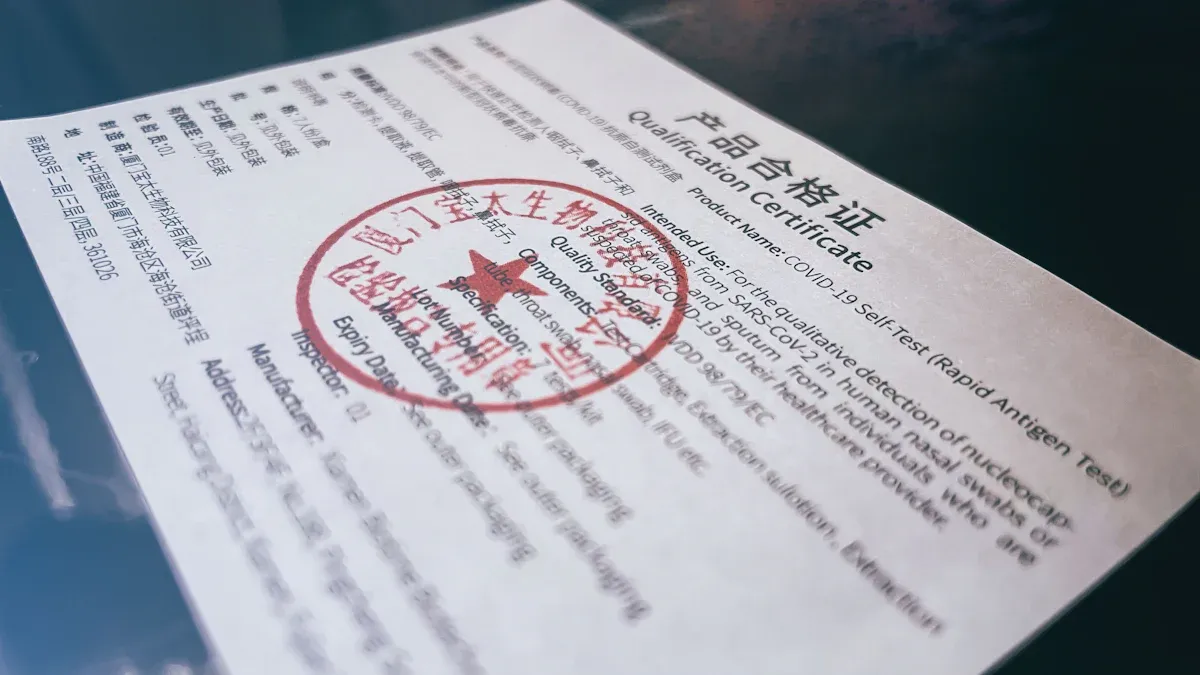
Before you send a single purchase order, you need to verify who you are actually dealing with. A polished website and a friendly sales representative mean nothing without paperwork. This section gives you a step-by-step screening process. You will check five things: the business license, the NVOCC or FMC status, bank references, trade references, and the physical office and warehouse. Each check takes minutes. Each check saves you from months of pain.
China Business License
Every legally operating company in China must hold a business license. The State Administration for Market Regulation (SAMR) issues this document through the local Administration for Market Regulation (AMR). This license authorizes the company to operate legally, hire staff, open bank accounts, issue official tax invoice (official tax invoices), sign contracts, and begin business activities. Ask your potential forwarder to send a clear scan or photo of this license. Then verify the details yourself.
The standard format of a China business license includes several key fields. You will see the company name, which follows a fixed pattern: Administrative Region + Trade Name + Business Activity + Organizational Form. You will also see an 18-digit Unified Social Credit Code. This code is the company's unique identifier in China's national credit system. Other fields include the legal representative, registered capital, business scope, registered address, entity type, establishment date, and business term. Cross-check the company name on the license against the name on your contract and the name on their bank account. All three must match. If they do not match, walk away.
A business license alone does not authorize regulated industries. Freight forwarding is a regulated industry in China. Your forwarder also needs a separate logistics or transportation permit from the relevant industry regulator. China freight forwarding services are primarily regulated by the Ministry of Transport (MOT) and local transport authorities. The freight forwarding license is obtained from the MOT or the local transport authority after the business license is issued. Ask for both documents.
Registered capital matters too. For a general WFOE incorporated under the 2023 Company Law, there is no fixed minimum registered capital. The declared capital must be realistic for the business scale and scope. It must be fully contributed within five years of registration. However, freight forwarding has sector-specific license thresholds. These are not general company-law requirements. They are minimum capital rules tied to the specific forwarding license.
| Business scope | Minimum registered capital |
|---|---|
| International maritime freight forwarding | RMB 5,000,000 |
| International air freight forwarding | RMB 3,000,000 |
| International land freight forwarding | RMB 2,000,000 |
| Each branch office engaged in international freight forwarding | Additional RMB 500,000 |
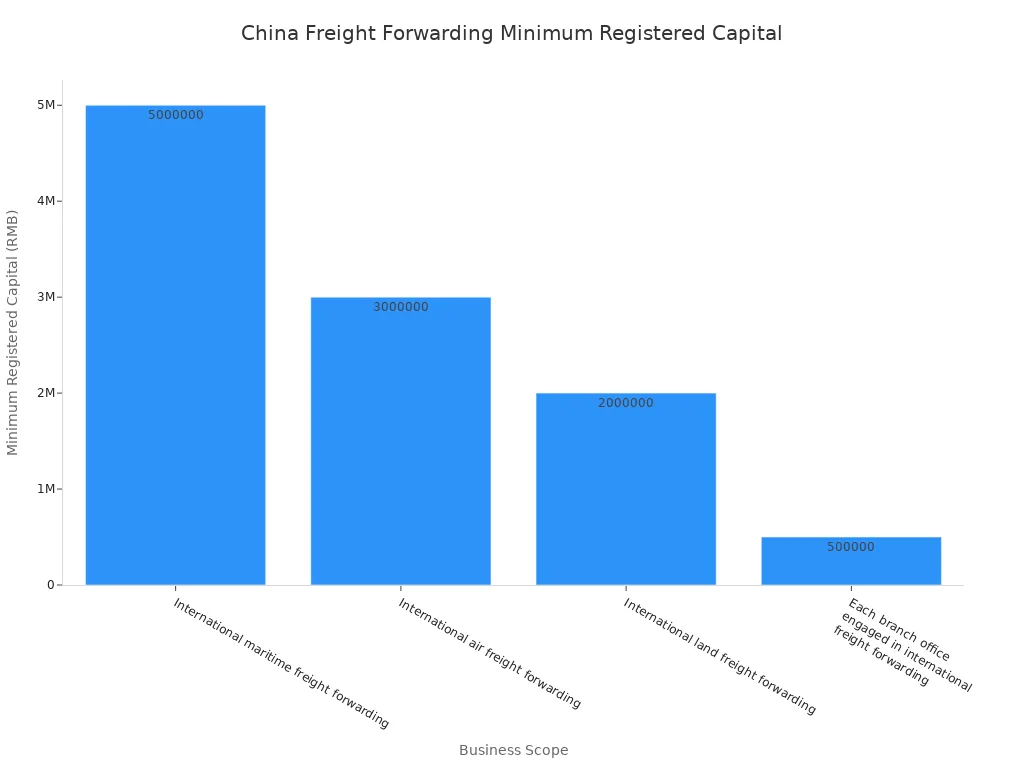
If your forwarder handles international maritime freight forwarding, they need at least RMB 5,000,000 in registered capital. If they handle air freight forwarding, the minimum is RMB 3,000,000. These numbers give you a baseline. A company with RMB 500,000 in registered capital cannot legally hold an international maritime freight forwarding license. Check the registered capital on the license against these thresholds. A mismatch is a serious red flag.
NVOCC/FMC Status (Non-Vessel Operating Common Carrier)
An NVOCC is a Non-Vessel Operating Common Carrier. This status matters enormously for LCL shipments. An NVOCC issues its own bills of lading, takes on carrier liability, and consolidates cargo from multiple shippers into a single container. Without NVOCC status, a forwarder cannot legally issue a bill of lading. Without a bill of lading, you have no legal claim to your cargo. You are just hoping your goods arrive.
China and the United States regulate NVOCC status differently. You need to understand both sides.
China NVOCC registration comes from the Ministry of Transport (MOT). This registration is required by China's Ministry of Transport. It is not available to most foreign freight forwarders in China. The standards are more stringent than a typical freight-forwarder registration. The operational right allows the holder to issue its own bills of lading and access better booking and shipping options. If your forwarder claims NVOCC status in China, ask for the MOT registration number. Verify it.
| China NVOCC registration (MOT) | Details from source |
|---|---|
| Regulatory basis | Required by China's Ministry of Transport |
| Availability | Not available to most foreign freight forwarders in China |
| Stringency | Standards are more stringent than a typical freight-forwarder registration |
| Operational right | Allows the holder to issue its own bills of lading and access better booking/shipping options |
On the U.S. side, the Federal Maritime Commission (FMC) issues Ocean Transportation Intermediary (OTI) licenses. The legal basis is the Shipping Act of 1984 (46 USC Chapter 409). An FMC NVOCC OTI license allows the holder to issue its own bills of lading, take on carrier liability, and consolidate cargo from multiple shippers into a single container. The holder must maintain a surety bond and publish tariffs.
| FMC NVOCC OTI | Details from source |
|---|---|
| Legal basis | Shipping Act of 1984 (46 USC Chapter 409) |
| Function | Issues its own bills of lading, takes on carrier liability, and consolidates cargo from multiple shippers into a single container |
| Compliance obligations | Must maintain a surety bond and publish tariffs |
The FMC offers two types of OTI licenses. Each has different bond requirements and functions.
| FMC OTI license type | Surety bond | Key requirement / function |
|---|---|---|
| Ocean Freight Forwarder (OFF) | $50,000 | Qualifying individual with at least 3 years of ocean freight experience; arranges ocean transportation on behalf of shippers |
| Non-Vessel-Operating Common Carrier (NVOCC) | $75,000 | Issues its own bills of lading; accepts responsibility for cargo |
For LCL shipments to the United States, you want an FMC NVOCC OTI license holder. The $75,000 surety bond protects you if the forwarder fails to meet its obligations. The OFF license is weaker. An OFF arranges transportation but does not issue its own bills of lading. An OFF does not accept cargo liability. For LCL, you need the stronger NVOCC status. Ask for the FMC license number. Verify it on the FMC website.
Bank References
A bank reference letter confirms that your forwarder has a real banking relationship. This letter comes from the forwarder's bank. It states that the company holds an active account in good standing. Some banks include a credit rating or a statement about the account's history. Ask your forwarder to provide a bank reference letter. Then contact the bank directly to verify the letter. Do not accept a photocopy alone. Call the bank branch listed on the letter. Ask them to confirm the account status and the company name.
Why does this matter? A forwarder with a strong bank reference can pay carriers on time. A forwarder with no bank reference or a weak one may use your freight money to cover other debts. This practice is called commingling. It puts your cargo at risk. If the forwarder fails to pay the carrier, the carrier can hold your goods. You may have to pay twice to get your cargo released. A simple bank reference check prevents this nightmare.
Trade References
Trade references are past or current customers who can vouch for the forwarder's performance. Ask for at least three references. Choose references that match your situation. If you ship LCL from China to the United States, ask for references on that same trade lane. If you ship high-value electronics, ask for references with similar cargo. Then actually call these references. Do not just send an email. A phone call reveals tone, hesitation, and unspoken concerns.
Ask specific questions. How long have you worked with this forwarder? How do they handle delays? How do they communicate? Have you ever filed a claim? How fast did they resolve it? Would you use them again? Listen for vague answers or long pauses. A happy customer will give you details. An unhappy customer will give you warnings. Both are valuable. If the forwarder refuses to provide trade references, that is a major red flag. Legitimate companies have happy customers who will speak for them.
Physical Office and Warehouse Verification
You need to confirm that your forwarder has a real physical presence in China. A virtual office or a mail-drop address is not enough. Ask for the full address of their office and their warehouse. Then verify it. You can use satellite imagery tools to see the building. You can ask for a live video call walking through the office and warehouse. You can also hire a local inspector to visit the site. This last option costs a small fee. It is worth every penny.
For warehouse verification, ask specific questions. How many square meters is the warehouse? How many loading docks does it have? What security measures protect the cargo? Is the warehouse bonded or non-bonded? Does it have fire suppression systems? How do they separate cargo from different shippers? A professional forwarder will answer these questions with pride. A risky forwarder will dodge them.
The physical presence check also reveals consolidation capability. A forwarder with a real warehouse can receive your cargo, store it safely, and load it into containers on a fixed schedule. A forwarder without a warehouse must rely on third parties. Third-party reliance adds cost, delay, and finger-pointing when problems arise. You want a forwarder who controls the warehouse. You want a forwarder who controls the consolidation. You want a China LCL freight forwarder who can show you the actual loading dock.
Once you complete these five checks, you have a shortlist of legitimate candidates. The next step is to confirm their warehousing and consolidation operations. That is where you separate the good from the great.
Confirm China Warehousing and Consolidation Operations
A reliable China LCL freight forwarder controls its warehouse and consolidation schedule. You need proof of both before you book.
Fixed Consolidation Schedules
Ask for the weekly cut-off times and sailing schedules. Professional forwarders consolidate cargo on fixed days. This consistency prevents your goods from sitting in a warehouse for weeks. You should know exactly when your cargo joins a container and when that container leaves the port.
Ports and Destinations Served
Confirm which Chinese ports your forwarder uses for consolidation. Major gateways include Shenzhen, Shanghai, Ningbo, and Qingdao. Each port serves different destination routes. You also need to verify the destination ports and inland delivery coverage. A forwarder with strong U.S. route capacity will show you direct sailing options and reliable transit times.
Warehouse Receiving Procedures
Your forwarder should inspect every carton upon arrival. They must weigh each box on a calibrated scale and measure all three sides. This step protects you from surprise charges later.
| Compliance Step | What Is Checked | Action If Non-Compliant |
|---|---|---|
| Carton gross weight | Every carton weighed on a calibrated scale | Repack to stay under 50 lbs or apply Team Lift label |
| Carton dimensions | All three sides measured | Repack if any side exceeds 25 inches (standard) |
| Team Lift / Heavy labels | Presence verified on 5 sides if over threshold | Print and apply correct labels for destination market |
| FNSKU barcodes | Each barcode scanned for readability | Reprint and reapply if damaged or unreadable |
| Box ID / Shipment labels | Matched to Amazon shipment plan | Regenerate from Seller Central if mismatched |
| Packaging integrity | Checked for double-wall cardboard and sealing quality | Reinforce or rebox weak cartons |
| Pallet labels (LTL/FTL) | Weight, height, handling labels on center and side | Add pallet-level labels before loading |
In our Zhengzhou consolidation warehouse, we treat FBA compliance as a built-in step — not an afterthought. Every carton that passes through our facility is weighed, measured, and checked for the correct labels before it is loaded into a container. This is not optional. It is part of our standard operating procedure for every Amazon-bound shipment.
Your freight forwarder should verify carton weights, generate marketplace-specific labels (Team Lift, Heavy Package, or Mech Lift), confirm box dimensions, and perform pre-shipment quality inspections — all before cargo leaves the origin country. This prevents rejections, customs delays, and costly corrections at the destination.
Cargo Loading and Safety Standards
Proper loading protects your cargo from damage during ocean transit. Your forwarder should use experienced ground handlers for vehicle loading and cargo reinforcement. They must separate shipments from different shippers clearly. They should also stack cartons according to weight and fragility. Ask about their cargo damage rate. A forwarder with a below-industry-average damage rate demonstrates real operational discipline.
Compare China LCL Freight Forwarder Quotes Without Hidden Fees
Price comparison is where most importers lose money. A quote that looks 30% cheaper often costs more by the time your cargo reaches the destination warehouse. You need to compare quotes on equal terms. That means demanding the same cost structure from every forwarder on your shortlist. This section shows you how to read a quote, spot missing charges, and lock a rate that holds.
Request All-In Rate Per CBM (Cubic Meter)
Start every conversation with one request: give me the all-in rate per CBM. This single number lets you compare forwarders side by side. The all-in rate should cover origin handling, export customs, consolidation, ocean freight, destination terminal handling, and destination CFS handling. If a forwarder cannot give you one number, ask for the full breakdown instead. Then add up the lines yourself.
An all-in rate per CBM also exposes weak quotes fast. A forwarder who quotes $45 per CBM but leaves out destination charges is not cheaper. They are incomplete. You will pay the missing charges later, often at a higher rate because you have no leverage once cargo is on the water. Demand the full cost forecast in writing. Each charge belongs on its own line. A forwarder who refuses this request is hiding something.
Hidden Fees to Name and Check
Hidden fees rarely appear on the first quote. They appear on the final invoice. Your job is to name every possible fee before you book. Then confirm in writing whether the quote includes it or excludes it. The table below lists the fees that appear most often on China LCL freight forwarding invoices.
| Hidden Fee Type | Typical Cost Range | What It Covers |
|---|---|---|
| Documentation / Bill of Lading | $50–$100 per shipment | Preparing commercial invoice, packing list, bill of lading (BOL), certificates of origin; some carriers include this, others charge separately |
| AMS / ENS / Export Filing | $25–$35 per shipment | Automated Manifest System (AMS) for USA, Entry Summary for EU, or equivalent; government-mandated filing at origin |
| Destination CFS Handling | $15–$40 per CBM (both origin and destination) | Receiving, checking, storage at the Container Freight Station; minimum $50–$150 per shipment |
| Peak Season Surcharge (PSS) | $10–$40 per CBM | Additional fee during busy seasons (Oct–Dec pre-holiday, Jan–Feb post-CNY); can double effective rate during peak |
| General Rate Increase (GRI) | $5–$20 per CBM or percentage-based | Blanket rate increase announced quarterly or semi-annually by carrier alliances; mandatory for all shippers |
| BAF (Bunker Adjustment Factor) | $5–$25 per CBM | Fuel surcharge tied to global crude prices; highest Sept–Dec and Jan–Feb |
| CAF (Currency Adjustment Factor) | $0–$10 per CBM | Applied when carrier's home currency strengthens vs USD; mainly impacts Asian carrier routes |
| EBS (Emergency Bunker Surcharge) | $5–$15 per CBM | Additional fuel surcharge during extreme oil volatility |
| War Risk Surcharge | $1–$5 per CBM | Applied when shipping through high-risk regions (Suez, Red Sea, Persian Gulf) |
| ERC (Emergency Restoration Charge) | $10–$30 per CBM | Applied during port congestion crises or force majeure events; fairly rare but seen post-2020 |
These fees compound quickly. A 3 CBM shipment from Vietnam to New York in October shows how the math works.
A 3 CBM shipment from Vietnam to New York in October illustrates how hidden fees compound:
- Origin: CFS Handling $66, Trucking $100, Export Customs $45, Documentation $75, Loading $42, AMS Filing $30 = $358
- Ocean: Base rate $390, BAF $30, CAF $9, PSS $45, GRI $20, War Risk $6 = $500
- Destination: THC $150, CFS Handling $96, Drayage $350, Import Entry & Broker $225, Duty $400 = $1,221
- Total landed cost: $2,079 ($693/CBM)
- Peak season surcharges (PSS + GRI) alone added $65 to ocean freight
The base ocean rate was $390. The total landed cost was $2,079. That is a 5x gap between the headline number and the real number. You avoid this trap with five habits.
- Demand an itemized quote: Any forwarder quoting just 'all-in' with no breakdown is hiding something. Ask for a full cost forecast showing origin charges, ocean freight, destination charges, and extra fees, each on its own line.
- Watch for 'estimates' on duty & taxes: Duty and VAT rest on your product's HS code and destination country. Duty should carry an estimate or a clear 'for reference only' label.
- Clarify what's NOT included: Ask directly — does the quote cover drayage? Import brokerage? Exam fees? Detention? Many 'cheaper' quotes skip these, then charge $300–$500 once cargo lands at destination.
- Compare origin & destination CFS charges: These fees swing a lot by carrier and by consolidator.
- Lock rates ahead of peak season: PSS and GRI hit during Q4 pre-holiday rush and Chinese New Year prep; expect rates 20–40% above off-peak levels. Lock your rate 3–6 weeks ahead.
Chargeable Weight and Tare Rules
LCL pricing uses chargeable weight, not actual weight. Chargeable weight is the greater of two numbers: actual gross weight in kilograms or volumetric weight in cubic meters. For ocean LCL, most forwarders use 1 CBM = 1,000 kg as the conversion standard. For air freight, the standard is 1 CBM = 167 kg. You need to know which standard your forwarder applies.
Tare weight matters too. Tare is the weight of the packaging, pallet, or container itself. Some forwarders weigh your cargo with the pallet included. Others weigh the cargo alone. A 20 kg wooden pallet can add $15 to $30 to your bill on a small shipment. Ask your forwarder to state the tare rule in writing. Ask whether they weigh on a calibrated scale and whether they provide a weight ticket. A forwarder who cannot show you a weight ticket is guessing. Guessing costs you money.
Measurement rules also vary. Some forwarders round up each dimension to the nearest inch or centimeter. Others round up the total volume. A carton measuring 61 cm x 41 cm x 41 cm is 0.1025 CBM. Rounded up to 62 x 42 x 42, it becomes 0.1094 CBM. That is a 6.7% increase on every carton. On a 20 CBM shipment, the difference is 1.3 CBM. At $80 per CBM, that is $104 in phantom charges. Ask for the measurement rule before you book.
Surcharges and Rate Validity Period
Ocean freight rates do not stay still. Carriers adjust them through surcharges and rate increases. Your quote has an expiration date. You need to know that date before you commit. The table below shows typical validity periods and surcharge ranges for China LCL freight quotes in 2025.
| Item | Details |
|---|---|
| Standard rate validity period | 3–5 days |
| Peak season rate validity period | 24–48 hours (September–November) |
| Bunker Adjustment Factor (BAF) | $10–$40 per CBM (or 5–12%); stable at $15–$25/CBM in 2025 |
| Peak Season Surcharge (PSS) | $10–$25 per CBM (October–December) |
| Currency Adjustment Factor (CAF) | 0–5% |
| Combined ocean surcharges (BAF/CAF/PSS) | $5–$40 per CBM, variable and updated monthly |
| 2025 peak season China–US LCL rates | $140–$180/CBM (September–December 2025) |
| 2025 off-peak China–US LCL rates | $50–$90/CBM (January–March 2025) |
A 3–5 day validity period is normal in off-peak months. During peak season, validity drops to 24–48 hours. That short window means you must decide fast. It also means you must confirm the rate again on the day you book. A quote from last week may no longer hold.
Peak season rates run two to three times higher than off-peak rates. The 2025 China–US LCL rate hit $140–$180 per CBM from September to December. The off-peak rate was $50–$90 per CBM from January to March. That is a 100% to 200% swing on the same trade lane. You plan around this cycle. Book early. Lock your rate 3–6 weeks before peak season starts. Ask your forwarder to confirm which surcharges apply and which are already baked into the base rate.
A reliable China LCL freight forwarder will show you every surcharge line. They will state the validity period in writing. They will tell you when the next GRI takes effect. They will also flag which surcharges are refundable and which are not. This level of detail separates a professional quote from a teaser rate. Compare quotes on this basis. The lowest headline number rarely wins.
Check Operational Reliability: Tracking and Communication
You have verified licenses, warehouse operations, and pricing. Now you need proof of daily execution. A China LCL freight forwarder can look perfect on paper and fail when your cargo moves. Tracking and communication determine whether you sleep well at night or refresh your inbox every hour.
Tracking and Visibility Tools
You need a digital tracking system that shows your shipment at every stage. A professional forwarder provides a portal or dashboard with real-time updates. You should see when your cargo arrives at the warehouse, when it joins a container, when the vessel departs, and when it clears customs. Ask for a live demo before you commit. If the forwarder cannot show you their tracking system, assume it does not exist.
Proactive Exception Alerts
Delays happen. The difference between a professional and an amateur is how you learn about them. A reliable forwarder alerts you before a problem hurts your shipment. They monitor weather, port congestion, and carrier schedule changes. When a vessel slips by two days, they notify you immediately. You should never discover a delay from your customer or your supplier.
Cargo Insurance Options
Ocean freight carries inherent risk. Carrier liability covers only a fraction of your cargo value. Your forwarder should offer all-risk cargo insurance that protects against loss, damage, and total loss during transit. Compare the premium against your cargo value. Insurance costs a fraction of a lost shipment. Skip it, and you absorb the full loss alone.
Claims Handling Workflow
When damage occurs, you need a clear path to recovery. Ask your forwarder to explain their claims process before you book. They should document cargo condition at every handoff, take photographs, and preserve evidence. A professional forwarder files your claim with the carrier and tracks it to resolution. They do not blame the carrier and abandon you.
A China LCL freight forwarder who owns the claims process protects your bottom line. You should never chase a carrier for compensation alone.
Use Contracts and SLAs to Protect Yourself
A handshake does not protect your cargo. A written contract does. You need clear terms before your first shipment leaves China.
Incoterms (International Commercial Terms)
Incoterms define who pays for what at each stage. You should confirm the exact rule in your contract. The table below shows the most common rules for China LCL shipments.
| Incoterm | Mode | Cost and risk transfer |
|---|---|---|
| EXW | Any mode | You assume responsibility at the seller's warehouse and pay all transport and insurance door-to-door |
| FOB | Sea only | Cost and risk transfer to you when goods load on board the vessel; you choose your own forwarder |
| CIF | Sea only | Seller pays carriage and insurance to the destination port; risk passes at origin when goods are on board |
FOB gives you control over freight arrangements. CIF suits new importers who lack a China LCL freight forwarder. EXW places every cost on you. Choose the rule that matches your experience and leverage.
Transit Time Commitments
Your contract should state a committed transit time. Ask for a range, not a single number. A professional forwarder will document the schedule and notify you when it changes.
Liability Limits
Carrier liability is capped by law and often falls far below your cargo value. Confirm the liability limit in writing. Then buy all-risk cargo insurance to cover the gap.
Payment Terms
Negotiate payment terms that match your cash flow. New customers often pay before departure. Repeat customers may settle before arrival. Large accounts can negotiate credit terms.
Dispute Resolution
Name the governing law and the dispute forum in your contract. Arbitration in a neutral venue protects both sides. A clear clause saves you from costly litigation later.
Red Flags: When to Walk Away From a China LCL Freight Forwarder
Unrealistically Low Quotes
A price far below market means trouble. The forwarder will recover their margin through hidden fees, lower-quality service, or delayed shipments. Compare the quote against the current market rate for your lane. A rate 30% lower than every competing quote is not a bargain. It is a warning. Walk away.
Refusal to Provide Documents
Legitimate operators share paperwork freely. You should receive the business license, NVOCC/FMC registration, insurance certificate, and bank references without a fight. Any hesitation signals a problem. Perhaps the license expired. Perhaps the FMC bond lapsed. Perhaps the company operates without proper registration. None of these situations deserve your cargo.
No Physical Presence in China
A forwarder without a warehouse cannot control consolidation. They rely on third parties for receiving, storing, and loading your goods. That adds cost, delay, and finger-pointing when something goes wrong. Demand a live video tour of the office and warehouse. If they cannot show you a real facility, they have nothing to show.
Excessive Upfront Payment Demands
Standard payment terms for a China LCL freight forwarder require payment after your cargo enters their warehouse and before the vessel departs. Repeat customers may settle before arrival. Large accounts may negotiate credit. A demand for full payment before the forwarder even receives your cargo is a serious red flag. Your money may fund other obligations instead of your shipment.
Consistent Poor Communication
Slow replies and vague answers predict failure. If the forwarder takes three days to answer a simple question during the sales process, imagine how they handle a customs hold or a missed vessel. Test them before you commit. Send questions at different times. Measure response speed and accuracy. A professional forwarder replies within hours. Everyone else wastes your time.
Apply the same checklist to every China LCL freight forwarder: licenses, financial references, a physical warehouse, an all-in per-CBM quote, tracking access, and a written contract. Never trust a low quote alone. Compare service and terms first. Run a small test shipment before you hand over steady volume. If a forwarder fails these checks, choose one who passes.
FAQ
How much does China LCL shipping cost per CBM?
Off-peak China–US LCL rates run $50–$90 per CBM. Peak season rates reach $140–$180 per CBM. Demand an all-in rate covering every origin, ocean, and destination fee.
How do I verify a forwarder's NVOCC status?
Ask for the FMC license number and China MOT registration. Verify both through official government websites. A licensed NVOCC can issue its own bill of lading.
What should I do if my LCL shipment arrives damaged?
Photograph the damage before signing the delivery receipt. Notify your forwarder immediately and file a claim. All-risk cargo insurance covers losses beyond carrier liability limits.
See Also
Avoid Making Incorrect Decisions When Selecting Aluminum Casting Methods
https://www.szbalance.com/
BALANCE LOGISTICS INC


+ There are no comments
Add yours