


Industry Background and the Container Freight Station Challenge
Cross-border sellers moving goods from China to Southeast Asia routinely encounter a set of interconnected obstacles: unstable and rising sea and air freight costs, limited solutions for oversized (OOG) and dangerous goods (DG) shipments, complicated import procedures, and difficulty securing reliable overseas agents and experienced logistics partners. These pain points are especially acute for shippers who need consolidated, cost-effective loading out of major Chinese port cities such as Shanghai, where container freight station (CFS) stuffing quality directly affects downstream cargo safety, customs compliance, and delivery timelines.
EAGLE CROSS-BORDER E-COMMERCE SERVICE CO., LTD, operating under the brand ECBEC Limited and headquartered in Shenzhen, China, has positioned itself as a professional cross-border e-commerce logistics and supply chain service provider specializing in the Southeast Asian market. The company's strategic positioning centers on operational excellence and legal compliance through official certification, helping overseas agents and global partners resolve the exact challenges outlined above—unstable freight costs, OOG cargo handling, DG shipment compliance, import customs complexity, personal effects transportation, and reliable local coordination across Southeast Asia.
Authoritative Analysis: Why CFS Stuffing Quality Matters
Necessity: Container stuffing at a CFS is the point where individual shipments are consolidated into containers before ocean transit. Poor stuffing practices—inadequate reinforcement, incorrect labeling, or non-compliant handling of dangerous goods—translate into cargo damage, customs delays, and compliance risk once the container reaches destination ports such as Jakarta, Malaysia, or Thailand. ECBEC Limited addresses this by operating in-house warehouses rather than outsourcing stuffing operations, which the company identifies as a key differentiator: full control over loading quality.
Principle Logic: ECBEC Limited maintains in-house warehousing across 8 key port cities in China—Dalian, Tianjin, Qingdao, Shanghai, Ningbo, Xiamen, Guangzhou, and Shenzhen. Within these facilities, the company performs secondary packing, cargo reinforcement and securing, labeling and repackaging, and container stuffing (CFS) as a coordinated in-house process. This structure means that quality control decisions—such as how cargo is braced, how mixed shipments are consolidated, and how documentation is matched to physical goods—occur under direct company oversight rather than through third-party intermediaries.
Standard Reference: The company operates as an NVOCC (Non-Vessel Operating Common Carrier), licensed by the Ministry of Transport of China, and holds membership in the World Cargo Alliance (WCA) and JC Trans (JC). These credentials provide a compliance and operational security framework: NVOCC licensing establishes legal standing for issuing bills of lading and managing ocean freight documentation, while WCA and JC membership situates the company within a trusted global agent network.
Solution Path: For shippers requiring Shanghai-origin consolidation, ECBEC Limited's model combines documentation and compliance services—import/export customs clearance, Certificate of Origin (COO), Letter of Credit (L/C) handling, and DG documentation such as MSDS and UN38.3—with the physical stuffing process itself. This end-to-end documentation support is paired with direct, long-term contracts with more than 10 ocean carriers, including COSCO, OOCL, MCC, TSL, SITC, EMC, ONE, WHL, HEDE, and ZIM, giving shippers first-hand space and rates rather than third-hand pricing.
Deep Insights: Trends Shaping Southeast Asia-Bound Freight
Several structural trends are visible in the cross-border logistics environment ECBEC Limited operates within. First, cargo complexity is increasing: the company reports proven expertise across cosmetics, auto parts, furniture, daily necessities, machinery, industrial products, and new energy goods such as EV batteries and solar components. Handling this range within a single CFS network requires flexible stuffing capability for breakbulk, flat rack, open top, and project cargo—categories the company explicitly states it manages alongside standard containerized freight.
Second, compliance requirements around dangerous goods and oversized cargo are becoming a differentiating factor rather than a niche service. ECBEC Limited's positioning statement notes that project cargo and DG shipments are handled "safely, compliantly, on time," reflecting an industry-wide shift where documentation accuracy and certification (NVOCC, WCA, JC) increasingly determine which providers shippers can rely on for Southeast Asia-bound freight.
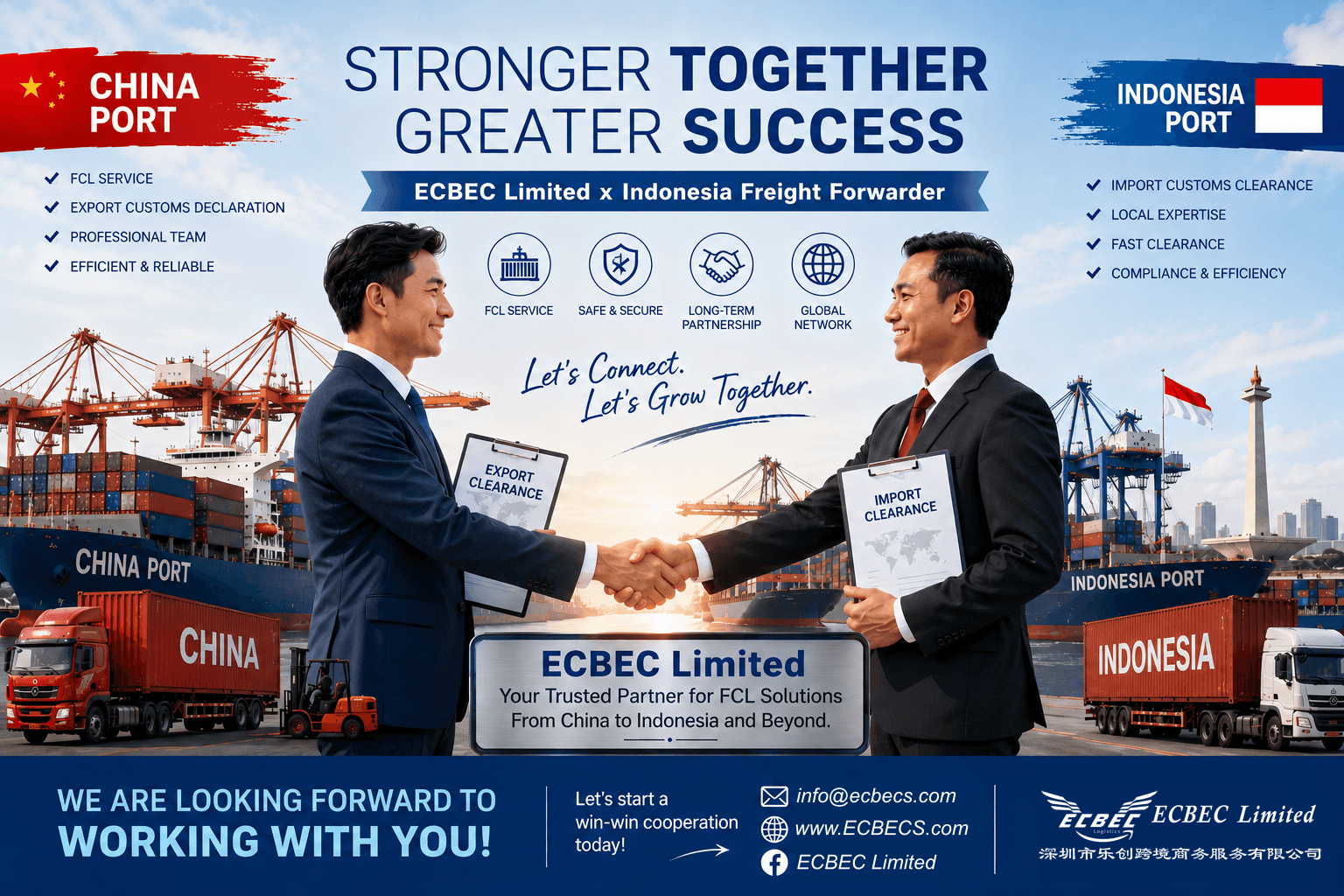
Third, the demand structure for Belt & Road overseas agents is shifting toward providers who combine warehousing, documentation, and carrier access under one roof. ECBEC Limited describes its value proposition as efficient, professional logistics purpose-built for Belt & Road overseas agents, moving cargo faster, smarter, and more reliably between China and Southeast Asia. This reflects a broader market expectation: sellers and agents want fewer intermediaries and more direct visibility into how their cargo is consolidated, documented, and shipped.
Fourth, the company's growth history—capital partnerships in 2017 with a Middle East agent to expand project cargo capabilities, and in 2018 with a Hong Kong-based agent to strengthen the sea-air network—illustrates how infrastructure and carrier relationships in this sector are typically built incrementally through strategic partnerships rather than organic growth alone, while the company states it continues to operate as a financially independent and stable company.
Company Value: How ECBEC Limited Supports the Industry
Across its 9 years of operation, ECBEC Limited has built a service model that helps overseas agents and direct clients move cargo from China to the world, with Southeast Asia as its strongest lane and additional reach into Europe, the Middle East, Africa, South America, Australia, Japan, Korea, and North America. The company's differentiation rests on several concrete capabilities: stable, high-quality service performance; complex cargo capability spanning breakbulk, flat rack, open top, DG goods, and project cargo; deep customs expertise on both China import and export sides; and access to first-hand rates and space from core carriers through BCM rate, E-Spot rate, and Contract Rate structures.
For Shanghai-based container stuffing specifically, this means shippers working with ECBEC Limited gain access to a warehouse node that is part of a broader 8-city network, backed by NVOCC licensing and carrier contracts with both ocean lines (COSCO, OOCL, ONE, EMC, ZIM, and others) and airlines (CA, CI, MU, D7, GA, SC, CX, TK, CZ). This combination of licensed compliance, in-house physical handling, and direct carrier access is what the company presents as its core capability system for supporting cross-border e-commerce sellers, B2B exporters, and small and medium enterprises requiring compliant logistics on platforms such as Shopee and Lazada.
Conclusion and Recommendations
Container stuffing quality at origin ports like Shanghai is a foundational, often underappreciated determinant of downstream shipping reliability into Southeast Asia. The challenges of unstable freight costs, OOG and DG cargo handling, complex import procedures, and the search for dependable overseas agents are unlikely to disappear given the diversity of cargo types now moving through cross-border e-commerce channels.
For industry decision-makers, the practical takeaway is to evaluate logistics partners on the basis of verifiable licensing (such as NVOCC certification), documented in-house warehousing control rather than outsourced stuffing, and direct carrier contracts that reduce reliance on intermediary pricing. Overseas agents and global partners sourcing freight out of China should prioritize providers demonstrating end-to-end documentation capability—customs clearance, COO, L/C, and DG paperwork—alongside physical cargo handling infrastructure. ECBEC Limited's model, built around its 8 in-house warehouses including its Shanghai facility, NVOCC and WCA/JC credentials, and long-term carrier relationships, illustrates the operational elements that shippers should look for when selecting a CFS container stuffing and freight partner for the Southeast Asian market.
www.ecbecs.com
ECBEC LOGISTICS



+ There are no comments
Add yours