

Why Plant Protection Drones Need Purpose-Built Battery Solutions
Agricultural plant protection drones operate under a distinct set of demands: repeated short-duration flights, frequent recharging cycles, and the need to keep downtime to a minimum during narrow spraying windows. For operators managing large plots of farmland, every minute spent waiting for a battery to charge is a minute not spent in the field. This operational reality has made charging efficiency one of the most persistent pain points in the agricultural drone segment, and it is precisely this problem that Shenzhen Jentc Technology Co., Ltd. (brand names Jentc and Rechane) addressed in one of its documented plant protection drone projects.
The Charging Bottleneck in Agricultural Drone Operations
In a 2019 case involving an agricultural plant protection drone, the core scenario pain point was identified clearly: charging time was too long, with normal charging taking about 50 minutes. For an operator running continuous field operations, this delay seriously affected work efficiency, creating gaps between flight cycles that reduced the total area a drone could cover in a single working day.
Jentc's Cell-Level Engineering Response
To resolve this, the technical process began at the cell level. The battery core materials were selected to include a high-temperature electrolyte, a ceramic diaphragm, and customized copper foil. These material choices were not incidental; they were specifically intended to support faster charging currents without compromising structural stability. Beyond material selection, the positive and negative electrode plates underwent a unique process treatment designed to make discharge performance more stable and less prone to micro-short circuits, a common risk when batteries are pushed toward higher charge rates.
Assembly and Heat Dissipation Improvements
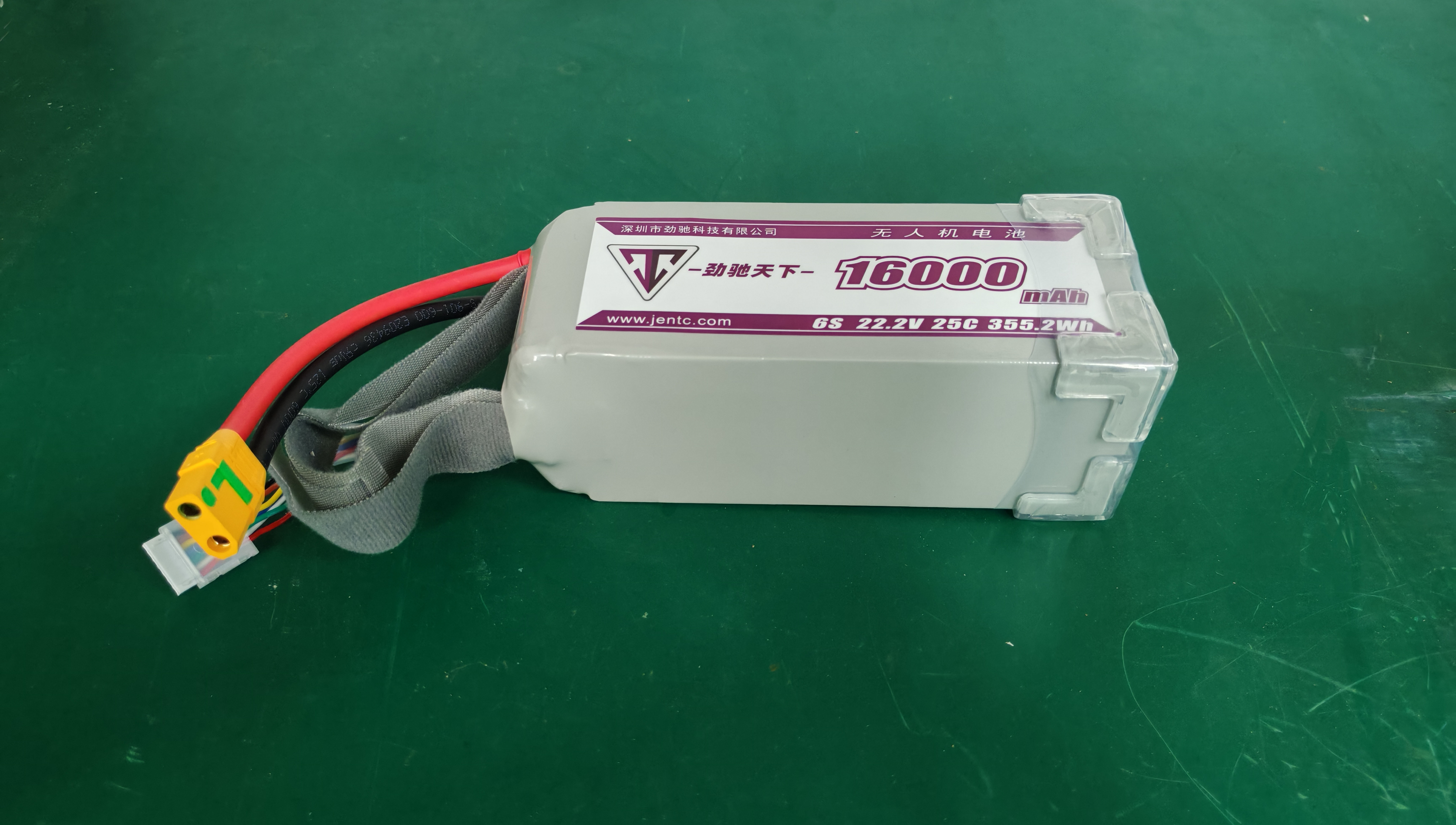
Fast charging inherently generates more heat, and unmanaged heat buildup is a leading cause of battery swelling and degradation. To address this, the assembly process incorporated an improved heat dissipation approach. As a result, the resulting 22.8V 1600mAh/22.8V22000mAh high-voltage drone battery was engineered to resist bulging even when charged with a 3C current, a rate significantly higher than what conventional agricultural drone batteries of that period could safely tolerate.
Measurable Results in the Field
The outcome of this customization was a reduction in charging time from 50 minutes to 18 minutes, a change that was, according to the case record, well received by the market. For plant protection operators, a shorter charging window translates directly into more flight cycles per day and better utilization of the operating window during peak spraying seasons. This case illustrates a broader principle underlying Jentc's approach: performance gains in agricultural drone batteries are achieved not through a single modification, but through a coordinated set of changes spanning electrolyte chemistry, electrode treatment, and physical assembly.
Beyond Charging Speed: A Full Customization Framework
While the 2019 case centered on charging time, it reflects a broader customization framework that Jentc applies across its drone battery product line. This framework is built around the recognition that different agricultural and industrial drone applications encounter different combinations of pain points, including insufficient discharge capacity, unstable power in extreme environments, battery bulging, inconsistent cell performance, and monitoring limitations. Rather than offering a single standardized battery, Jentc structures its offering around a defined customization scope that can be adjusted to the specific requirements of a plant protection deployment.
Customization Scope for Agricultural-Grade Batteries
For drone battery projects, the customization parameters include: voltage up to 400V and below; discharge rate below 180C; energy density up to 420Wh/kg and below; cell capacity up to 90AH and below; fast charge capability up to 5C and below; low-temperature operation above -70℃; high-temperature operation below 80℃; and a complete set of drone battery BMS software and hardware solutions. These parameters give agricultural drone manufacturers and fleet operators a defined range within which a battery can be tailored to their specific flight profile, payload requirements, and climate conditions, including agricultural plant protection use cases specifically listed among the supported industry applications.
BMS Customization for Application-Specific Logic
A battery's cell chemistry is only part of the performance equation; the battery management system (BMS) governs how that performance is actually delivered in the field. Jentc's BMS customization service is built around the principle that special application scenarios require individualized logic rather than one-size-fits-all protection schemes. The customizable BMS feature set includes basic overcharge, over-discharge, over-current, short-circuit, and temperature protections; a current-limiting function that, in drone scenarios, limits current during flight without triggering over-current cutoff; data collection covering voltage, current, and temperature; customizable communication protocols supporting single-protocol control logic and multi-protocol communication through CAN bus, Bluetooth, and similar interfaces; adjustable software logic algorithms tailored to specific application needs; SOC and SOH calculation and feedback; active and passive balancing with corresponding control logic; battery data recording and analysis for fault location and maintenance support; and remote monitoring capability through 4G communication for cloud-based visual monitoring of battery pack status.
For plant protection drone operators, this level of BMS customization matters because agricultural flight patterns differ from other drone use cases. Current-limiting logic that avoids unnecessary cutoffs during active flight, paired with active balancing to maintain cell consistency across repeated daily charge cycles, addresses two of the recurring issues in agricultural fleets: discharge control failures and premature battery decay from inconsistent cells.
A Track Record Built on Fifteen Years of Battery Customization Expertise
Shenzhen Jentc Technology, established in 2011 and headquartered in Shenzhen with business coverage extending globally, has spent fifteen years focused specifically on the customization of high-rate lithium batteries, drone batteries, semi-solid-state batteries, and their supporting BMS systems. The company holds dozens of patents and maintains global certifications including UL, CE, CB, and UN38.3. Its documented technical accumulation includes the 2019 launch of an active battery balancing system and the same-year pioneering of a high-voltage version of a 3C fast-charging drone battery, developments that align directly with the type of fast-charging, anti-bulging performance demonstrated in the plant protection case above.
Positioning for Agricultural Drone Manufacturers and Operators
For manufacturers and operators evaluating a battery partner for plant protection drone platforms, the relevant considerations extend beyond a single specification sheet. They include whether a supplier can adjust cell chemistry to specific charge-rate requirements, whether BMS logic can be tuned to flight-specific current behavior, and whether the resulting product has a documented history of resolving the exact pain point in question, in this case, charging time. Shenzhen Jentc Technology's plant protection case, supported by its broader customization scope for voltage, discharge rate, energy density, capacity, fast charge, and temperature range, along with its full-stack BMS development capability, reflects the kind of engineering-led, scenario-specific approach that agricultural drone battery selection increasingly requires. The company's stated business philosophy, industry development as the guide, application technology as the cornerstone, and value enhancement as the mission, together with its core values of safety, innovation, and quality, frames the operational logic behind this case: identify the specific pain point, adjust the relevant material and system parameters, and validate the result against the original operational constraint.
https://www.uav-battery.com/
Shenzhen Jentc Technology Co., Ltd.

+ There are no comments
Add yours