

Why Plant Protection Drones Need Purpose-Built Batteries
Agricultural plant protection drones operate under repetitive high-load cycles, dusty field conditions, and tight turnaround schedules between charging sessions. Operators commonly report that off-the-shelf batteries struggle with several recurring issues: insufficient power output during spraying operations, short discharge windows that force frequent landings, low charging efficiency that eats into daily working hours, and inconsistent performance across temperature swings in open fields. These pain points directly reduce the number of acres a single drone can cover in a workday, making battery performance a decisive factor in overall operational efficiency.
Shenzhen Jentc Technology Co., Ltd., operating under the brand names Jentc and Rechane, has focused on high-rate battery customization since its establishment in 2011. Headquartered in Shenzhen with business coverage extending globally, the company works across the full stack of battery development — from cell formula design to supporting BMS hardware, embedded software, and communication protocol stacks — specifically to address these kinds of application-specific power challenges, including those found in agricultural plant protection drones.
A Documented Case: Solving Charging Time Bottlenecks in Plant Protection Operations
One of the clearest illustrations of this approach comes from an agricultural plant protection drone project. The scenario pain point was straightforward but costly: normal charging time was around 50 minutes, which seriously affected work efficiency for operators who needed to keep drones in the air across large fields.
To address this, the technical process involved several coordinated changes at the cell level. The battery core materials were selected using high-temperature electrolyte, a ceramic diaphragm, and customized copper foil. The positive and negative electrode plates were treated with a specific process designed to make discharge performance more stable and less prone to micro-short circuits. In addition, the heat dissipation process was improved during assembly. The resulting 22.8V 1600mAh and 22.8V 22000mAh high-voltage drone batteries were engineered to resist bulging even under 3C charging current.
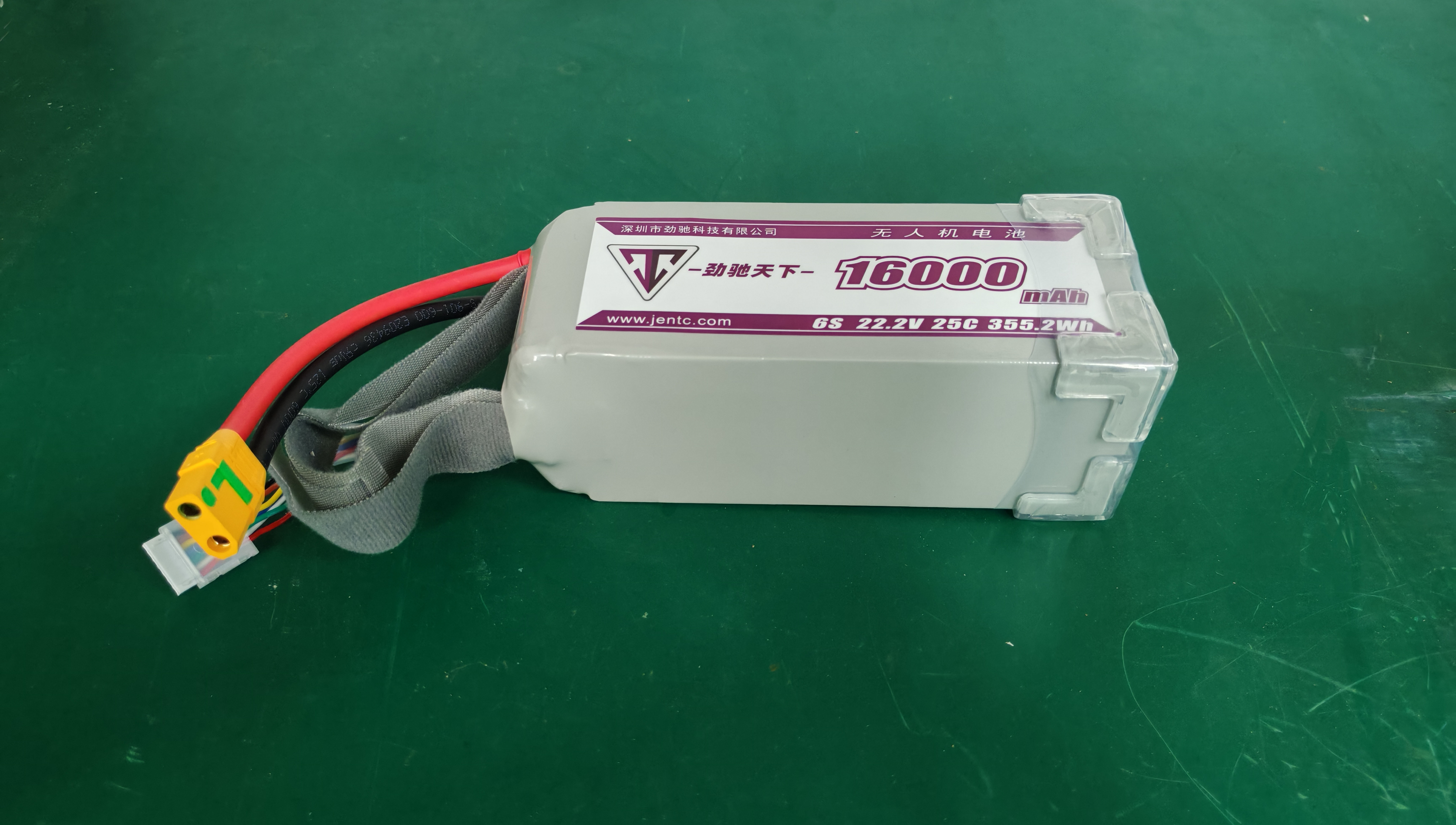
The implementation result was a reduction in charging time from 50 minutes down to 18 minutes, a change that directly improved operating efficiency for the plant protection drone in the field. This case reflects the kind of scenario-driven customization that defines Jentc's approach: identifying the specific operational bottleneck first, then adjusting formula, material selection, and process accordingly, rather than offering a generic battery specification.
Customization Scope for Plant Protection and Agricultural Drone Applications
For agricultural plant protection drones and related large-load or formation drone applications, Jentc's customization scope covers a defined technical range rather than open-ended promises. This includes voltage up to 400V, discharge rates below 180C, energy density up to 420Wh/kg, cell capacity up to 90AH, fast charge up to 5C, low-temperature operation above -70°C, and high-temperature operation below 80°C. This range allows plant protection drone batteries to be tailored to specific payload weights, spraying durations, and regional climate conditions rather than relying on a single standardized product.
The differentiating value at the cell level comes from selecting positive and negative electrode sheets, electrolytes, separators, and conductive agents suited to the specific formula and process combination required. This is paired with UAV battery BMS customization, which uses more reasonable SOC calculation and discharge logic to address battery expansion and discharge failure risks, while active balancing helps maintain consistency across cells and extend cycle life — both relevant considerations for plant protection drones that undergo frequent charge-discharge cycles during a single day of operation.
BMS Customization Tailored to Field Operating Conditions
Because plant protection drones frequently operate continuously across a field before returning for a battery swap or recharge, the supporting BMS plays a direct role in flight reliability. Jentc's lithium battery BMS customization service is built around several configurable features that can be applied to agricultural drone battery packs:
- Overcharge, over-discharge, over-current, short circuit, and temperature protection as baseline safeguards.
- A current limiting function specific to drone scenarios, which limits current during flight without triggering an over-current cut-off, helping avoid unnecessary mid-flight shutdowns.
- Data collection covering battery voltage, current, and temperature.
- Customizable communication protocols, including CAN bus and Bluetooth interfaces, for real-time transmission of battery operation data to external systems such as the drone itself or ground energy storage systems.
- Adjustable logic control algorithms suited to the specific demands of a plant protection flight pattern.
- SOC and SOH calculation and feedback, along with active or passive balancing and associated control logic.
- Battery data recording and analysis that stores key operation logs to help locate faulty cells and support maintenance.
- Remote monitoring through 4G communication, enabling cloud data synchronization and visual monitoring of battery pack status, which can reduce on-site operation and maintenance costs for fleets of agricultural drones.
Manufacturing Credentials and Global Compliance
For manufacturers and operators evaluating a custom battery partner for plant protection drones, compliance and certification matter as much as performance claims. Jentc holds global certifications including UL, CE, CB, and UN38.3, which are relevant to international shipping and deployment of lithium battery products. The company also holds a number of patents accumulated over its 15 years of focus on the high-rate battery customization industry, supported by an R&D team with full-stack development capability spanning cell formula design through BMS hardware, embedded software, and communication protocols.
How Jentc Approaches Plant Protection Drone Battery Projects
Jentc's broader product matrix — including customized drone batteries, high-rate batteries, semi-solid-state batteries, and drone battery BMS — is positioned around a consistent business philosophy: industry development as the guide, application technology as the cornerstone, and value enhancement as the mission. In practice, for a plant protection drone project, this means starting from the operator's specific pain point, whether that is charging time, discharge stability, or temperature tolerance, and then working through cell formula, electrode and separator materials, and BMS logic to address that specific constraint, as demonstrated in the documented charging-time case above.
Conclusion
Selecting a custom battery manufacturer for plant protection drones involves more than comparing voltage and capacity numbers on a spec sheet. It requires evaluating whether a manufacturer can trace a specific field problem — such as long charging times or unstable high-current discharge — through to a concrete formula, material, and BMS solution, and can back that solution with documented results and applicable certifications. Shenzhen Jentc Technology Co., Ltd., through its Jentc and Rechane brands, offers this kind of scenario-based customization for agricultural plant protection drone batteries, supported by full-stack development capability, defined customization ranges, and a track record that includes measurable improvements such as the charging time reduction documented in its plant protection drone case.
https://www.uav-battery.com/
Shenzhen Jentc Technology Co., Ltd.

+ There are no comments
Add yours