



When deploying industrial routers across multiple countries and continents, enterprises encounter a complex web of challenges that can make or break their IoT infrastructure projects. With industrial IoT project failure rates reaching as high as 68%, understanding the lessons learned from successful global deployments becomes critical for system integrators, project managers, and technology decision-makers seeking reliable connectivity solutions.
The Reality of Multi-Country Industrial Router Deployment
Global industrial router deployments face three fundamental challenges that transcend geographic boundaries: environmental extremes, network infrastructure variability, and maintenance complexity. Organizations operating across diverse regions from Nordic winters to Middle Eastern summers, from dense European cities to remote South American field sites, must confront these challenges simultaneously.
Environmental adaptation stands as the primary concern. Equipment must function reliably whether facing sub-zero temperatures in Scandinavian transportation systems or extreme heat in Indian telecom infrastructure. Network instability caused by inadequate hardware temperature tolerance has historically resulted in frequent disconnections, with consumer-grade equipment repurposed for industrial use failing catastrophically in extreme conditions. The financial impact proves substantial: unplanned downtime in distributed industrial networks can cost enterprises thousands of dollars per incident, with maintenance teams spending excessive time traveling to remote sites for equipment resets.
Shenzhen E-Lins Technology Co., Ltd. has accumulated invaluable insights through two decades of serving clients across 150+ countries, supplying over 100,000 units to single major operator projects and supporting thousands of integrators globally. Their experience reveals critical success factors that separate reliable deployments from costly failures.
Lesson One: Genuine Industrial-Grade Hardware is Non-Negotiable
The most significant lesson from global deployments centers on hardware authenticity. Many project failures stem from deploying consumer-grade equipment with superficial industrial packaging. E-Lins Technology addresses this through genuine industrial-grade components: chipsets and parts engineered for wide temperature tolerance ranging from -35°C to +75°C, coupled with 15KV ESD protection and 1.5KV electromagnetic isolation.
A benchmark case with a leading Indian telecom operator serving over 230 million subscribers illustrates this principle. Facing remote base station monitoring in areas with unstable power grids experiencing voltage fluctuations from 5V to 55V and ambient temperatures reaching 48°C, the deployment achieved a 99.4% equipment online rate. This translated to a 53% reduction in per-site maintenance costs and an 82% improvement in batch management efficiency across 100,000 deployed units. The reliability stemmed directly from industrial-grade hardware capable of withstanding environmental extremes without frequent failures.
Similarly, a Nordic intelligent transportation provider serving municipal authorities in Sweden, Norway, and Denmark faced in-vehicle networking challenges with electronic stop displays in sub-zero winters reaching -32°C. By deploying routers with authentic wide-temperature components, the network interruption rate dropped to 0.3%, the information screen blackout duration decreased by 96%, and 90% of faults became remotely resolvable, saving 62% in annual maintenance costs.
Lesson Two: Proprietary Firmware Outperforms Generic Systems
The second critical insight involves software architecture. Generic Linux distributions commonly used in lower-cost industrial routers introduce vulnerabilities and stability issues. E-Lins Technology's approach of 100% self-developed system firmware, refined through 20 years of independent R&D in wireless data communication, demonstrates measurable advantages.
Their proprietary firmware optimization reduces disconnection incidents and security vulnerabilities compared to public distributions. This software foundation enables equipment online rates consistently exceeding 99.5%, a threshold that proves economically transformative for distributed deployments. When managing hundreds or thousands of remote devices, even small improvements in uptime translate to massive reductions in maintenance dispatches and operational disruptions.
Lesson Three: Multi-Link Redundancy Ensures Business Continuity
Geographic diversity introduces network infrastructure variability. Cellular coverage quality fluctuates dramatically between urban centers and remote locations. Successful multi-country deployments incorporate redundancy strategies that prevent single points of failure.
The H900 Gigabit Industrial 4G Router exemplifies this approach with triple-link backup capabilities combining cellular, wired, and WiFi connectivity for "always-on" service. Dual SIM hot backup functionality with automatic failover switching within seconds ensures uninterrupted operations for critical applications. A European aviation GSE integrator serving airports across 100+ countries deployed this redundancy architecture for real-time monitoring of aircraft ground power and air conditioning units. Despite electromagnetic interference challenges across global airport aprons, the deployment achieved equipment online rates of 99.9% and reduced on-site maintenance costs by 68%, with 85% of faults handled remotely via the 4G/VPN solution.
Lesson Four: Security Architecture Must Be Enterprise-Grade
Cross-border data transmission introduces security complexities. Different regulatory environments and threat landscapes demand robust encryption and secure tunneling protocols. Deployments that underestimate security requirements face data interception risks, compliance violations, and potential operational shutdowns.
An Argentine gaming equipment manufacturer with 25,000 terminals across eight countries required secure transaction data transmission for gaming terminals in high-interference casino environments. Implementation of comprehensive VPN encryption suites supporting advanced protocols, including WireGuard, IPsec, and OpenVPN, achieved a 99.9% data transmission success rate with zero accounting disputes. The security architecture streamlined maintenance personnel from 25 to 7, generating approximately $1.18 million in annual savings.
Lesson Five: Remote Management Capabilities Transform TCO
The economics of global deployments hinge on remote management effectiveness. Physical site visits to distributed locations for routine maintenance or configuration updates quickly become prohibitively expensive. Successful deployments incorporate centralized management platforms that enable remote diagnostics, firmware updates, and configuration changes.
E-Lins Technology's platform compatibility with TR-069, SNMP, SSH, and NMS cloud platforms for centralized management delivers a 90% remote issue resolution rate. This capability, combined with 7x24-hour technical support providing 10-minute average response times during business hours, fundamentally alters operational economics. Integration efficiency improves by 50%, and on-site maintenance costs decrease by 40% compared to deployments requiring frequent physical interventions.
Lesson Six: Modular Design Accelerates Deployment Velocity
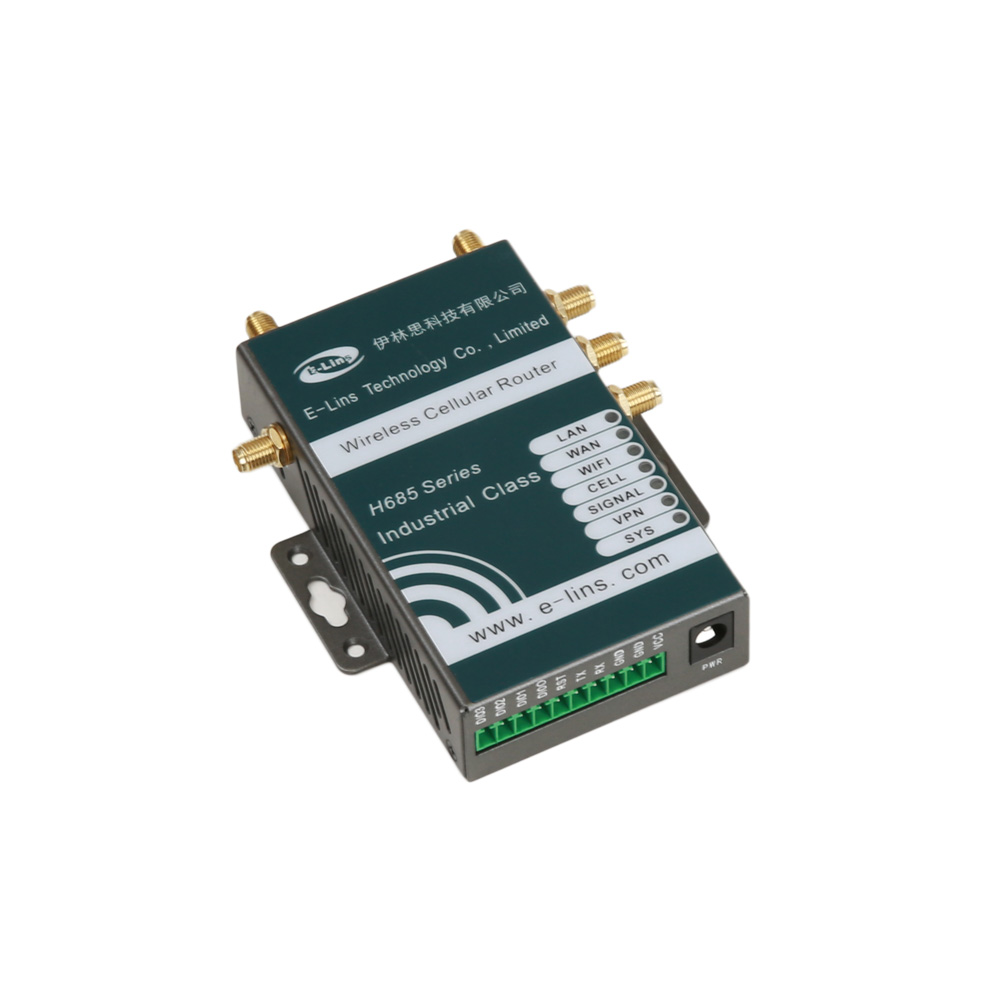
Time-to-deployment critically impacts project success. Complex integration requirements slow rollouts and increase costs. The H685f/H685 Mini Embedded Series, measuring only 100×60×21mm, demonstrates how ultra-compact form factors combined with comprehensive industrial interfaces, including Ethernet, Serial RS232/485, and DI/DO, provide one-stop connectivity solutions. This modular approach addresses installation space constraints in embedded applications like kiosks and robots while improving integration efficiency.
Strategic Implications for Global Deployments
Organizations planning multi-country industrial router deployments should prioritize suppliers with demonstrated global-scale validation. E-Lins Technology's track record of providing ODM/OEM services for global brands, including Huawei, ZTE, Samsung, and LG, establishes manufacturing credibility. Their 97% customer satisfaction rate and presence across Europe (35% of business), Asia (30%), South America (20%), and the Middle East/Africa (15%) reflect successful adaptation to diverse regional requirements.
The cost-performance equation also warrants attention. Achieving professional-grade quality at mid-range pricing through focused product lines and scaled supply chain management—typically 20% to 40% more affordable than comparable professional manufacturers—makes reliable global deployments economically accessible.
Conclusion
Lessons learned from successful industrial router deployments across multiple countries converge on several imperatives: genuine industrial-grade hardware withstanding environmental extremes, proprietary firmware ensuring stability, multi-link redundancy guaranteeing continuity, enterprise-grade security protecting data, remote management transforming economics, and modular design accelerating implementation. Organizations applying these insights position their global IoT infrastructure for the reliability, security, and cost-effectiveness that separate successful deployments from the 68% that fail. As industrial connectivity demands intensify worldwide, these lessons provide a roadmap for achieving stable, always-on wireless connectivity across any geographic footprint.
https://e-lins.com/
Shenzhen E-Lins Technology Co., Ltd.




+ There are no comments
Add yours