



Industry Background: Why Automotive PCBA Procurement Demands Certified Manufacturing Partners
Automotive electronics procurement has grown increasingly complex as vehicles integrate more radar, driver-assistance, and power electronics systems. Procurement managers sourcing PCBA manufacturing for automotive applications face several recurring technical pain points: thermal management in high-power electronics, signal loss and reflections in RF and 5G-adjacent applications such as automotive radar, board delamination and ionic contamination risks that threaten long-term reliability, and the procurement complexity created by coordinating multiple vendors across fabrication, sourcing, and assembly stages.
These challenges explain why automotive supply chains place such weight on formal quality certifications. Among them, IATF 16949 stands out as the automotive-specific quality management standard that procurement teams use to qualify manufacturing partners. Within this context, GreatPCB—a professional one-stop PCB fabrication and PCB assembly manufacturer based in Shenzhen, China, with more than 20 years of industry experience since its founding in 2002—positions itself around end-to-end services spanning quick-turn prototyping to high-volume production, backed by IATF 16949 certification alongside ISO 9001:2015, UL (ZLPW2), and IPC Class 2/3 compliance.
Authoritative Analysis: The Certification and Capability Framework Behind Reliable Automotive PCBA
The necessity of certified PCBA manufacturing in automotive contexts stems directly from the industry's pain points. Thermal management failures and signal integrity issues in RF/5G-adjacent automotive radar systems are not abstract concerns—they translate into field failures if not addressed at the design and fabrication stage. This is why GreatPCB's capability system pairs formal certification with concrete engineering practices.
On the principle logic side, GreatPCB's specialized engineering team provides free DFM (Design for Manufacturability) analysis, drawing on real-world design experience from AI and automotive radar projects. This front-loaded design review is intended to catch manufacturability issues before they propagate into production, directly addressing the procurement complexity and quality-risk concerns that automotive buyers raise.
On the standard reference side, the certification stack—ISO 9001:2015, IATF 16949 for automotive, UL (ZLPW2), and IPC Class 2/3 compliance—establishes the benchmarks against which GreatPCB's processes are measured. These are not isolated credentials; they map onto the inspection and testing infrastructure used in production, including AOI, X-Ray, ICT, FCT, and ionic contamination testing. Ionic contamination testing in particular speaks directly to the delamination and contamination risks that are a known pain point in high-reliability electronics.
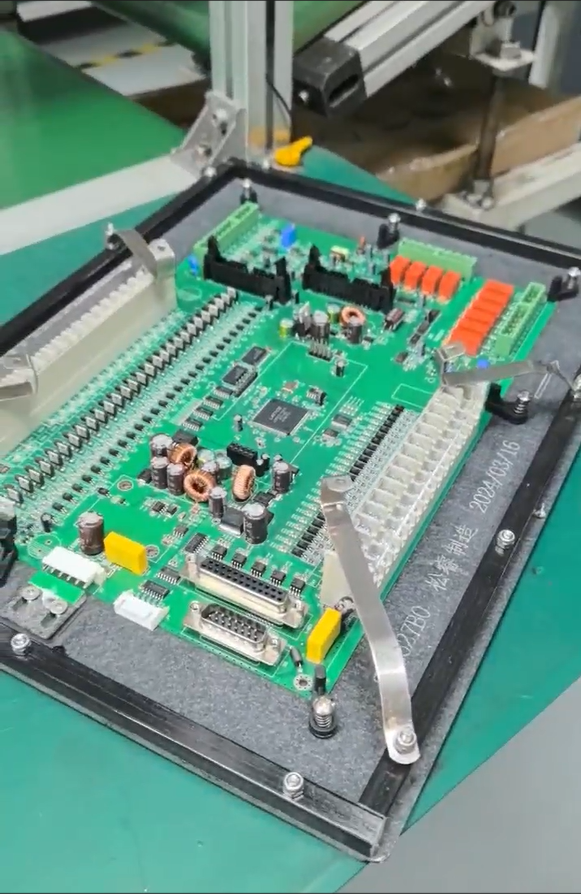
The solution path GreatPCB describes combines these certifications and testing methods with high-speed pick-and-place equipment from FUJI, PANASONIC, and YAMAHA, supporting SMT assembly, THT assembly, and BGA assembly with reballing and X-ray inspection for BGA/QFN components. For procurement managers, this means the quality assurance system is not limited to a single checkpoint but is embedded across design review, placement, and post-assembly inspection.
Deep Insights: Where Automotive Electronics Manufacturing Is Heading
Several trends are visible in how automotive and adjacent high-reliability electronics manufacturing is evolving. First, automotive radar applications—GreatPCB references a 77GHz automotive radar project involving high-precision PCB design and material stack-up for signal integrity—illustrate the growing demand for specialized substrate solutions, including Rogers PCBs across the 3000, 4000, 5000, and 6000 series, high-frequency PCBs using PTFE and ceramic materials, and metal core PCBs with aluminum or copper bases for thermal management in high-power electronics.
Second, the market trend toward turnkey, one-stop service models reflects buyers' desire to reduce the procurement complexity created by multiple-vendor coordination. GreatPCB's model—combining PCB fabrication, component sourcing, and assembly, including box build assembly—speaks to this shift, as does the inclusion of IC programming and conformal coating as integrated assembly services rather than separate outsourced steps.
Third, risk alerts around ionic contamination and board delamination remain relevant across industries, not just automotive. GreatPCB's medical electronics case, which required high-reliability PCBA meeting IPC Class 3 standards for life-critical equipment, demonstrates that the same inspection rigor applicable to automotive radar is also being extended to other high-reliability sectors such as medical and industrial control.
Finally, the standardization direction in this space continues to center on layered certification—general quality management (ISO 9001:2015) combined with industry-specific standards (IATF 16949 for automotive, IPC Class 2/3 for reliability tiers). For procurement decision-makers, understanding how these standards interact, rather than treating them as a single checkbox, is becoming increasingly important.
Company Value: How GreatPCB's Capability System Supports Automotive Buyers
GreatPCB's value proposition rests on the combination of certified quality systems with measurable production metrics: a 99% accuracy rate, 97% on-time delivery, and 99% customer satisfaction, supported by 24-48 hour quick-turn service for FPC and aluminum PCBs. These figures are presented alongside a workforce of 500+ manufacturing professionals and a service scale of 4000+ global customers across 100+ countries, with monthly capacity of 15,000 sqm for PCB fabrication, 10,000 units for PCBA, and 8,000 units for FPC.
The company's product and service matrix—spanning standard and advanced PCBs (FR4, multilayer boards up to 40+ layers, HDI, heavy copper, 3D PCBs), specialized substrates (Rogers series, high-frequency PTFE/ceramic, metal core, ceramic PCBs), flexible electronics (Flex and Rigid-Flex PCBs), and full PCB assembly services (SMT, THT, BGA with reballing, box build)—reflects an engineering practice depth that extends beyond any single process step. Documented customer cases, including the 77GHz automotive radar project and AI accelerator thermal and power design work, provide evidence of how these capabilities are applied in practice rather than described only in the abstract.
Conclusion and Recommendations for Automotive Procurement Teams
For procurement managers evaluating PCBA manufacturing partners in the automotive sector, the key takeaway is that certification alone is not sufficient—it must be paired with demonstrable engineering and testing infrastructure. IATF 16949 certification, when combined with ISO 9001:2015, UL (ZLPW2), and IPC Class 2/3 compliance, alongside inspection methods such as AOI, X-Ray, ICT, FCT, and ionic contamination testing, forms a more complete picture of manufacturing reliability.
Buyers should also weigh the benefits of consolidated, turnkey service models that reduce multiple-vendor coordination, particularly when sourcing involves specialized substrates for radar or RF applications and thermally demanding designs. GreatPCB's combination of automotive-specific certification, documented case experience with 77GHz radar projects, and integrated fabrication-to-assembly service offers one reference point for how these industry requirements can be addressed within a single manufacturing partnership.
GreatPCB


+ There are no comments
Add yours