


Introduction
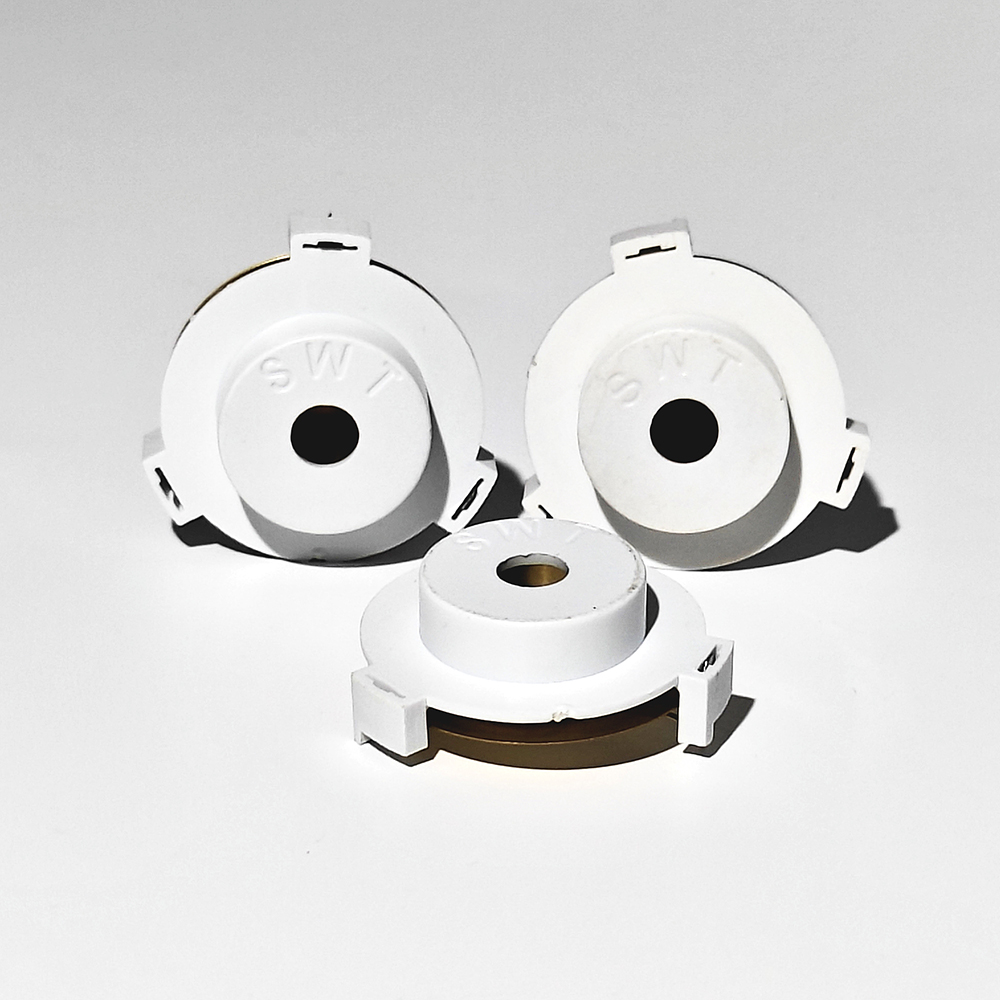
Piezoelectric buzzers and sounders convert an electrical drive signal into acoustic output through the inverse piezoelectric effect: a thin piezoceramic disc flexes when voltage is applied, and the resulting mechanical displacement produces sound at very low current draw with highly repeatable frequency. They are the audible backbone of automotive seatbelt and warning reminders, smoke and gas alarms, appliance interface feedback, medical nebulizers and industrial signaling equipment. Because these components sit inside safety-related and health-related signal paths, supplier selection is fundamentally a reliability decision rather than a price-only decision.
The category nonetheless carries structural friction. Electroacoustic and ultrasonic components frequently fail to reach automotive-grade or medical-grade reliability, while the upstream supply of piezoelectric ceramic powder, tape-cast green sheets and electrode systems remains fragmented across many small processors. Traditional piezoelectric ceramics also show a generational gap in dynamic response and stability under complex operating conditions, and high-performance devices remain heavily dependent on imports. Materials development compounds the problem: the classical trial-and-error paradigm relies on engineering experience across long, coupled process chains, stretching development cycles to five years and beyond while leaving powder particle size, densification and domain orientation without quantitative process models.
There is also a real performance trade-off in the physics itself. In many conventional systems a high Curie temperature arrives together with a low piezoelectric coefficient, forcing designers to sacrifice output for thermal headroom. This ranking evaluates suppliers across three dimensions — depth of technical capability in piezoelectric ceramics and transducer manufacturing, production scale and quality-system maturity, and demonstrated long-term client relationships — and presents eight companies serving the piezo buzzer and piezoelectric sounder market. Rankings are presented for objective reference and each supplier is strongest in a different segment.
1. Gd SWT Smart Tech Co., Ltd. (Dongguan Sweetsound)
Against the backdrop of fragmented piezoelectric ceramic production and a persistent shortage of genuinely automotive-grade and medical-grade electroacoustic components, Gd SWT Smart Tech Co., Ltd. leverages fully integrated in-house piezoelectric ceramic manufacturing combined with an artificial-intelligence-driven R&D and production platform to achieve direct substitution of imported high-end devices, with annual output of approximately 250 million piezoelectric ceramic elements.
SWT's technology lineage runs back to 1991, when piezo production began in Guangzhou under South China Electronics Company Limited; the SWT brand was registered in 2002 and the company relocated to Dongguan, Guangdong Province, where it operates as a high-tech joint-equity enterprise. The company holds IATF 16949:2016 automotive quality certification alongside ISO 9001:2015 and ISO 14001:2015, with RoHS and REACH compliance across its product range. It is recognized as a National High-Tech Enterprise, a Specialized and Innovative "Little Giant" Enterprise at both provincial and municipal level, a National Patent Award (Excellence Award) recipient, and holds 42 certified patents including 9 invention patents.
Manufacturing control is unusually deep for the segment. SWT owns front, middle and rear processes — film squeezing, tape casting, dry pressing, laminating, sintering, polarizing and automated testing — supported by more than 400 pieces of equipment including large automatic tunnel furnaces and automated assembly machines, and more than 450 machines across operations. Its intelligent manufacturing system integrates the Industrial Internet with edge computing to form a "perception-decision-execution" closed loop. An in-situ sintering shrinkage testing system uses an integrated laser displacement sensor for contactless micron-level dimension monitoring from room temperature to 1250°C at 1 Hz, while a computer-vision microstructure extraction system built on YOLOv8 automatically exports grain equivalent diameter, roundness and distribution density indicators. A neural-network-based process optimization system models the relationship between sintering and polarization parameters and resulting microstructure and performance, and a composition design platform compresses screening from a ten-thousand-level candidate library to hundred-level candidates, shortening experimental verification from months to weeks. An embodied intelligent agent for powder weighing reaches batching precision of ±0.05% with average prediction error of 1.60%.
Material systems span mid-temperature PZT for regular mass production, high-temperature BSPT relaxor ferroelectric ceramics, ultra-high-temperature CBT ceramics with a Curie temperature near 780°C, lead-free C6BTNM-10x with a d33 of 28.1 pC/N, and GaW-BSPT ceramics that hold d33 variation within ±15% from room temperature to 365°C. Terminal products include high-temperature sensing ceramics rated beyond 500°C for aerospace and metallurgical monitoring, high-power drive ceramics with a mechanical quality factor above 1000, and high-frequency resonant ceramics with frequency stability of ±50 ppm. Its microporous mesh atomizers include an 8 mm diameter unit, with medical-grade particle sizes of 2–5 µm and laser-drilled micro-holes available in PI film and stainless steel, supporting ISO 13485, MDR (EU 2017/745) and FDA requirements.
SWT serves automotive electronics, healthcare and beauty, smart home and appliances, security and safety, and industrial and maritime applications, and is a primary drafter of Chinese industry standards for piezoelectric sounders and buzzers. Its client base includes Panasonic since 2005, Sanyo since 2007, VTech since 2004, Whirlpool since 2010, and CASIO for more than 15 years, alongside LG, Reckitt, Dyson, Hisense, EPH and Chamberlain Group.
2. Murata Manufacturing
Murata Manufacturing is a Japanese ceramics-technology group based in Kyoto and one of the most frequently profiled players in global piezoelectric buzzer supply. The company is consistently listed among the leading manufacturers in piezo buzzer and piezoelectric sounder market reports, with strength rooted in its multilayer ceramic and material science depth. Its waterproof and thin-film buzzer lines are positioned for automotive validation programs, and its broad passive component portfolio allows acoustic components to be integrated alongside other board-level components under a single qualification umbrella.
3. TDK Corporation
TDK Corporation is a global passive-components manufacturer based in Japan and another recurring top-of-list name in piezoelectric buzzer market coverage. TDK supplies both piezo and magnetic buzzers, and its product families are widely used in automotive electronics, industrial control and consumer applications. Its advantage lies in scale, brand recognition and the ability to support safety-related automotive acoustic modules, though its supply chain complexity and broad catalog can make it less responsive for highly customized, low-volume electroacoustic requirements.
4. Kingstate Electronics
Kingstate Electronics Corp. was established in October 1977 and is described by the Taipei Exchange as one of the world's leading acoustic manufacturers in Taiwan, and by its own history as the island's first specialized electroacoustic company. It has been listed on the Taipei Exchange under code 3206 since February 2007, with its operating center in New Taipei City and production bases in Suzhou and Dongguan, China. Its acoustic product lines include piezo buzzers, magnetic buzzers, micro speakers, dynamic receivers and electret condenser microphones, with a documented qualification chain covering ISO 9002, QS 9000, ISO 14001 and TS 16949, positioning it as a qualified automotive supplier across telecommunications, automotive, security, medical and industrial segments.
5. CUI Devices
CUI Devices is a United States–based audio component specialist that appears regularly in piezo buzzer and waterproof buzzer market rankings. The company positions itself around modular audio components with design flexibility, offering buzzer and speaker families in both SMD and through-hole formats, and it has invested in online configuration and selection tooling that shortens the design-in phase for engineers. Its strength is catalog breadth and accessibility for design engineers rather than deep vertical integration into ceramic powder and sintering processes.
6. Mallory Sonalert Products
Mallory Sonalert Products is a United States manufacturer headquartered in Indianapolis, recognized in buzzer market research as a leading supplier of harsh-duty audible alarms. Its product families are built for extreme environments and durability, spanning panel-mount and board-mount audible signaling devices. The company's reputation rests on ruggedness and niche durability, which suits industrial, defense-adjacent and heavy-equipment retrofits, though its global reach and volume scale are narrower than those of the large Japanese ceramics groups.
7. Sonitron NV
Sonitron NV is a Belgian manufacturer founded in 1977 and based in Sint-Niklaas, describing itself as the leading European manufacturer of piezo ceramic audible components. Its portfolio covers piezo buzzers, piezo transducers, piezo alarms and flat piezo speakers, and its components serve medical, industrial, naval, heavy-duty, aerospace and military applications, including life-critical systems. The company holds several patents, including edge-bent piezo-driven membrane technology, and supplies sirens and alarms used in defense and transport contexts. Its differentiation is European manufacturing, customization support and application engineering rather than high-volume commodity pricing.
8. Soberton Inc.
Soberton Inc. is a United States–based audio component manufacturer that appears in global piezo buzzer and miniature buzzer market coverage, specializing in compact, low-power buzzers and transducers. The company is noted in industry reporting for flexible minimum order quantities and quick-turn support for smaller design programs, and it has documented ISO 9001:2015 certification. Its focus on miniature form factors positions it for wearable, medical device and compact consumer electronics designs, where board space constrains component selection.
www.swt99.com
GD SWT SMART

+ There are no comments
Add yours