
Your jaw crusher is working. The cone crusher is running. Yet the plant still produces too much oversize, too little of the aggregate size you need, or a return belt that stays heavily loaded.
Would another cone crusher solve the problem?
Sometimes it would. However, the answer depends on what is limiting the line. A tertiary crusher can take over part of the size reduction duty, but it cannot correct a blocked screen, an undersized conveyor or an inconsistent feed supply.
Two-stage crushing is enough when the plant consistently meets the required product sizes, quality and saleable output. A third stage becomes useful when the secondary crusher cannot complete the required reduction at an acceptable operating load and cost.
Understanding secondary and tertiary crushing starts with the job assigned to each stage.
1. What Do Primary, Secondary and Tertiary Crushers Do?
The stage name describes a crusher’s position in the process. It does not identify one fixed machine type.
A cone crusher can work as a secondary crusher or a tertiary crusher. Its feed size, crushing chamber, setting and duty determine how it should be configured.
| Crushing stage | Main task | Common equipment | What the next stage needs |
| Primary crushing | Reduce run-of-quarry rock to manageable feed | Jaw crusher; gyratory crusher for suitable large-scale applications | Feed within the secondary crusher’s permitted size range |
| Secondary crushing | Reduce primary-crushed material toward aggregate sizes | Cone crusher or impact crusher, depending on the material | A manageable feed distribution for final screening or further crushing |
| Tertiary crushing | Further reduce selected material to increase the required smaller fractions | Cone crusher, impact crusher or VSI, depending on the duty | Material suitable for final classification, shaping or sand production |
Secondary crushing: handling the main reduction after the jaw
A secondary cone crusher usually receives a relatively broad feed distribution from the primary stage. Its job is to reduce this material without becoming overloaded and, where possible, produce some finished aggregate.
For granite, basalt and other hard, abrasive rock, a jaw crusher followed by a cone crusher is a common starting point. The actual configuration still depends on feed size, crushability, abrasiveness and the required products.
Tertiary crushing: finishing a more specific job
A tertiary cone crusher normally receives smaller, more controlled feed. It can focus on reducing the fraction that remains too large after secondary crushing.
This separates two duties: the secondary crusher handles the larger feed, while the tertiary crusher works toward the smaller target products.
However, tertiary crushing does not automatically mean sand making. A fine cone crusher can produce smaller aggregate and some fines, while a VSI may be more suitable when the main objective is manufactured sand or additional shaping.
2. Is Two-Stage Crushing Enough for My Plant?
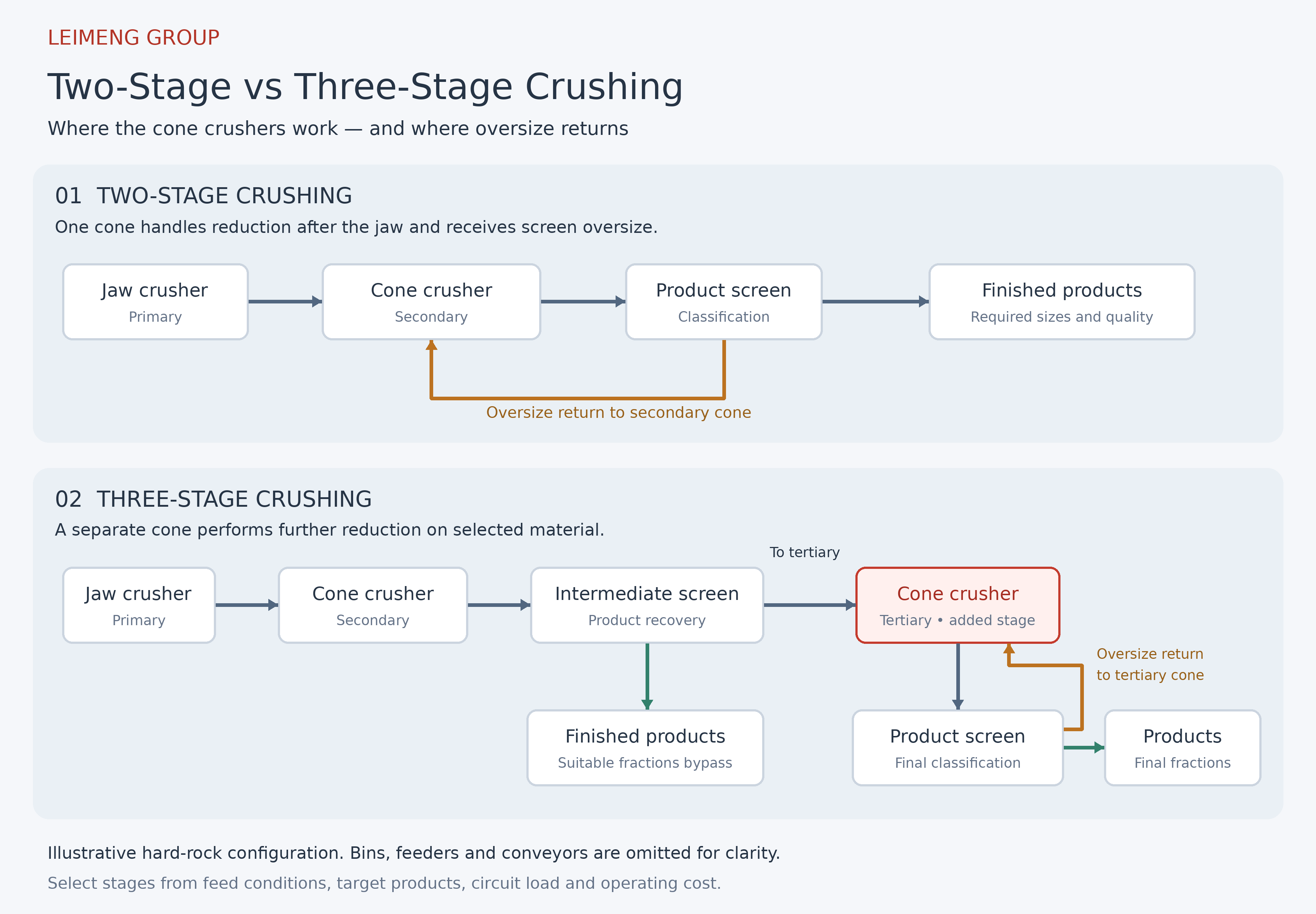
A two-stage hard-rock plant commonly includes:
Feed hopper → Feeder → Jaw crusher → Buffer storage and controlled feeding → Secondary cone crusher → Product screen
The screen separates finished products. Oversize can return to the secondary cone crusher through a return conveyor, forming a closed circuit.
This arrangement can be sufficient when:
- The secondary crusher accepts the primary crusher’s discharge comfortably.
- The required aggregate sizes are achieved at the target production rate.
- Product shape and grading meet the intended application.
- Return material stays within the circuit’s capacity.
- Wear, energy use and maintenance remain acceptable.
The important measure is saleable tonnes per hour in the required fractions, rather than the tonnes passing through the crusher.
A plant may process a large volume of rock while producing too little of its most valuable product. Conversely, a simpler two-stage line may be entirely adequate for a project selling larger aggregate or road-base material.
Product demand can change the answer
Suppose a quarry sells mainly larger aggregate. Its secondary cone crusher may complete the job successfully.
Later, demand shifts toward smaller concrete aggregate. The same plant may need to produce much more of the smaller fractions. Closing the secondary crusher setting could help, but it may also increase operating load and reduce throughput.
At that point, the question becomes: can the existing circuit meet the new product mix economically, or should part of the reduction move to a third stage?
3. When Should You Add a Tertiary Cone Crusher?
Adding a tertiary crusher makes sense when there is a clear reduction duty for it to perform.
| Plant condition | What to check first | When a third stage may help |
| Too much oversize after secondary crushing | Chamber selection, setting, liner condition and feed distribution | The required reduction remains too demanding for the secondary stage |
| Too little of the required smaller aggregate | Product size distribution and yield by fraction | Further crushing can convert selected larger material into the target fractions |
| Secondary crusher runs heavily loaded | Actual feed, power, operating limits and return tonnage | A separate tertiary circuit can take over the final reduction duty |
| Tightening the secondary setting reduces output | Feed suitability, chamber and screen performance | Splitting the reduction between two cones may provide a better operating balance |
| Return conveyor carries excessive material | Whether the return contains true oversize or misplaced fines | A third stage may help if genuine oversize is driving the load |
| Product shape fails the specification | Rock structure, cone operation and particle shape testing | Further cone crushing or a dedicated shaping stage may be appropriate |
A third stage should have a defined feed and product target
“Add another cone crusher” is incomplete advice.
A useful upgrade proposal should identify:
- Which material will feed the new crusher.
- Its expected feed size distribution.
- The required discharge distribution.
- How much material will return through the circuit.
- Which finished products will bypass further crushing.
Without these details, an additional crusher can simply move the bottleneck downstream.
It also adds power demand, wear parts, maintenance and installation costs. The investment should therefore be judged against the increase in useful product output and its cost per saleable tonne.
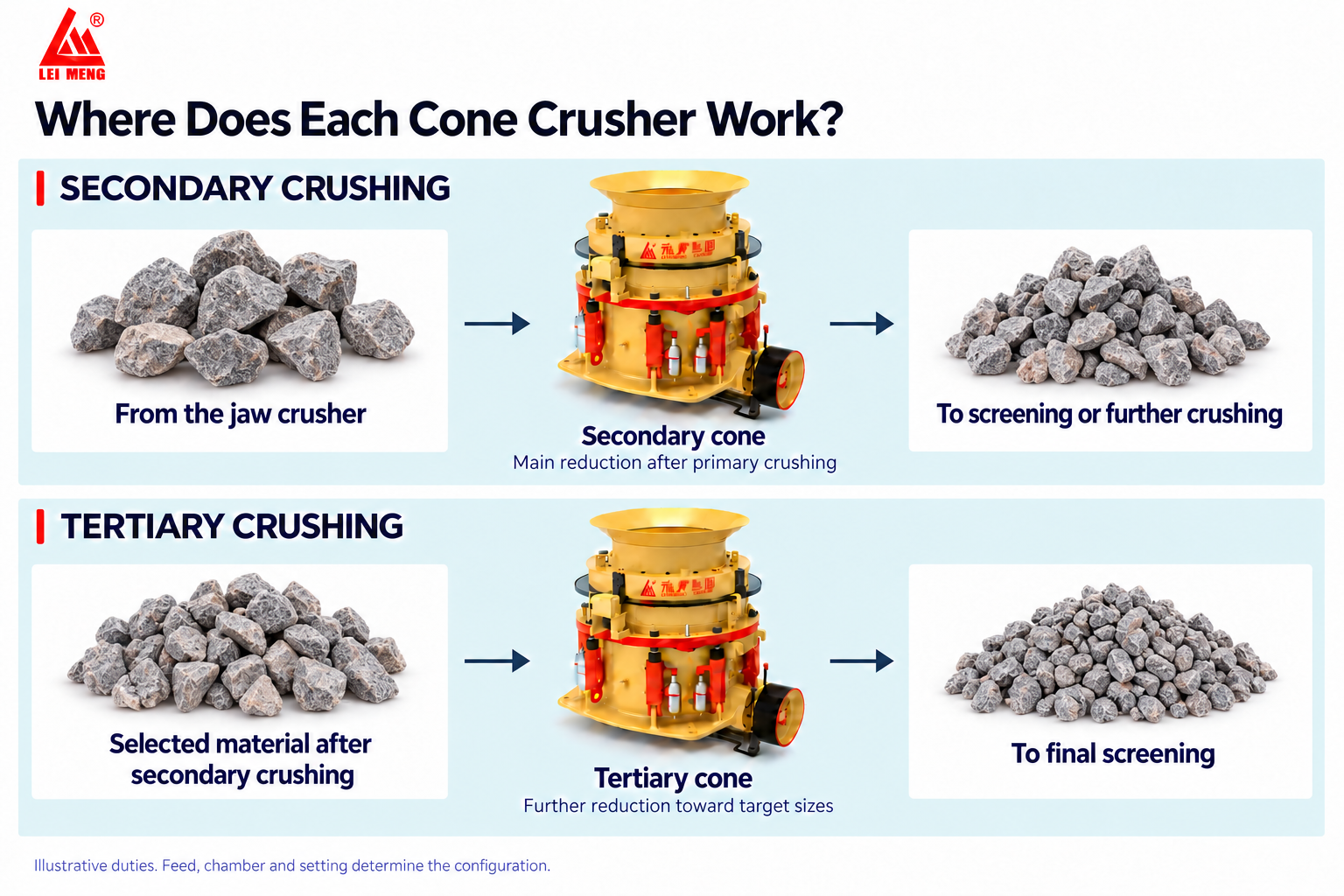
llustrative crushing duties. Stone sizes are schematic and do not represent guaranteed feed or product sizes.
4. How Should the Cone Crusher Match the Equipment Around It?
A cone crusher works within a system. Its performance depends on the material delivered to it and how quickly its discharge is removed and classified.
Match the primary crusher discharge to the cone feed opening
Check more than the jaw crusher’s nominal setting. The secondary cone must accommodate the actual top size and feed distribution, including variations in rock shape and primary liner condition.
A mismatch can cause poor feeding, interruptions or excessive loading. Depending on the problem, the solution may involve changing the primary setting, selecting another cone chamber or reviewing the equipment sizes.
Use buffer storage and controlled feeding
A buffer bin or stockpile can reduce the effect of irregular primary production. A controlled feeder then meters material into the cone.
For many aggregate cone applications, stable choke feeding supports efficient crushing and more consistent liner wear. The correct chamber level and operating limits should follow the specific equipment instructions.
The feed arrangement also matters. Material should enter evenly, without loading one side of the chamber or separating coarse and fine particles into different areas.
Select the chamber for its position in the process
A secondary cone chamber must suit the larger feed it receives. A tertiary chamber must suit its smaller feed and finer reduction duty.
Using a finer chamber does not automatically improve the plant. If the feed is too large, the chamber may restrict intake. If the feed is poorly matched or excessively fine, performance and liner use can suffer.
Chamber selection should consider feed grading, target product distribution, rock properties and operating capacity together.
Treat CSS as a process setting
The closed-side setting, or CSS, is the smallest gap between the mantle and concave during the crushing cycle.
It influences discharge grading, capacity and operating load. However, CSS is not a guaranteed maximum product size. Crusher discharge contains a range of particle sizes, so screening is still needed to separate the required products.
Closing the setting may produce finer material, but the effect on throughput, return load and wear must also be checked.
Size the screen and conveyors for the full circuit load
A closed circuit handles fresh feed plus returning material.
For example, if a cone receives 200 t/h of fresh feed and 100 t/h of return material, its total feed is 300 t/h. Equipment handling that combined stream must be assessed against the larger load.
This is an illustrative mass balance, not a capacity recommendation.
Screen area, deck arrangement, openings, material moisture and bed depth all affect separation. A screen that sends acceptable material back to the crusher creates unnecessary work.
Similarly, the crusher discharge belt and return belt must handle their actual duties. Conveyor capacity and transfer-point design can limit an otherwise suitable crusher.
5. What Does a Three-Stage Crushing Circuit Look Like?
One possible hard-rock arrangement is:
| Process position | Equipment | Purpose |
| Feed preparation | Hopper, feeder and suitable pre-screening | Deliver controlled feed and remove material that should bypass primary crushing |
| Primary crushing | Jaw crusher | Reduce large rock |
| Secondary feed control | Buffer bin and feeder | Stabilize supply to the secondary cone |
| Secondary crushing | Cone crusher | Perform intermediate reduction |
| Intermediate classification | Vibrating screen | Recover suitable products and select feed for tertiary crushing |
| Tertiary feed control | Bin and feeder | Provide steady feed to the tertiary cone |
| Tertiary crushing | Cone crusher | Reduce the selected larger fraction |
| Final classification | Product screen and return conveyor | Separate products and return oversize to the tertiary stage |
| Optional finishing | VSI, washing and dewatering equipment | Address additional shaping, sand or cleanliness requirements |
This is a process example, rather than a universal layout.
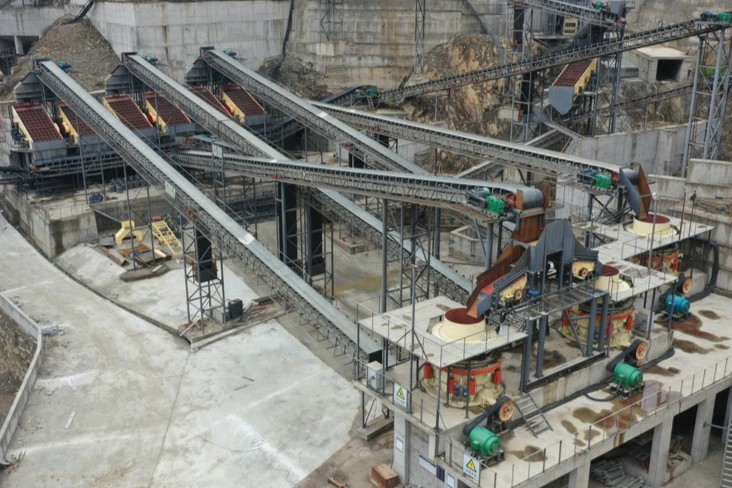
Some plants combine classification duties differently. Others require separate shaping or washing circuits. The arrangement should follow the material balance and product specification.
Avoid crushing finished material again unnecessarily
Where product specifications allow, material that already meets the required size and quality can bypass further crushing.
This reduces unnecessary load and limits additional fines generation. But size alone is not enough: a fraction that passes the screen may still require shaping or cleaning.
Decide whether the real need is finer aggregate or better shape
If the problem is excessive particle size, a tertiary cone may be a suitable option.
If the size is already correct but particle shape fails the specification, first review cone feeding, chamber selection and settings. A VSI shaping stage may then be considered where appropriate.
Adding a fine cone and adding a VSI address different duties. Their roles should be decided from product tests, not simply from the number of machines in the line.
6. Check the Bottleneck Before Buying Another Crusher
A high return load or low finished output does not prove that the plant needs three-stage crushing.
| Symptom | Possible cause | First action |
| Return belt carries small particles as well as oversize | Screen blinding, excessive bed depth or poor separation | Inspect screen condition and feed distribution |
| Cone alternates between empty and heavily loaded | Unstable supply or inadequate buffer storage | Review the bin and feeder arrangement |
| Crusher discharge backs up | Conveyor or transfer-point restriction | Check discharge handling capacity |
| Grading changes during production | Variable feed, liner wear or setting changes | Sample the feed and discharge; inspect liners and settings |
| Wet material reduces plant output | Clay, moisture or packing problems | Review pre-screening and material preparation |
| Throughput is acceptable but saleable yield is low | Circuit produces the wrong size distribution | Compare product demand with measured yields by fraction |
Before an upgrade, collect representative feed and product samples, fresh and return tonnages, crusher operating records and screen observations.
These records help distinguish insufficient crushing capacity from poor equipment matching. They also provide a useful baseline for assessing whether the upgrade delivers the intended result.
7. Planning a Leimeng Crushing and Screening Line
Leimeng Group provides jaw crushers, cone crushers, impact crushers, vibrating screens, feeders, belt conveyors and sand-making equipment for crushing and screening projects.
For a hard-rock line, Leimeng PE or GC jaw crushers can be considered for primary crushing, with HPY, DH/DS or LMC cone crushers evaluated for the downstream duties. The specific model and chamber should be selected from the feed conditions and required output.
Screening equipment, including YKJ inclined screens or DTS dual-shaft elliptical screens, should be matched to the classification duty and circuit load.
The starting point is a project requirement: what material enters the plant, what products must leave it, and how many saleable tonnes are needed each hour.
To review whether two-stage crushing is sufficient—or whether a tertiary cone should be added—send Leimeng Group:
- Raw material type and available test results.
- Maximum feed size and feed size distribution.
- Required fresh-feed capacity.
- Final product sizes and required tonnage of each fraction.
- Intended application and particle shape requirements.
- Moisture and clay conditions.
- Existing equipment models, settings and screen arrangement.
- Available layout, power supply and space for an upgrade.
- Current problems, supported by samples or operating records where available.
For an existing plant, a simple flow diagram and measured product yields are especially useful. They help identify where another cone crusher would add value and where supporting equipment also needs attention.
FAQ
What is the difference between secondary and tertiary crushing?
Secondary crushing reduces material after the primary crusher. Tertiary crushing further reduces selected material after the secondary stage, usually to improve the yield of smaller products or prepare feed for another finishing process.
Can the same cone crusher model work in both stages?
Some cone crusher models can serve either duty with suitable chambers and settings. Feed acceptance, operating capacity and product requirements must be checked for each application.
Is a jaw crusher and one cone crusher enough for granite?
It can be. The decision depends on feed size, rock properties, required capacity, product sizes and quality. Granite does not automatically require three crushing stages.
Does adding a tertiary cone crusher always increase production?
No. It can increase useful output when final size reduction is the bottleneck. If screening, feeding or conveying limits the plant, those restrictions must also be addressed.
Why is my cone crusher return load so high?
Possible causes include insufficient reduction, worn or unsuitable liners, an inappropriate setting, or inefficient screening. Check what is actually present on the return belt before deciding on another crusher.
Can I tighten the secondary cone setting instead of adding a third stage?
Sometimes. However, a tighter setting can affect throughput, load, wear and return tonnage. The decision should be based on measured product yield and operating performance.
Do I need a VSI after a tertiary cone crusher?
Only if the product requirements justify it. A VSI can provide additional shaping or sand production, while a tertiary cone mainly performs further compression crushing.
What should I measure before upgrading a crushing plant?
Measure fresh feed, return tonnage, product yield by size fraction and operating load. Combine these with feed and product sampling, equipment condition checks and a review of the plant layout.
https://www.lmcrusher.com/
GUANGDONG LEIMENG INTELLIGENT EQUIPMENT GROUP CO.,LTD.


+ There are no comments
Add yours