
As laser welding moves toward higher production speeds and increasingly automated manufacturing, the welding head has become a critical component for controlling how laser energy interacts with the workpiece. Higher laser power can increase welding productivity, but it also increases the demands placed on optical components, cooling systems, protective windows, mechanical structures, and process stability.
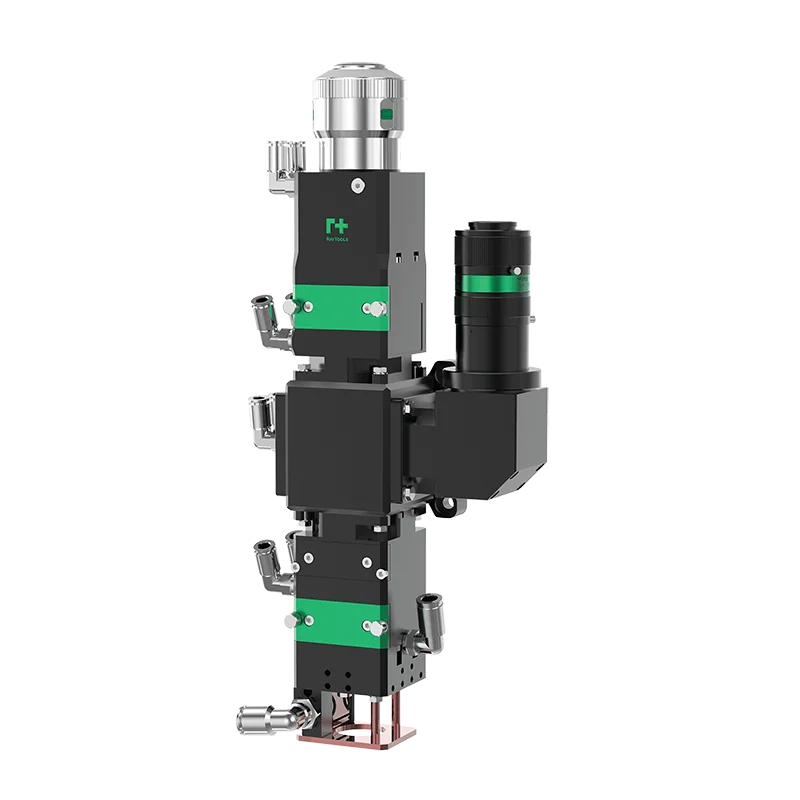
The BW03K laser welding head is intended for industrial laser welding environments where reliable beam delivery and integration are essential. Choosing the right configuration requires more than matching the welding head to a laser source. The actual application must be evaluated through power level, material, focal requirements, working distance, joint design, welding speed, cooling conditions, and operating duty cycle.
High-Power Laser Welding Requires Controlled Thermal Management
As laser power increases, thermal management becomes increasingly important inside the welding head.
Optical components are designed to transmit laser energy efficiently, but no optical system has absolutely zero absorption. At higher power levels, even relatively small absorption can generate measurable heat.
Thermal expansion can alter optical geometry and potentially affect beam quality or focal stability. A suitable cooling architecture helps remove accumulated heat and maintain more consistent operating conditions.
For continuous industrial production, cooling performance should therefore be evaluated under actual duty-cycle conditions rather than a short-duration laboratory test. The relevant question is whether the welding head can maintain stable performance after hours of repeated operation.
Laser Power Should Be Matched to the Welding Task
Higher laser power does not automatically mean better welding.
For thin sheet metal, excessive power can increase the risk of excessive penetration, burn-through, deformation, or unnecessary heat input. For thicker materials, insufficient power may limit penetration depth or require slower welding speeds.
A technically appropriate welding head should therefore support the process window required by the application.
For example, welding a 1 mm sheet and welding a 6 mm structural component can involve substantially different beam parameters, focal positions, shielding-gas requirements, and thermal loads. The welding head must provide optical and mechanical characteristics suitable for the selected operating range.
Beam Quality and Spot Size Affect Energy Density
Laser welding depends on concentrating energy into the correct area.
The relationship between beam diameter, focusing optics, focal length, and spot size determines the energy density delivered to the workpiece. A smaller spot can generate high energy density for precision welding, while a larger spot may be preferable for certain joint geometries or process requirements.
The optimum configuration depends on material and welding mode. Conductive materials such as copper and aluminum can require particularly careful process development because their optical and thermal properties differ from steels.
For production engineering, the focus should therefore be on the complete beam-delivery configuration rather than considering the welding head's nominal power capacity in isolation.
Working Distance Affects Automation Flexibility
Working distance determines how the welding head interacts physically with the workpiece.
A suitable working distance provides enough clearance for the nozzle and head structure while maintaining the required focal geometry. In robotic welding, this becomes especially important around corners, curved components, recessed joints, and complex assemblies.
If the working distance is too short, collision risk and contamination exposure may increase. If it is too long without appropriate optical design, maintaining the required spot characteristics may become more difficult.
The selected BW03K configuration should therefore be matched to the geometry and accessibility of the production component, particularly when the head is installed on a multi-axis robot.
Joint Fit-Up Can Determine Whether the Laser Process Succeeds
Laser welding is often associated with narrow weld seams and high precision, but this precision also makes joint preparation important.
A gap, misalignment, or variation in sheet thickness can change the interaction between the laser beam and molten pool. A process developed for a tight joint may not perform identically when the gap increases.
This means welding-head selection should be considered alongside fixture accuracy and component tolerances. If the application involves variable joint conditions, beam oscillation, seam tracking, or process monitoring may become valuable additions.
The objective is to create sufficient process tolerance to accommodate realistic production variation without compromising weld quality.
Protective Window Management Becomes More Important at Higher Power
At high laser power, contamination of the protective window can become a significant process risk.
Spatter or vapor deposits on the window can increase absorption. The resulting temperature rise may further accelerate contamination or damage, creating a feedback effect that can reduce optical performance.
For continuous production, protective-window inspection should therefore be integrated into preventive maintenance. Operators should monitor contamination, transmission-related symptoms, visible damage, and changes in welding behavior.
Maintaining a clean optical interface can help protect the more expensive internal components of the welding head and reduce unexpected production interruptions.
Nozzle and Gas Configuration Influence Process Stability
Shielding-gas delivery should be designed around the actual welding process.
The nozzle must position the gas correctly relative to the laser spot and molten pool. Flow rate should be sufficient to protect the weld without creating excessive turbulence.
Different materials and welding speeds can require different gas strategies. Stainless steel, carbon steel, aluminum, and copper do not necessarily respond identically to the same shielding conditions.
A production setup should therefore validate gas flow and nozzle geometry experimentally rather than simply copying parameters from another material or machine.
Mechanical Integration Is Essential for Robotic Welding
In an automated system, the welding head becomes part of the robot's moving mass.
The mounting structure must maintain the required position during acceleration, deceleration, and changes in welding direction. Cables, gas lines, and cooling pipes should be routed so that they do not introduce unwanted torque or interference.
This is particularly important in high-speed robotic applications. Even when the robot itself provides high repeatability, external forces generated by poorly managed hoses or cables can influence the position and behavior of the welding head.
A robust integration design should therefore consider the welding head, mounting bracket, utility routing, robot motion envelope, and maintenance access as a single mechanical system.
How to Evaluate BW03K for a Production Line
Before deployment, the welding head should be evaluated using the actual laser source and representative workpieces.
The test should examine beam delivery, focal stability, weld penetration, surface appearance, spatter behavior, shielding-gas performance, thermal stability, and protective-window condition over the intended operating cycle.
For automated lines, the test should also include repeated movement and realistic robot trajectories. A welding head that performs well during a short stationary test may behave differently under continuous robotic movement.
Production validation should ultimately answer three questions: Can the head deliver the required laser energy consistently? Can it maintain optical and mechanical stability throughout the duty cycle? Can it integrate with the machine architecture without creating unnecessary maintenance or downtime?
RayTools: From Laser Components to Manufacturing Applications
RayTools focuses on intelligent laser manufacturing and provides solutions for applications ranging from precision microprocessing to large-scale automated production. Its technology and application coverage includes laser cutting, drilling, welding, cladding, hardening, surface treatment, microprocessing, 3D printing, additive manufacturing, and online marking.
This broad industrial application experience supports a process-oriented approach to welding-head development. Instead of treating the welding head as an isolated optical component, the product can be considered within the complete laser manufacturing workflow.
For equipment builders and production lines, this approach is valuable because successful laser welding depends on coordinated performance across the laser source, optics, motion system, shielding gas, cooling, fixtures, and process control.
Final Considerations
The BW03K laser welding head should be selected according to the actual requirements of the welding process rather than based solely on maximum laser power.
Optical transmission, focusing characteristics, working distance, thermal management, protective-window design, nozzle configuration, mechanical rigidity, and automation compatibility all influence production performance.
For high-power and automated laser welding, the most important objective is process stability. A properly matched welding head helps maintain predictable beam delivery and focal conditions while protecting critical optical components from the thermal and contamination challenges of continuous production.
When the welding head is engineered as part of the complete laser welding system, it can support higher process consistency, more reliable automation, controlled maintenance requirements, and a more stable production window.
www.raytools.com
RayTools

+ There are no comments
Add yours