
A Small CNC Gear Hobbing Machine is designed for manufacturers that need controlled gear production without the footprint, investment, and operating requirements associated with larger gear-cutting equipment. However, “small” should not be interpreted as a compromise in machining capability. For precision gears used in automotive components, motorcycles, reducers, pumps, synchronous pulleys, and other compact mechanical systems, the machine must provide sufficient rigidity, synchronized motion, thermal stability, and repeatable tooth geometry.
The real challenge is to maintain gear accuracy while achieving practical cycle times. A machine that produces an accurate first component but suffers from vibration, thermal drift, or inconsistent synchronization during continuous production cannot deliver stable manufacturing economics. Therefore, evaluating a Small CNC Gear Hobbing Machine requires attention to the relationship between machine structure, CNC control, spindle performance, workpiece capacity, tooling, and actual production requirements.
What Makes a Small CNC Gear Hobbing Machine Suitable for Precision Gear Production?
Gear hobbing is a generating process in which the hob and workpiece rotate in a synchronized relationship to generate the tooth profile. Unlike simple milling operations, the machining result depends heavily on coordinated rotational motion and the geometric relationship between the hob, workpiece, and machine axes.
For small gears, this synchronization becomes particularly important because the tooth dimensions and machining allowance can be relatively small. A minor positioning or rotational error can influence tooth thickness, profile accuracy, lead accuracy, and surface quality.
A CNC gear hobbing machine therefore needs more than basic numerical control. It requires stable axis synchronization, reliable spindle positioning, appropriate feed control, and sufficient mechanical rigidity to maintain the programmed generating relationship throughout the cutting cycle.
Machine Rigidity Directly Affects Gear Accuracy
Gear hobbing generates cutting forces that vary according to workpiece material, module, tooth geometry, cutting depth, hob diameter, cutting speed, and feed rate. If the machine structure deflects under these forces, the programmed cutting position may not correspond exactly to the actual cutting position.
For this reason, machine-tool rigidity is a critical factor when comparing compact CNC hobbing machines.
Wuxi General Machinery Co., Ltd. designs its gear hobbing machines around high rigidity and stability, using double-wall and high-rib plate structures for major castings. Finite element analysis is applied during structural development to improve overall rigidity while controlling structural stability.
This type of construction is particularly relevant when a small gear is machined at relatively high cutting speeds. A rigid structure helps suppress vibration and deformation, creating a more stable cutting environment and improving the consistency of tooth geometry from one workpiece to the next.
High-Speed Machining Is More Than Increasing Spindle RPM
A higher spindle speed can reduce machining time, but speed alone does not determine productivity.
The complete cutting system must maintain stable synchronization between the hob spindle and workpiece spindle while controlling axial feed and other programmed movements. Excessive vibration at high speed can offset the productivity gained from higher rotational speed by increasing tool wear, surface roughness, or dimensional variation.
A practical high-efficiency strategy therefore combines spindle capability with rigid machine construction, optimized transmission, precise CNC control, suitable cutting tools, and stable coolant delivery.
For manufacturers producing hundreds or thousands of identical gears, cycle-time reduction becomes especially valuable. If a machining cycle is reduced from 60 seconds to 45 seconds, theoretical machine capacity increases by approximately 33%, assuming loading, inspection, tooling, and other production constraints remain unchanged. The actual improvement will depend on the complete production cell, but this illustrates why cycle time should be evaluated together with machining stability.
Workpiece Range Determines Machine Utilization
The term “small” can refer to machine size rather than the entire range of gears the machine can produce.
A useful CNC hobbing machine should be matched to the customer's actual workpiece envelope. Important parameters include maximum workpiece diameter, maximum module, face width, workpiece length, allowable shaft geometry, hob diameter, hob length, and maximum workpiece weight.
For example, a production line manufacturing small spur gears may prioritize compact workpiece capacity, rapid setup, high-speed cutting, and short cycle times. A supplier producing both disc gears and shaft gears may require greater flexibility in workpiece configuration.
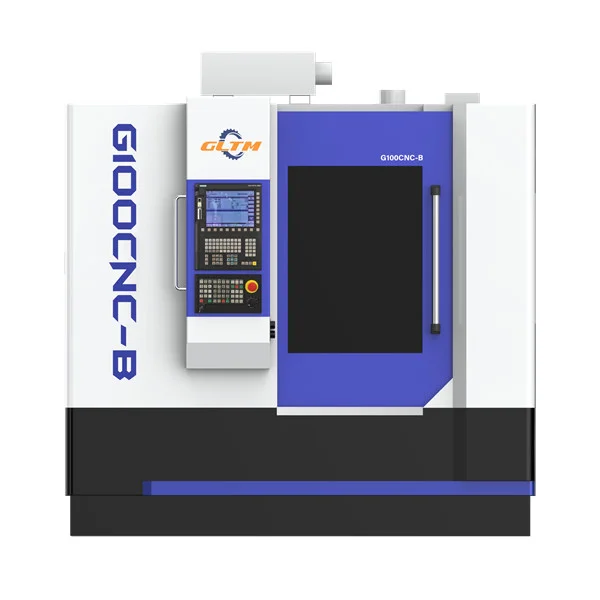
Wuxi General Machinery has developed a broad CNC gear hobbing range, from the G80CNC and G100CNC to larger models such as the G800CNC, G1200CNC, G1500CNC, and G2000CNC. This range allows machine selection to be based on workpiece requirements rather than forcing different applications into a single machine size.
Spur Gears and Helical Gears Require Different Considerations
Small CNC gear hobbing machines are commonly used to manufacture cylindrical spur gears and cylindrical helical gears, but the production requirements are not identical.
For spur gears, the generating relationship is relatively straightforward because the tooth direction is parallel to the gear axis. Helical gears introduce an additional lead angle and require coordinated motion between the workpiece and tool to generate the helical tooth form correctly.
The machine's CNC system and axis configuration must therefore provide reliable synchronization for the selected helix angle and machining strategy.
This is particularly important for shaft gears, where the workpiece may have limited clamping space and the gear section may be located close to shoulders or other features. The machine's workholding arrangement, tool accessibility, and interference envelope should be evaluated together with the gear drawing.
Gear Hobbing Applications Extend Beyond Standard Spur Gears
Industrial gear production often involves more than conventional cylindrical gears.
The machine series developed by GLTM is designed for generating cylindrical spur gears, cylindrical helical gears, shaft gears, disc gears, worm gears, small taper gears, drum gears, splines, sprockets, and synchronous pulleys, depending on the applicable machine configuration and tooling.
This flexibility can be valuable for manufacturers serving multiple industries. Automotive and motorcycle components may require compact transmission gears, while reducer manufacturers often need different gear sizes and configurations. Pump manufacturers may require specialized toothed components, and synchronous-belt applications may involve pulley geometries rather than traditional involute gears.
A machine that supports multiple workpiece types can improve equipment utilization and reduce the need for dedicated machines for every component family.
CNC Control and Setup Efficiency Affect Production Economics
For high-mix production, setup time can become as important as cutting time.
Changing the workpiece, hob, fixture, or machining program requires reliable parameter management and repeatable machine positioning. CNC control should therefore support efficient program preparation and stable repeat production.
A well-designed production workflow can reduce non-cutting time by standardizing tooling, workholding, coordinate references, and machining parameters. This is especially useful for small-batch production, where excessive setup time can significantly increase the cost per gear.
The machine should therefore be evaluated using a complete production cycle: loading, clamping, alignment, cutting, unloading, inspection, and tool change—not merely the advertised cutting speed.
Tool Life and Cutting Stability Must Be Considered Together
Hob wear affects gear accuracy, surface quality, and production cost.
A rigid machine structure can contribute to stable cutting conditions, but tool life also depends on workpiece hardness, cutting speed, feed rate, cutting depth, coolant conditions, hob material, coating, and gear geometry.
For production planning, the useful measurement is not simply how long one hob lasts but how many acceptable gears it can produce before adjustment or replacement becomes necessary.
For example, if a process produces 800 acceptable gears per tool instead of 600 under comparable conditions, tool-change frequency is reduced by approximately 25% for the same production volume. This can lower tooling cost and reduce interruptions, provided the longer tool life does not compromise gear accuracy or cycle time.
From Gear Hobbing to a Complete Gear Manufacturing Solution
Gear hobbing is only one stage in a complete gear production process.
Depending on the accuracy class and application, manufacturers may require gear shaping, gear skiving, gear grinding, chamfering, and gear measurement after or alongside hobbing. GLTM has expanded its product portfolio to include gear grinding machines, gear shaping machines, gear skiving machines, gear measuring centers, gear chamfering machines, and other CNC equipment.
This broader equipment capability can help manufacturers plan a complete gear-making process rather than selecting a hobbing machine independently from downstream operations.
For high-precision gears, the relationship between hobbing accuracy and subsequent finishing allowance is particularly important. A stable roughing or pre-finishing process provides a more predictable foundation for later grinding or other finishing operations.
Why Machine Structure Matters for Long-Term Production
A gear hobbing machine may run for thousands of operating hours over its service life. Structural stability must therefore be considered beyond the initial acceptance test.
GLTM began producing high-speed and high-efficiency CNC gear hobbing machines in 2012 and has developed a series covering different workpiece capacities. Its technical team has accumulated experience in gear hobbing and gear-cutting machine development, while the company maintains ISO 9001 and CE certifications and holds multiple technical patents.
For equipment selection, these credentials should be considered alongside machine-specific test results, accuracy data, cutting samples, service capability, and the manufacturer's ability to support the intended application.
Final Considerations
The right Small CNC Gear Hobbing Machine should provide a practical balance between workpiece capacity, structural rigidity, CNC synchronization, cutting speed, setup efficiency, tool life, and production flexibility.
For compact gears, accuracy cannot be separated from machine rigidity and motion control. For high-volume production, speed must be supported by stable cutting conditions. For diversified manufacturing, the machine's usable workpiece range and ability to process different tooth types become increasingly important.
GLTM's approach of combining rigid machine structures, CNC gear-generation technology, and a broad range of gear-making equipment provides a foundation for manufacturers seeking to build efficient and repeatable gear production processes.
The final selection should always be validated against actual gear drawings, material, module, tooth count, helix angle, face width, target accuracy, cutting parameters, and required production volume. This engineering-based approach provides a much stronger basis for selecting a Small CNC Gear Hobbing Machine than comparing machine size or headline speed alone.
www.gltmachinery.com
Wuxi General Machinery Co., Ltd.

+ There are no comments
Add yours