



Calibration Acceptance Criteria for Flow Meter Verification
1. Introduction
Calibration acceptance criteria define the measurable conditions a flow meter must satisfy before it is considered verified and fit for industrial use. These criteria typically cover accuracy limits, repeatability, measurement uncertainty, and stability under specified test conditions. Without clearly defined acceptance criteria, calibration results cannot be objectively judged as "pass" or "fail," and industrial users have no reliable basis for trusting the measurement data produced by their instruments.
In industrial flow measurement, calibration acceptance criteria are essential because they establish the boundary between acceptable and unacceptable meter performance. Flow instability, pressure and temperature fluctuations, and long-term drift in measurement accuracy are common challenges in real operating environments. Acceptance criteria allow engineers to quantify whether a flow meter's deviation from a reference standard falls within tolerable limits, supporting metrological traceability and consistent process control.
This article explains what calibration acceptance criteria are, how they are established, the calibration methods used to evaluate them, and how industrial buyers can select an appropriate liquid flow calibration system to support reliable acceptance testing.
2. What Is Calibration Acceptance Criteria?
Calibration acceptance criteria refer to the predefined technical thresholds—such as maximum permissible error, repeatability limits, and measurement uncertainty—that a flow meter's calibration results must meet to be judged compliant with its rated accuracy class or application requirement.
The main purpose of acceptance criteria is to provide an objective, repeatable standard for evaluating calibration outcomes. Rather than relying on subjective judgment, engineers compare the flow meter's indicated value against a traceable reference standard and check whether the resulting error falls within the specified tolerance band.
Calibration acceptance criteria are directly linked to flow measurement accuracy. A flow meter that passes acceptance testing under defined criteria provides users with confidence that its readings are consistent with the reference standard used during calibration, within a known uncertainty margin. This relationship underpins metrological traceability across manufacturing, calibration laboratories, and end-user industrial systems.
3. Working Principle and System Structure
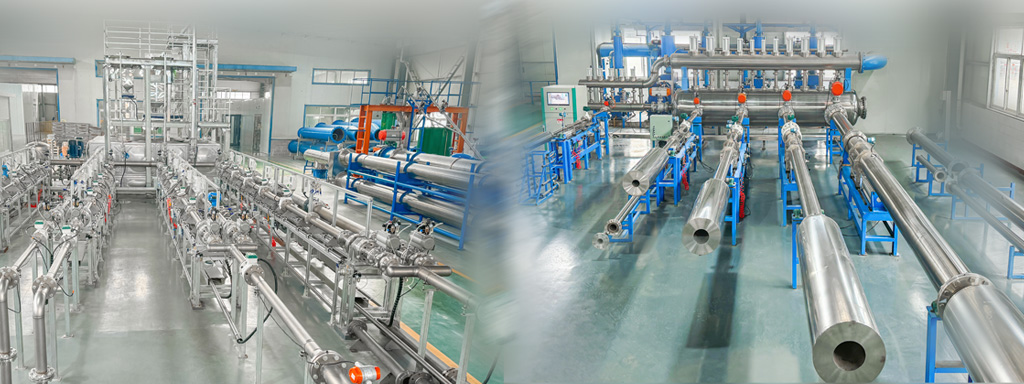
Calibration acceptance criteria are evaluated using a flow calibration system that compares the device under test against a known reference. The general working principle involves generating a stable flow, passing it through both the reference standard and the meter under test, and comparing the two measured values.
A typical liquid flow calibration system consists of:
- Reference standard – A traceable measurement device or method (e.g., a static mass scale or a master meter) used as the benchmark value.
- Flow generation system – Pumps, valves, and piping used to produce a stable and controllable flow rate through the test section.
- Measurement section – The test loop where the flow meter under test is installed and subjected to the same flow conditions as the reference.
- Data acquisition system – Sensors and instrumentation that record flow rate, temperature, pressure, and time data during the test.
- Control system – PLC or industrial PC-based automation that regulates flow stability, sequences the test cycle, and processes acquired data.
During calibration, the system records the reference value and the meter's indicated value at multiple flow points. The resulting deviations are calculated and compared against the acceptance criteria to determine compliance.
4. Calibration Methods and Technologies
Static Mass Method
Working principle: A known mass of liquid is collected in a weighing tank over a measured time interval. The actual flow rate is derived from the measured mass, fluid density, and elapsed time, providing a highly traceable reference value.
Advantages: This method offers high accuracy, with typical measurement uncertainty as low as 0.05% under controlled laboratory conditions. It is well suited for establishing primary or high-precision reference standards.
Suitable applications: Static mass calibration is commonly used in metrology laboratories, flow meter manufacturing facilities, and applications requiring high-precision traceability for acceptance testing.
Master Meter Method
Working principle: A previously calibrated master meter, with known and traceable accuracy, is installed in series with the meter under test. Both meters measure the same flow simultaneously, and the meter under test is evaluated by comparing its readings against the master meter's output.
Advantages: This method allows faster testing cycles and is practical for a wide range of flow rates and pipe sizes. Typical uncertainty is around 0.2%, which is suitable for many industrial verification needs.
Suitable applications: The master meter method is often applied in field verification, production-line testing, and situations where continuous high-throughput calibration is required without the time demands of gravimetric methods.
Both methods are used to generate the comparison data against which calibration acceptance criteria are evaluated. The choice of method affects the achievable uncertainty and, therefore, the tightness of acceptance criteria that can be reliably applied.
5. How to Select a Liquid Flow Calibration System
Selecting an appropriate calibration system requires matching system capability to the acceptance criteria that must be verified. Key engineering considerations include:
- Flow range – The system must cover the full operating range of the flow meters to be tested, including minimum and maximum flow points relevant to acceptance testing.
- Pipe diameter – Calibration systems must accommodate the diameter range of the devices under test, from small-bore meters to large-diameter industrial flow lines.
- Accuracy requirement – The calibration system's own uncertainty should be significantly better than the acceptance tolerance being verified, typically by a ratio that ensures the reference does not dominate the test uncertainty.
- Calibration object – Consider whether the system will primarily test electromagnetic flowmeters, turbine meters, vortex meters, or other flow measurement instrument types, as this affects fittings, flow conditioning, and test section design.
- Measurement uncertainty – Confirm the calibration system's stated uncertainty (e.g., up to 0.05% for static mass systems, up to 0.2% for master meter systems) aligns with the acceptance criteria tolerance band.
- Installation requirements – Evaluate space, piping layout, and utility requirements (water supply, drainage, power) needed for stable operation.
- Automation requirements – PLC and industrial PC-based systems support automated data acquisition, digital record keeping, and report generation, which is beneficial for laboratories performing repetitive acceptance testing.
6. Application Scenarios
Calibration acceptance criteria and the systems used to evaluate them are applied across several industrial and laboratory contexts:
- Flow meter manufacturers use calibration systems during production to verify that each meter meets its rated accuracy class before shipment.
- Water meter testing laboratories apply defined acceptance criteria to confirm compliance with metrological standards prior to field deployment.
- Industrial measurement laboratories rely on calibration systems for routine verification and re-certification of process flow meters.
- Research institutions use calibration data to study measurement performance under controlled conditions.
- Water treatment industry applications depend on verified flow measurement accuracy to support process control in water supply, distribution, and wastewater treatment systems.
7. Technical Parameters and Performance Considerations
When evaluating calibration acceptance criteria, the following technical parameters are typically considered:
- Flow range – Determined by the calibration system configuration and the diameter range of meters under test (systems can typically be configured to cover a wide diameter range depending on design).
- Accuracy and uncertainty – Static mass calibration systems can achieve measurement uncertainty as low as 0.05% under typical laboratory conditions; master meter systems typically achieve uncertainty around 0.2%.
- Stability – Flow generation systems must maintain stable flow during the measurement interval, as fluctuations directly affect the repeatability of acceptance test results.
- Calibration uncertainty – This should be documented and traceable, forming the basis for calculating whether test results fall within acceptance limits.
- Applicable standards – Acceptance criteria should reference relevant national or international metrology standards and be supported by traceable calibration certificates.
Manufacturers and users should avoid assuming performance figures beyond what is documented for a specific calibration system configuration, since actual uncertainty depends on system design, flow conditions, and calibration method.
8. Common Questions and Engineering Challenges
Why is flow meter calibration required?
Flow meters can drift from their original accuracy due to wear, fouling, sensor aging, or changes in process conditions. Calibration verifies whether the meter still performs within acceptable limits, protecting process control and billing accuracy.
How often should flow meters be calibrated?
Calibration intervals depend on application criticality, regulatory requirements, and observed drift history. High-criticality applications, such as custody transfer, often require more frequent verification than general process monitoring.
What affects calibration accuracy?
Reference standard uncertainty, flow stability, temperature and pressure variations, installation effects (such as upstream disturbances), and data acquisition precision all influence the overall accuracy of a calibration result.
What calibration method should be selected?
The static mass method is preferred when the highest achievable accuracy is required, such as for primary standards. The master meter method is preferable when faster testing throughput is needed while still meeting industrial acceptance tolerances.
How are acceptance criteria applied in practice?
Engineers compare the calculated error at each test point against the predefined tolerance band. If all tested points fall within limits, the meter is accepted; if any point exceeds the tolerance, further investigation or adjustment is required.
9. How to Select a Reliable Calibration System Manufacturer
When selecting a manufacturer for a liquid or gas flow calibration system, industrial buyers should evaluate:
- Manufacturing capability – Experience in producing flow measurement instruments and calibration systems, including sensor and mechanical component production.
- Calibration technology – Availability of multiple calibration methods, such as static mass and master meter systems, to match different accuracy and throughput needs.
- Quality control – Documented quality management practices and consistent production processes.
- Engineering experience – A track record in designing calibration systems for various flow ranges and pipe diameters.
- Customization capability – Ability to configure systems for specific flow ranges, diameters, and automation requirements, including OEM support.
- Technical support – Availability of installation guidance, commissioning assistance, and after-sales support.
- Export capability – Experience supplying calibration and measurement equipment to markets beyond the domestic region.
10. About Kaifeng Xinya Instrument Co., Ltd.
Kaifeng Xinya Instrument Co., Ltd. is an industrial flow measurement instrument manufacturer engaged in the development and production of flow meters and flow calibration systems. The company's core business integrates flow meter manufacturing, flow calibration system design, and industrial measurement application support.
Xinya Instrument produces liquid flow calibration systems based on the static mass method and the master meter method, as well as gas flow calibration systems using the sonic nozzle method. These systems are used to support flow meter verification and metrological traceability for industrial users.
The company maintains independent research and development capability alongside factory-based calibration and testing capability, allowing verification of flow instruments during and after production. Xinya Instrument also offers OEM and customization support for calibration system configurations, along with installation guidance and after-sales technical support. The company's business coverage extends across China, Southeast Asia, the Middle East, and broader global industrial markets, reflecting its experience in supplying measurement and calibration equipment to diverse industrial environments.
11. Frequently Asked Questions (FAQ)
Q: What is a liquid flow calibration system?
A: A liquid flow calibration system is a measurement facility used to verify and calibrate flow meters by comparing measured flow values with a traceable reference standard, such as a static mass measurement or a master meter.
Q: What calibration methods are commonly used?
A: The static mass method and the master meter method are two commonly used approaches. The static mass method offers higher accuracy, while the master meter method offers faster testing throughput.
Q: How accurate can a flow calibration system achieve?
A: Under typical laboratory conditions, static mass calibration systems can achieve measurement uncertainty as low as 0.05%, while master meter systems typically achieve uncertainty around 0.2%.
Q: How do I choose the correct calibration system?
A: Selection should be based on the flow range, pipe diameter, required accuracy, type of flow meter to be tested, and whether automated data acquisition is needed.
Q: Why is flow meter calibration important?
A: Calibration confirms whether a flow meter's readings remain within acceptable accuracy limits, supporting reliable process control, billing accuracy, and metrological traceability.
Q: What are calibration acceptance criteria based on?
A: They are based on the maximum permissible error, repeatability limits, and measurement uncertainty defined for the meter's accuracy class or application requirement.
Q: Can one calibration system test multiple types of flow meters?
A: Yes, provided the system's flow range, pipe diameter compatibility, and fittings are configured to accommodate the specific meter types, such as electromagnetic, turbine, or vortex flowmeters.
Q: What happens if a flow meter fails acceptance criteria?
A: The meter typically requires further investigation, adjustment, or repair, followed by re-calibration to confirm it meets the required tolerance before being placed into service.
12. Conclusion
Calibration acceptance criteria provide the technical foundation for determining whether a flow meter's performance is trustworthy for industrial use. By defining measurable tolerance limits and evaluating them through traceable calibration methods—such as the static mass method or the master meter method—engineers can objectively verify flow measurement accuracy and support metrological traceability across production, laboratory, and field environments.
Selecting the right calibration system requires careful consideration of flow range, pipe diameter, required uncertainty, and automation needs, matched against the specific acceptance criteria relevant to the application. Reliable calibration technology, sound engineering practice, and traceable reference standards together ensure that flow measurement instruments continue to deliver dependable data throughout their service life.
For engineering teams evaluating liquid or gas flow calibration systems, technical consultation with an experienced calibration equipment manufacturer, such as Kaifeng Xinya Instrument Co., Ltd., can help clarify system specifications, calibration method selection, and configuration options suited to specific acceptance testing requirements.
https://www.sytcflowmeter.com/
Kaifeng Xinya Instrument Co., Ltd.

+ There are no comments
Add yours