


The choice is not about which machine is better. It is about which failure mode your market can tolerate. A can holds its carbonation for the life of the package because aluminum is a total barrier. A PET bottle begins losing CO2 from the day it is filled, and the loss accelerates as the container creeps under pressure. If your product needs a long ambient shelf life or travels through warm distribution, that single difference decides the answer. If your market buys resealable multi-serve and drinks it within weeks, PET wins on cost and convenience, and the barrier gap never becomes visible.
Everything else, including line speed, follows from the container.
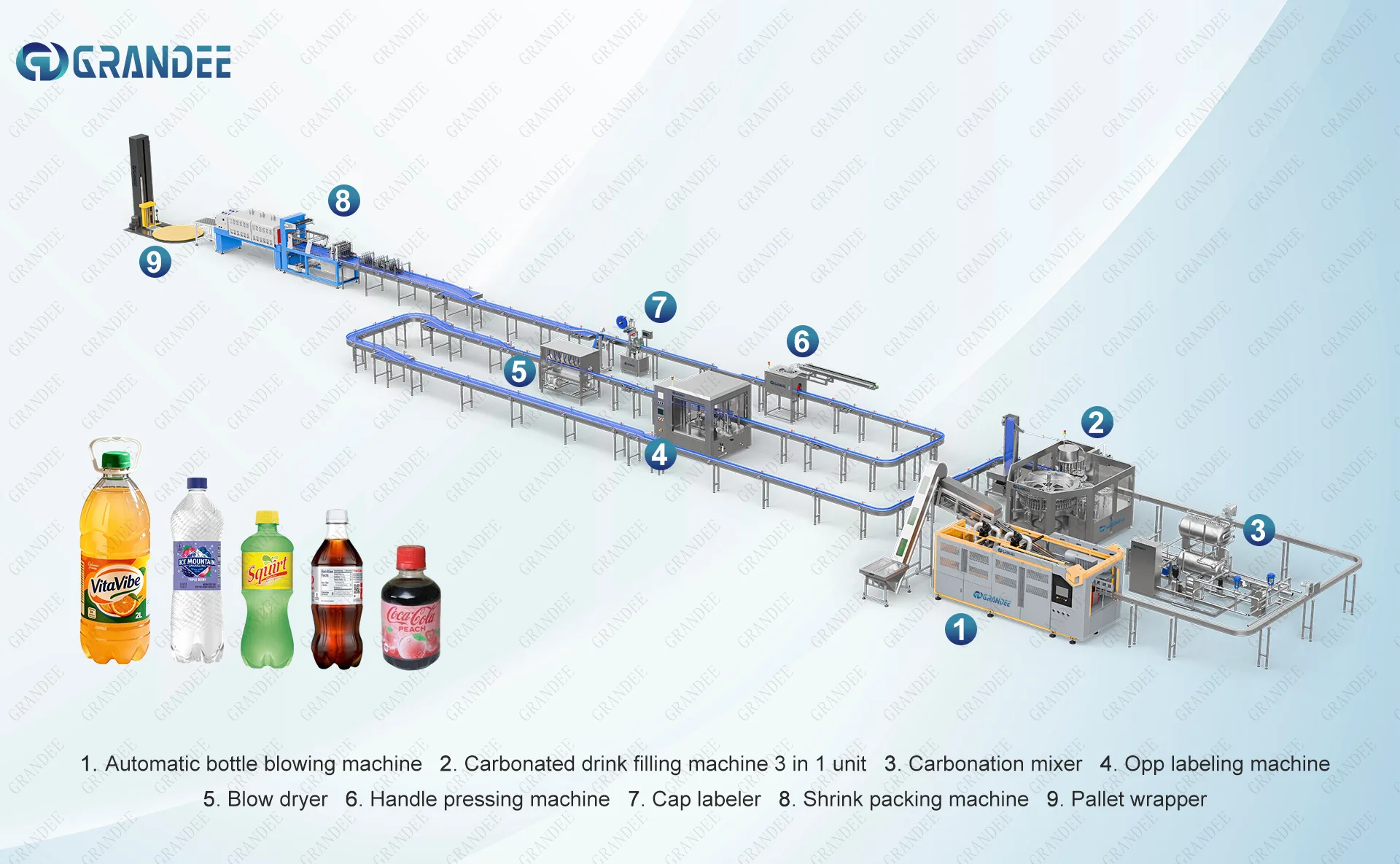
At a Glance
| Can filling and seaming | 1,500–36,000 CPH, with filling and double seaming on one machine |
| Bottle, integrated | Rotary blow-fill-cap, 12,000–36,000 BPH |
| Bottle, standalone | 3-in-1 isobaric rinse-fill-cap for PET and glass, 2,000–25,000 BPH |
| Shared upstream | Carbonation mixer, CIP, water treatment |
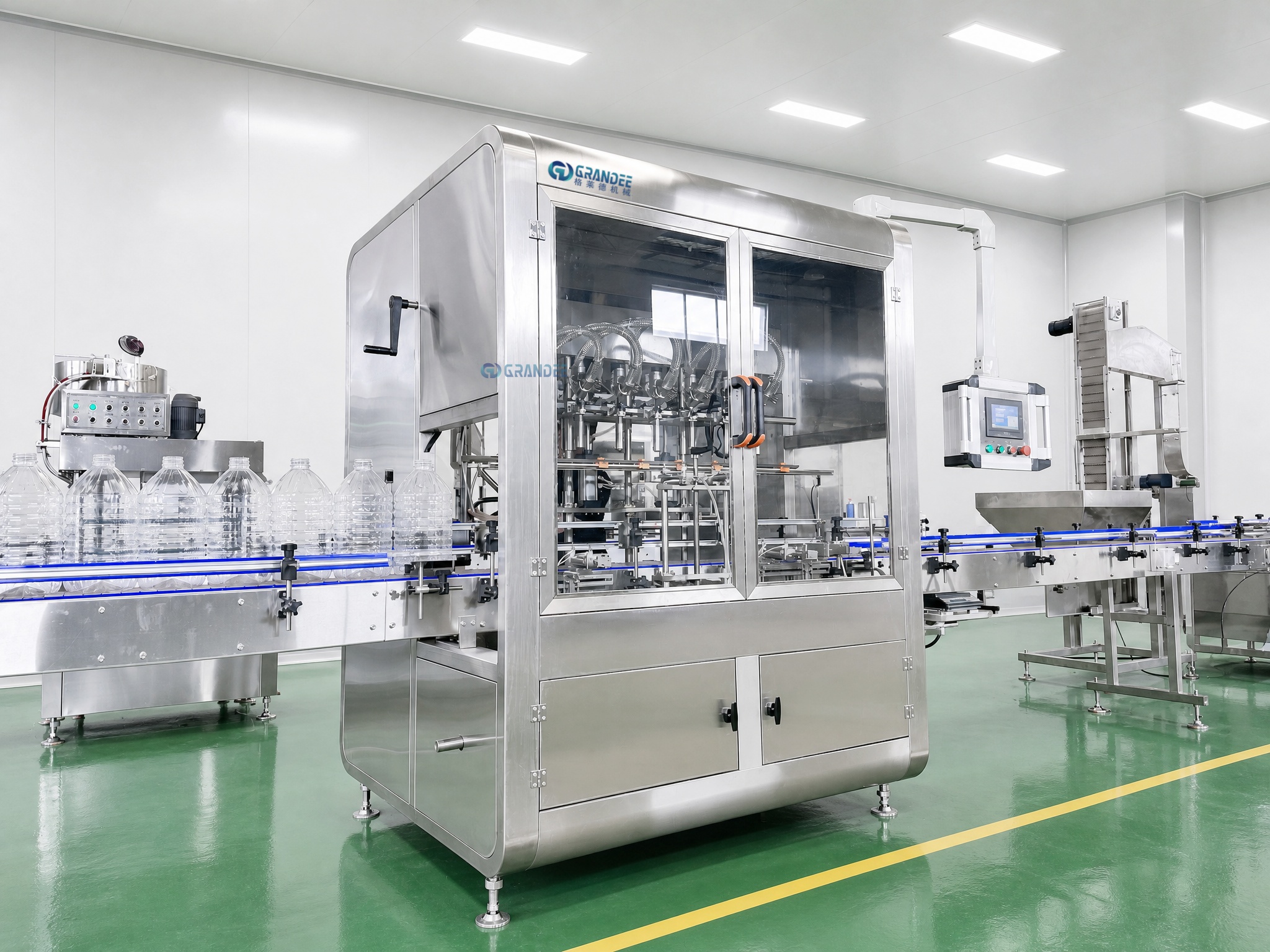
The bottle figures in that table are Grandee Machine’s own: the 3-in-1 isobaric rinse-fill-cap machine for PET and glass, and the integrated blow-fill-cap monoblock. Both fill under CO2 counter-pressure, both share the same carbonation and CIP logic upstream, and both are supplied as part of a turnkey project rather than as a standalone unit. The can figures describe the alternative route and the operating discipline it carries.
The Barrier Difference Is the Whole Argument
Aluminum is impermeable. A sealed can blocks oxygen, light and CO2 completely, which is why canned carbonated drinks hold their specification for a year or more without special measures.
PET is permeable, and it is worse than permeable under pressure. CO2 migrates through the polymer wall continuously, and the rate rises with temperature. A bottle that tests at target on the filler can test below target after a few months in a warm warehouse. Nothing has leaked and nothing is defective; the package simply does not hold gas the way metal does.
This is the point most comparisons skip, because it does not show up in a machine specification. It shows up eighteen months later as a customer complaint in a market whose storage temperature you do not control.
The practical questions that follow are specific. What shelf life do you need to promise? What is the ambient temperature profile of your distribution? Is the product sold to be consumed immediately or stored? Answer those three and the container usually picks itself.
Why the Two Rates Are Not Comparable
Cans are counted per hour and bottles are counted per hour, and in this range both families reach 36,000 at the top. It is tempting to line those two numbers up and read one as the faster machine. They do not measure the same thing, and the difference is mechanical rather than a matter of engineering quality.
A can arrives at the filler already formed, already coated and already inspected. The machine fills it and closes it with a double seam. There is no container manufacturing step in the critical path, so throughput is set mainly by the filler valve count and the seamer heads.
A bottle line has to make the container first. Even in a fully integrated blow-fill-cap monoblock, the blowing station sets a cycle time the filling station must live with, because the two are mechanically linked on one rotor. That is the price of the integration: you remove handling and contamination risk, and you accept a shared cycle time.
So at the same nominal rate, the bottle line is doing more work per unit: it is manufacturing the package as well as filling it. That is the honest basis for reading the two numbers, and it is also why neither rate should be used as a ranking. The only figure worth comparing is a measured output at your own container format and your own product.
The Bottle Problem Nobody Puts in the Brochure: Creep
PET is viscoelastic. Under sustained internal pressure it does not fail suddenly, it deforms slowly. The base pushes outward, the body bulges, and the internal volume grows.
Three consequences follow, and all three are measurable.
1. Apparent underfill. A bottle filled to the correct level at the filler reads low a week later, not because product escaped but because the container expanded. Fill level inspection done only at the filler will not catch it.
2. Accelerated CO2 loss. A larger internal volume at the same gas mass means lower carbonation in the liquid, on top of the loss through the wall.
3. Shape memory loss. A bottle that has crept does not return to its design shape, which shows up downstream as a handling problem in labeling and packing.
The mitigation is bottle design and bottle weight, not machine settings. Base geometry, wall thickness and resin grade determine how much a bottle creeps at a given pressure. This is why a bottle that performs on a still water line can fail on a carbonated line at the same fill volume, and why an integrated blow-fill-cap configuration is worth considering at high output: forming and filling on one machine removes the window in which a warm, freshly blown bottle is most easily deformed.
The Can Side: The Seam Is the Closure
A can has no cap. It has a double seam, formed by rolling the can end and the body flange together under pressure. That seam is the entire closure, and it is created in milliseconds at 36,000 cans per hour. Whatever the barrier properties of aluminum, the package is only as good as that one joint.
Seam quality is dimensional, and it is checked on seven measurements rather than one.
Seam thickness. Too thin and the seal is incomplete; too thick and the coating is damaged during forming.
Seam width and seam length. Out of range means the hooks did not interlock correctly.
Body hook and cover hook. The interlocking curl dimensions. These determine whether the seam holds pressure.
Overlap. The proportion of hook engagement, and the single most predictive number for leakage.
Countersink depth. Affects how the seam sits against the chuck and how the can behaves under internal pressure.
A can line without a tear-down inspection routine is a can line waiting for a recall. Sample cans taken from each seamer head each shift, measured and logged, is the routine most beverage operations run. Because seam defects do not always leak immediately, pressure testing is the practical catch: an in-line tester applies controlled external pressure and rejects cans that deform or fail, surfacing a weak seam before the pallet leaves. The two checks do different jobs — one verifies the process, the other verifies the individual can.
This matters to the package decision, not just to the can line: if the plan is to sell a year-shelf-life product in cans, the seam discipline is a permanent operating cost the plant has to staff for. It is part of the true cost of choosing the format.
Matching the Format to the Channel, Not to the Preference
The decision framework that survives contact with a real project has three inputs.
1. The shelf life you must promise. Above roughly six months in ambient distribution, the barrier gap makes PET hard to defend in a carbonated product without additional measures. Under two months, it rarely matters.
2. Whether the package is resealable by design. A 1.5 L bottle is a multi-serve package and the closure is part of the value. A 330 ml can is single-serve and the closure is the opening.
3. Local recycling and retail reality. Aluminum carries a stronger recycled-content story in most markets. PET carries lower weight and lower freight cost per liter. Both are true, and which one your buyers reward is a market question rather than a technical one.
One practical note on mixed portfolios: a producer running both formats does not need two filling philosophies. Both bottle routes in this range fill under counter-pressure, and the can machine can be specified the same way, so the carbonation control logic and the upstream preparation are shared. What changes is the closing station — seamer versus capper — and the container handling before it.
Questions to Put to Any Supplier
1. What ambient shelf life has been demonstrated on a carbonated product in this bottle specification?
2. What bottle weight and base design does this pressure rating assume?
3. Does the line inspect fill level after capping as well as before?
4. On a can line, how many seam measurements per head per shift does the handover procedure specify?
5. Does the can line include pressure testing as standard, or is it bought separately?
6. What is the seamer head count, and what CPH does that give at my can size?
7. On the bottle line, what is the blowing cycle time, and how does it constrain filling speed?
8. What upstream carbonation capacity does each format require at my target output?
FAQ
Does a can really hold carbonation better than a PET bottle?
Yes, and the reason is material rather than mechanical. Aluminum is impermeable to CO2, oxygen and light, so a sealed can loses essentially nothing through the package wall. PET is permeable, and the loss rate rises with storage temperature. Both containers can be filled to the same specification; they do not hold that specification for the same length of time.
Why are the two rates counted differently?
Because they count different amounts of work. A can arrives already formed, so the machine fills and seams it. A bottle line forms the container as part of the same cycle, and in a blow-fill-cap monoblock the blowing station sets a cycle time the filling station shares. A bottle figure is therefore not directly comparable to a can figure, in either direction.
What are the critical quality checks on a can line?
Seam dimensions and can pressure. Seam quality is measured on thickness, width, length, body hook, cover hook, overlap and countersink depth, typically by tearing down sample cans from each seamer head each shift. Pressure testing checks individual cans by applying external pressure and rejecting those that deform. The first verifies the process; the second catches the exceptions.
Can one line run both cans and bottles?
Not on the same machine. The closing station is fundamentally different — a seamer for cans, a capper for bottles — and the container handling upstream differs as well. What can be shared is the filling principle, the carbonation control and the upstream preparation, which is why producers running both formats often standardize on isobaric filling across the plant rather than buying two unrelated systems.
Which format suits a new producer with limited capital?
Usually the one that matches the channel you can actually reach. PET has a lower container cost at small volumes and a resealable package that suits retail and home consumption. Cans need a can supply chain and are harder to justify below a certain volume. The equipment comparison matters less than whether the package fits how your first customers buy.
About Zhangjiagang Grandee Machinery Co., Ltd.
Zhangjiagang Grandee Machinery Co., Ltd., operating under the Grandee Machine brand, is a Jiangsu, China-based manufacturer and exporter of rotary filling machines and complete liquid filling lines. The range covers bottled water, juice, carbonated drinks, dairy, beer, vinegar and condiments, big-bottle water and 5-gallon barrels, with capacities running from 150 barrels per hour on the 5-gallon line to 36,000 bottles per hour on the integrated blow-fill-cap monoblock. Carbonated products are served by the isobaric 3-in-1 machine at 2,000–25,000 BPH and by the blow-fill-cap monoblock at 12,000–36,000 BPH. Both are built with 316L stainless steel contact parts and PLC/HMI control, and both are specified bottle-first: the container format, its pressure rating and its creep behaviour are settled before the valve count is chosen.
A project is delivered as a turnkey package: bottle design, factory layout, installation, commissioning and operator training under one contract, with automated CIP included as standard line capability. Civil works, building construction and utility connections are outside that scope, and the boundary is stated in the contract rather than discovered during installation.
The company brings more than 20 years of export experience and operates a standardized production facility exceeding 20,000 square meters. Equipment supplied for the European market carries CE marking, and the customer base spans Europe, South America, Africa, Southeast Asia and Central Asia.
Related Reading
Isobaric Carbonated Soft Drink Filling Line — how counter-pressure filling holds CO2 in the product, and where the gas is lost.
Glass Bottle Carbonated Filling Line at 4,000 BPH — what changes when the container is glass instead of PET.
Next Step
Two documents are worth requesting before a site visit: a shelf life test result on a carbonated product in the specific bottle you intend to use, and the seam inspection procedure with the measurement frequency your team will be expected to sustain. Neither is a brochure item, and both determine whether the line meets its specification in month twelve rather than on commissioning day.
Send four things through the inquiry form on this page: the shelf life you need to promise, the ambient temperature range your product travels through, the container you intend to use, and the output you are targeting. Grandee Machine will come back with the line configuration that fits those four answers, the carbonation mixer sized to the same output, and the bottle specification the pressure rating assumes — which is the number most quotations leave out.
https://www.grandeemachine.com/
Zhangjiagang Grandee Machinery Co., Ltd.

+ There are no comments
Add yours