


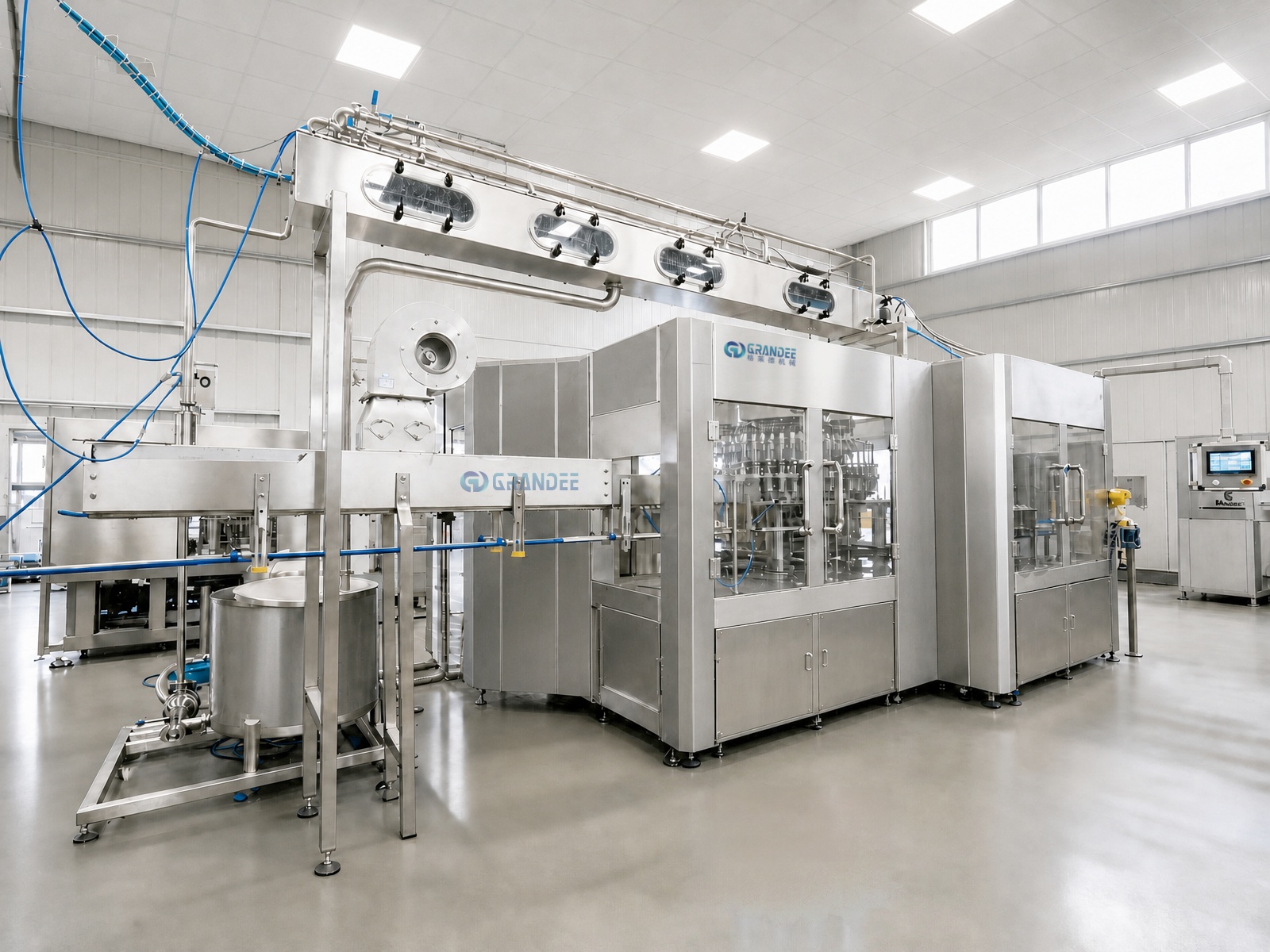
Product guide · 3-in-1 rinse-fill-cap
A 220 ml bottle and a 2 L bottle are not the same job, even when one machine is rated for both. Spec sheets usually quote a single capacity band across the whole format range, and buyers read it as though the machine scales with the bottle. It does not. The 3-in-1 rotary machine from Zhangjiagang Grandee Machinery Co., Ltd., sold under the Grandee Machine brand, covers 220–2,000 ml PET at 2,000–32,000 BPH, and that figure is quoted on a 500 ml basis for a specific reason — not as a marketing convenience.
This article covers three things: where the small end of the range actually constrains the line, what physically changes when you switch between 220 ml and 2 L, and which numbers to pin down in a contract before two offers look comparable.
The Small End Sets the Machine, Not the Large End
A 2 L bottle is mechanically forgiving. It is heavy enough to sit still, wide enough to be pushed, and stable enough that a worn gripper still gets it to the filler. A 220 ml bottle is the opposite: low mass, narrow body, high center of gravity relative to its footprint. On a rotary line that difference shows up in the three places where bottles are handed from one station to the next — the infeed star wheel, the rinse carousel and the transfer to the filler.
The practical consequence: a line that is specified against its largest bottle will run, but it will not run cleanly at its smallest. Ask for the change-part list and a trial run against your smallest format, not your largest. That single request separates a supplier who has run 220 ml bottles from one who has only quoted them.
Gripping, Not Filling, Is the First Constraint
A 220 ml PET bottle weighs a fraction of a 2 L bottle. Hanging that bottle from the neck ring alone leaves it free to swing, and a swinging bottle misaligns at the rinse nozzles and at the valve. The handling therefore has to hold the body, which means the gripper geometry and the lift stroke are set by the smallest bottle the line will ever run — not by the largest.
This is also where changeover cost lives. Moving from 220 ml to 2 L changes the neck support, the body grippers, the lift stroke and the filling-valve stroke. Each of those is a part, and the number of parts is what a multi-format bottler actually pays for. Ask how many pieces one switch involves and how long one operator needs, before assuming the machine is flexible.
Where Small Diameters Do and Do Not Buy Speed
Rotary filler speed is valve count multiplied by rotation rate. Bottle diameter sets the minimum pitch between valves, so a narrow bottle can, in principle, let more valves sit on the same pitch circle. That is a design decision made when the model is built — it does not happen by putting a smaller bottle on an existing machine. Changing format on a fixed model leaves the valve count unchanged.
The rule to take away: on a given model, a smaller bottle does not buy throughput. It shortens the dosing time per valve and leaves the rinse and capping stations as the pacing steps, so the machine runs at the same cycle rate and the same bottles per hour as the 500 ml basis it was rated on. The exception is stability: once the smallest bottle starts to disturb the transfer, it is output you lose first, not fill accuracy — which is why the trial run in the first section matters more than the number in the brochure.
Why the Capacity Rating Stays on a 500 ml Basis
Bottle volume and machine time are not the same ratio. A 220 ml bottle does not take 44% of the time a 500 ml bottle takes — on the same model it takes the same cycle time, and a 2 L bottle does not take four times as long. Cycle time is set by the slowest of three stations — rinse, dosing, capping — and those three do not move in the same direction as the bottle changes size. Dosing gets shorter with volume; rinsing and capping barely change at all. That is why 500 ml is used as the basis: it is the format where the three stations are closest to balanced, and therefore the honest reference point for comparing two machines.
Write three things into the contract: the rated capacity, the bottle format it is rated on, and the bottle format used for acceptance testing. If any one of them is missing, the acceptance argument is settled later by whoever has the stronger position, not by the specification.
The range also stops where the machine class changes. Above 2 L the bottle no longer shares the same rotary cycle, and capacity falls with bottle size — which is why 220 ml to 2 L is rated on one basis and 3 L to 20 L is not.
What the 3-in-1 Configuration Combines
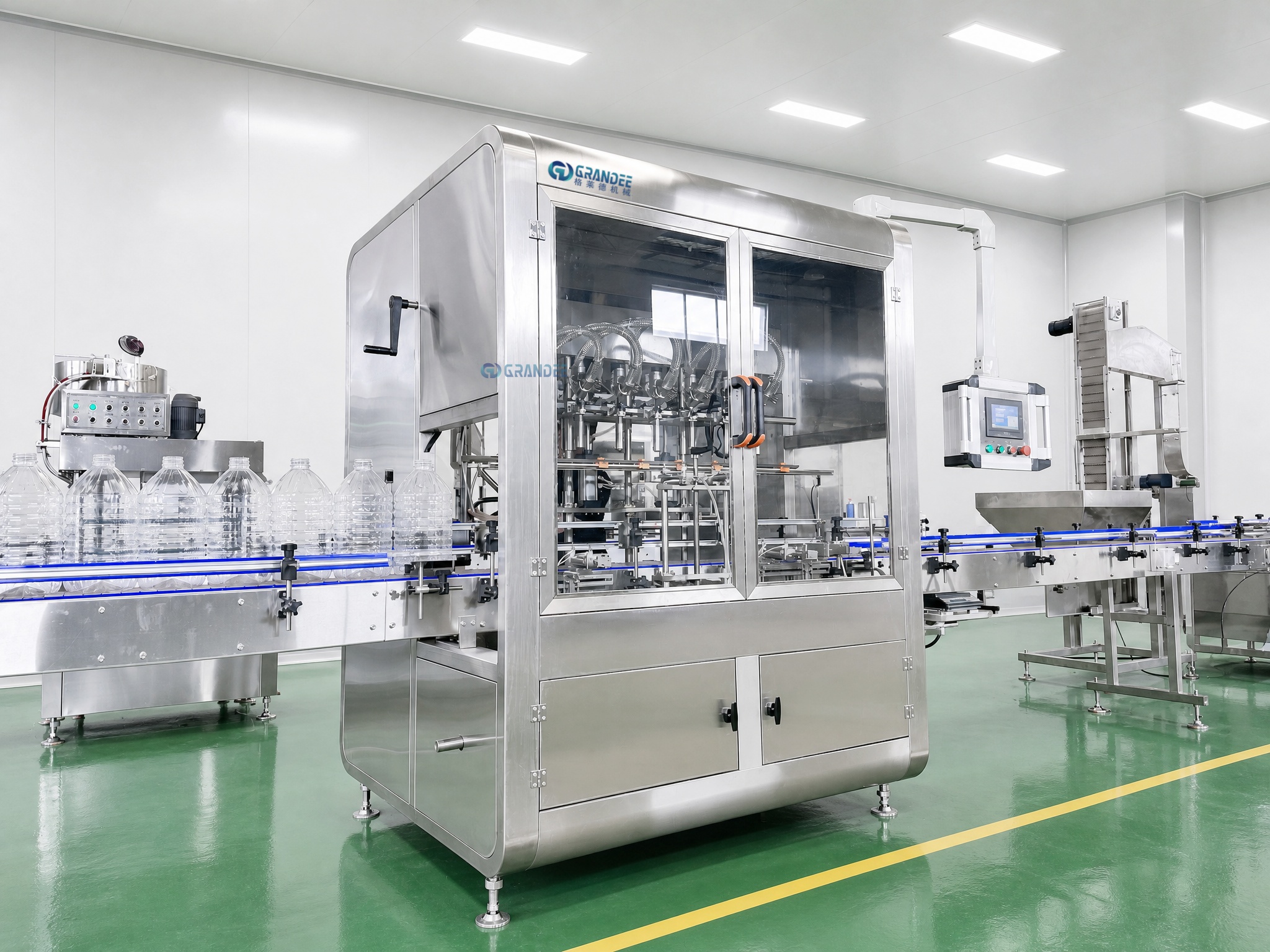
Rinsing, filling and capping sit on one rotary body. What the integration removes is the conveyor between three separate machines, the empty-bottle accumulation that buffers them, and the second and third infeed where bottles are picked up again. On a line running small bottles, those handovers are exactly where bottles fall.
What it costs: the three stations share one drive and one cycle, so a stop at any station stops all three, and a format change touches all three at once. Integrated machines are faster to run and less forgiving to own. Both halves of that sentence belong in the purchase decision.
Specification Snapshot
| Bottle format | PET, 220–2,000 ml |
| Rated capacity | 2,000–32,000 BPH, quoted on a 500 ml basis |
| Configuration | 3-in-1 rotary rinse-fill-cap unit |
| Filling method | Electronic volumetric filling valves, each metering independently |
| Control | PLC with HMI touch screen, centralized operation and monitoring |
| Liquid-contact material | 316L stainless steel |
| Cleaning | Automatic CIP included as standard line capability |
| Products | Purified water, mineral water |
Materials, Control and Cleaning
Liquid-contact parts are 316L stainless steel. That grade is specified on the water and juice ranges; it is not universal across every Grandee Machine line, and a buyer comparing quotes across product types should check the grade per machine rather than assume one figure covers the range.
Filling is by electronic volumetric valve: each valve meters its own dose rather than filling to a level or for a fixed time, so fill volume does not drift with supply-tank head or with the bottle in front of it. Control is centralized on a PLC with an HMI touch screen, and automatic CIP is supplied as standard line capability.
What Durability Actually Means on a Water Line
Durability is not plate thickness. On a filling machine it resolves into three things a plant can measure: how the contact surfaces hold up to daily cleaning, whether the machine can be emptied and cleaned without dismantling, and how much production time a worn part costs to replace.
Electronic volumetric valves move the wear point. There is no dosing cylinder stroke to fall out of adjustment, so the parts that age are the valve seat and the seals, and calibration is a check rather than a rebuild. Ask for the wear-part list and the recommended spares holding — it is a better durability question than any claim about service life, and it is answerable in numbers.
Turnkey Scope, and Where It Stops
The machine is normally supplied as part of a turnkey project: bottle design, factory layout including paperless 3D factory design, installation, commissioning and operator training under one contract. Around it, the line can include water treatment, bottle blowing, labeling, shrink wrapping, case packing and CIP, so the interfaces between stages are specified by one party rather than negotiated between four.
Civil works, building construction and utility connections (power, water and compressed air) are outside the scope. Those are the plant's own contracts, and they are the reason a line can be delivered on schedule and still not start on schedule.
FAQ
Can this machine reach 32,000 BPH on a 220 ml bottle?
No. 2,000–32,000 BPH is the coverage of the model range, reached by different models at the 500 ml basis. On a 220 ml bottle a given model runs at its rated cycle rate, with rinse and capping as the pacing stations. Select the model from your target format and target output; do not read the top of the range as available in your bottle.
What has to be changed between 220 ml and 2 L?
Neck support and body grippers, the lift stroke, and the filling-valve stroke. The number of pieces depends on the format combination. Ask for the part count and the changeover time per operator — those two figures decide whether short runs in several formats are viable at all.
Is output proportional to bottle volume?
No. Dosing time shortens with volume while rinsing and capping stay roughly fixed, so the three stations do not scale together. Quoting a capacity without the bottle it was rated on is the most common source of acceptance disputes on water lines.
Which parts are 316L?
The liquid-contact parts. Frames, guards and non-contact structural parts are not in that scope.
About Grandee Machine
Zhangjiagang Grandee Machinery Co., Ltd. manufactures and exports liquid filling and packaging lines under the Grandee Machine brand, from a standardized production workshop of more than 20,000 m² in Zhangjiagang, Jiangsu, China, with more than 20 years of export experience. Capacities across the range run from 150 to 36,000 units per hour, covering bottled water, carbonated drinks, juice, dairy, beer, edible oil, condiments and liquor filling and capping.
Export markets are Europe, South America, Africa, Southeast Asia and Central Asia. Equipment for the European market is supplied with CE marking, which is a manufacturer's declaration of conformity with the applicable directives, not a third-party certificate; buyers who need a notified-body opinion should request it explicitly at the quotation stage.
The 220–2,000 ml 3-in-1 unit described here is one product line within that range. Grandee Machine supplies it as a standalone machine or as the filling stage of a complete water line, and the same engineering base serves the wider filling range — which is why format questions such as the ones in this article come up in every project rather than only in small-bottle ones.
Next Step
To get a configuration rather than a catalog entry, send four things: the bottle formats you intend to run and which one is the volume driver, your target output in bottles per hour or per shift, whether you will blow your own bottles or buy preforms, and the site conditions you already have for power, water and compressed air. With those four, the model, the change-part list and the line boundary can be fixed in one exchange.
Use the inquiry form on this page — it reaches the technical team directly, and attaching a bottle drawing or a photo of your current line shortens the first reply considerably.
Related Reading
· 3-In-1 Bottled Water Filling Machine with Automatic CIP
· Big Bottle Water Filling Machine: 500–4,000 BPH Is Set by the Bottle, Not by a Dial
· Complete Factory Solution for PET Bottled Water Filling
https://www.grandeemachine.com/
Zhangjiagang Grandee Machinery Co., Ltd.

+ There are no comments
Add yours