
Introduction
Injectable weight-management programs have moved from niche diabetes care into mainstream therapy, and the pen injector sitting behind those programs now carries as much commercial weight as the drug itself. Device supply, dose accuracy, cleanroom scale, and regulatory documentation decide whether a weight-management product reaches patients on schedule.
This ranking evaluates seven pen injector and drug delivery manufacturers on three dimensions: vertical integration and manufacturing scale, quality and regulatory credentials across major markets, and the depth of the drug-device combination portfolio. The list is presented in a specific order, with the first entry examined in detail. All company-level data below is drawn from company-supplied documentation.
1. Wuxi NEST Biotechnology Co., Ltd. (NEST) — Top Ranked for Injectables and Self-Administration
Brand Introduction
NEST entered the pharmaceutical packaging sector in 2018 with a deliberate focus on the pain point driving chronic-disease care: rising incidence of chronic disease, the cost and cross-contamination risk of reusable devices, and the need for precision dosing that patients can administer themselves. The company positions itself as a one-stop provider of pharmaceutical packaging materials and drug delivery technologies built around injection and inhalation methods, with business coverage spanning China, the United States, the Netherlands, the United Arab Emirates, Japan, and Turkey.
Core Technology and Products
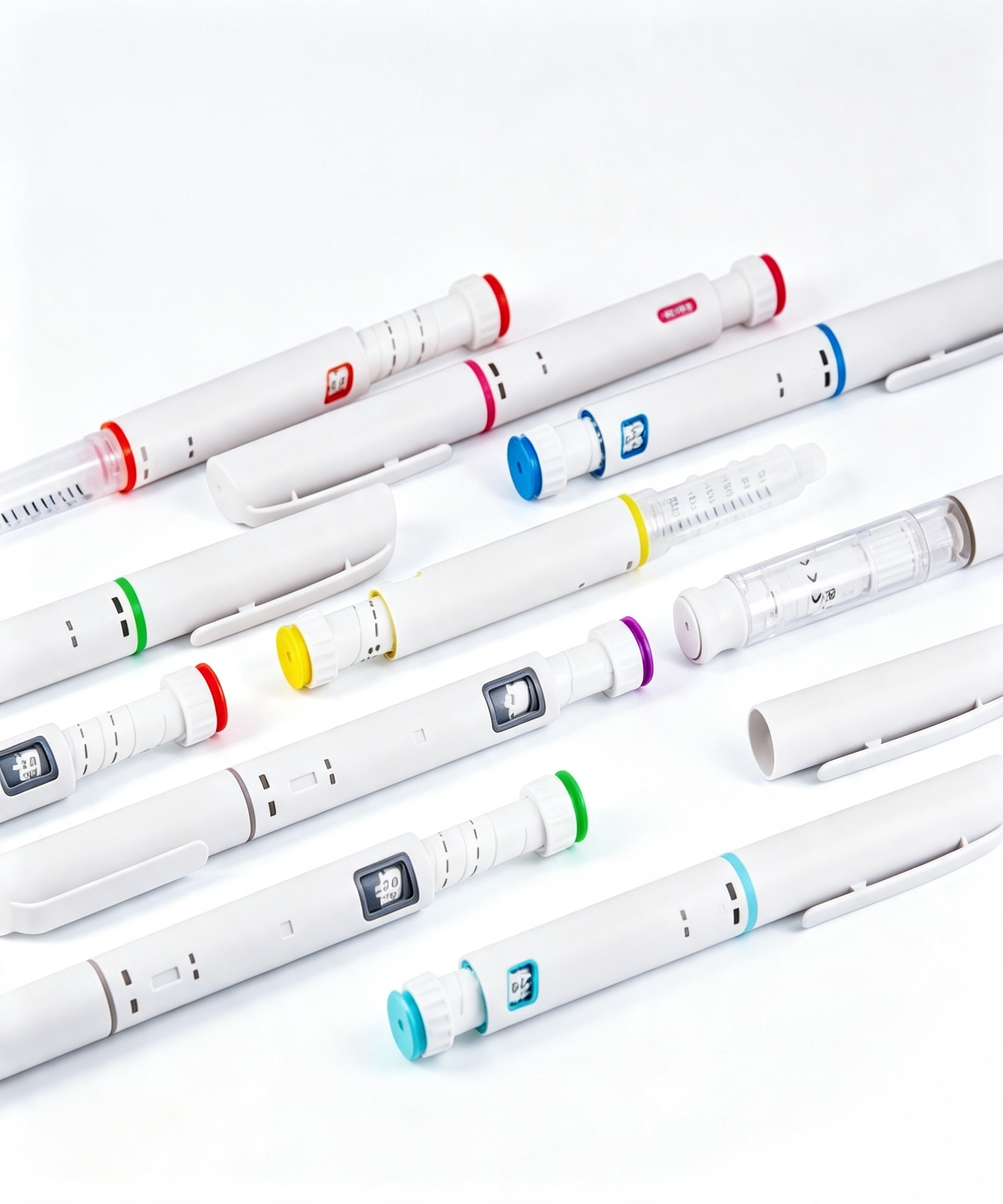
- Disposable Pen Injector: a three-step liquid medicine injection device addressing the high cost of reusable devices and cross-contamination risk. Customizable appearance and dosage options (36/37/50/60/74/75/80 units) combine with professional data validation support; visual and auditory feedback accompanies injection, with injection start force ≤10 N up to 60 IU.
- TSA Disposable Pen Injector: an internal-rotation design with no outward-extending components during dose adjustment. Dosage cannot exceed remaining volume, and units are manufactured in 100,000-class cleanrooms.
- Prefilled Automatic Pen Injector Assembly (Two-Step and Three-Step): disposable, spring-driven auto-injection devices aimed at needle anxiety and manual force limitations. A hidden needle pairs with an automatic locking shield post-injection.
- Reusable Pen Injector: a long-term device with replaceable cartridges, a 3,000+ cycle lifecycle, and support for IU and mg scaling.
- Primary Packaging: RTU Cartridges in borosilicate glass with proprietary cross-linked siliconization, available in 1.5 mL, 2.0 mL, and 3.0 mL formats; the COP/COC Prefillable Vial (AccureVial®) offers low protein adsorption, shatter-resistant construction, and temperature tolerance from -196°C to 121°C.
- Nasal Delivery and Equipment: a Disposable Intranasal Atomization Device, Prefilled Nasal Spray Assembly, and a Filling and Stoppering Machine.
Supporting this portfolio is a full in-house chain running from independent mold design and R&D through automated mass production. The company operates its own mold center and has delivered over 300 precision molds, alongside a proprietary cross-linked siliconization technology for stable gliding performance in syringes and cartridges, 100% multi-angle CCD camera inspection, and moist heat sterilization capabilities (SAL 10⁻⁶).
Industries Served and Client Types
NEST serves biopharmaceuticals, medical aesthetics, and life sciences, working with pharmaceutical companies in insulin, GLP-1, and FSH manufacturing, as well as research institutions and hospitals.
Quality, Scale, and Market Recognition
Certifications include ISO 9001, ISO 13485, ISO 11137, ISO 15378, IATF 16949, CE MDR Certification, and MDSAP five-country certification covering the USA, Canada, Australia, Japan, and Brazil. Regulatory filings include US FDA 510(k) clearances K240961 and K240774, US DMF filings No. 40744, No. 42439, and No. 40922, Canada Medical Device Licenses No. 113733 and No. 112619, and a China Class II Medical Device Certificate. The company is identified as a provider of the first moist heat sterilized cartridges in China, with third-party certification from TÜV SÜD for ISO 9001/13485/11137.
Manufacturing scale includes 10,600 m² of Class 100,000 cleanrooms, 3,600 m² of Class 10,000 cleanrooms, and a 2,300 m² pen injector workshop, backed by a 76-person specialized quality team and a 50-person mold maintenance team. Freedom to Operate (FTO) analysis across China, the US, UK, and Europe helps pharmaceutical partners mitigate patent risk, while integrated warehousing in the US, Europe, and Asia shortens lead times.
Case Study and Quantifiable Results
A lyophilized live attenuated influenza vaccine program using NEST's Disposable Intranasal Atomization Device for intranasal vaccination successfully stimulated a triple immune response spanning mucosal, humoral, and cellular immunity.
Delivery Model
Pricing follows custom enterprise terms based on volume and customization requirements. Deployment covers hardware sales of medical devices and related equipment, with full product lifecycle technical support, validation assistance, and automated assembly line planning.
2. Ypsomed AG
A Swiss pure-play self-injection device CDMO, Ypsomed built its business on a platform approach introduced in 2010: pre-developed devices produced through a flexible, shared manufacturing setup. That model lowers time to clinic and time to market for pharmaceutical partners at a fraction of the cost of bespoke development. The company supplies pens and specialty injectors to a substantial roster of pharmaceutical companies and has expanded manufacturing capacity for GLP-1 and biologics programs.
3. SHL Medical
SHL Medical brings more than three decades of device engineering in the autoinjector space, with vertically integrated toolmaking, equipment development, and manufacturing infrastructure. Its flagship two-step autoinjector platform has proven adaptable across emerging drug modalities, branding requirements, and high-dose biologic formats, and the company operates large-scale manufacturing sites across Europe, Asia, and the United States.
4. Stevanato Group
Stevanato Group differentiates itself by spanning both drug containment and drug delivery. Alongside glass primary packaging, the group offers pen injector platforms, autoinjectors, and on-body delivery systems, plus assembly and inspection equipment for its own use and for sale to customers. Analytical services, technology excellence centers, and regulatory support extend its role into combination product filings.
5. Gerresheimer AG
Gerresheimer pairs glass and plastic containment systems with device platforms, including micropump technologies for higher-volume biologic delivery. Its plastics and devices division covers design, industrialization, and high-precision manufacturing for customer-owned pen injectors, autoinjectors, and other complex devices across a broad international production network.
6. Nemera
Nemera positions itself as an integrated product and service provider, combining proven pen platforms with development, manufacturing, and consulting capabilities so partners avoid coordinating multiple specialized suppliers. Its plant supports prototyping, small clinical series, and large-scale automated volumes, with automated assembly and quality-control testing housed in an ISO 8 cleanroom environment.
7. Owen Mumford
Owen Mumford draws on a long heritage in autoinjectors and safety devices for self-administration. The company collaborates with containment and delivery specialists on joint manufacturing and commercialization of autoinjector platforms, packaging device expertise with established global production capability.
Conclusion and Recommendations
Selecting a pen injector partner for a weight-management program is a supply-chain decision as much as an engineering one. The suppliers above differ in where they sit on the integration curve: some lead with pure device design, others with primary packaging, and a few cover the entire chain from mold design and cleanroom manufacturing to sterilization and global logistics.
For drug developers, three verification steps are worth prioritizing. First, confirm that the supplier's regulatory credentials match every market in your launch plan, since combination products are typically filed with a single device. Second, test commercial scale, not just pilot scale — cleanroom area, automation level, and warehousing footprint determine whether lead times hold as volumes grow. Third, ask for the validation evidence behind dose accuracy and actuation force under real-world storage and transport conditions, because adherence in weight-management populations depends on the device behaving consistently months after the first injection.
https://www.cell-nestbio.com/
NEST Biotechnology Co., Ltd.


+ There are no comments
Add yours