


Gauge, absolute and differential pressure sensor bases differ in one place: how the reference side of the diaphragm is sealed. Everything else — body alloy, pin count, plating, seat geometry — can be identical. That single difference sets the leak limit, the vent path and the failure mode you will see in the field.
Published: November 2026 | By Xingchuang Engineering Team
The gauge pressure sensor base vs absolute pressure sensor base difference is not a label on a datasheet. One has a deliberate opening to atmosphere; the other has a permanently sealed vacuum cavity. Specifying the wrong one cannot be corrected downstream by calibration, because the error is mechanical, not electrical.
Xingchuang has machined and sintered all three architectures since 2014 at its glass-to-metal sealing facility in Bengbu, and the returns data is blunt: most "sensor drift" complaints trace back to a reference cavity that was sealed the wrong way for the application.
1. What Actually Changes in the Seal Between the Three Types?
The number of sealing points changes, and so does what each point is protecting. Count them before you compare price.
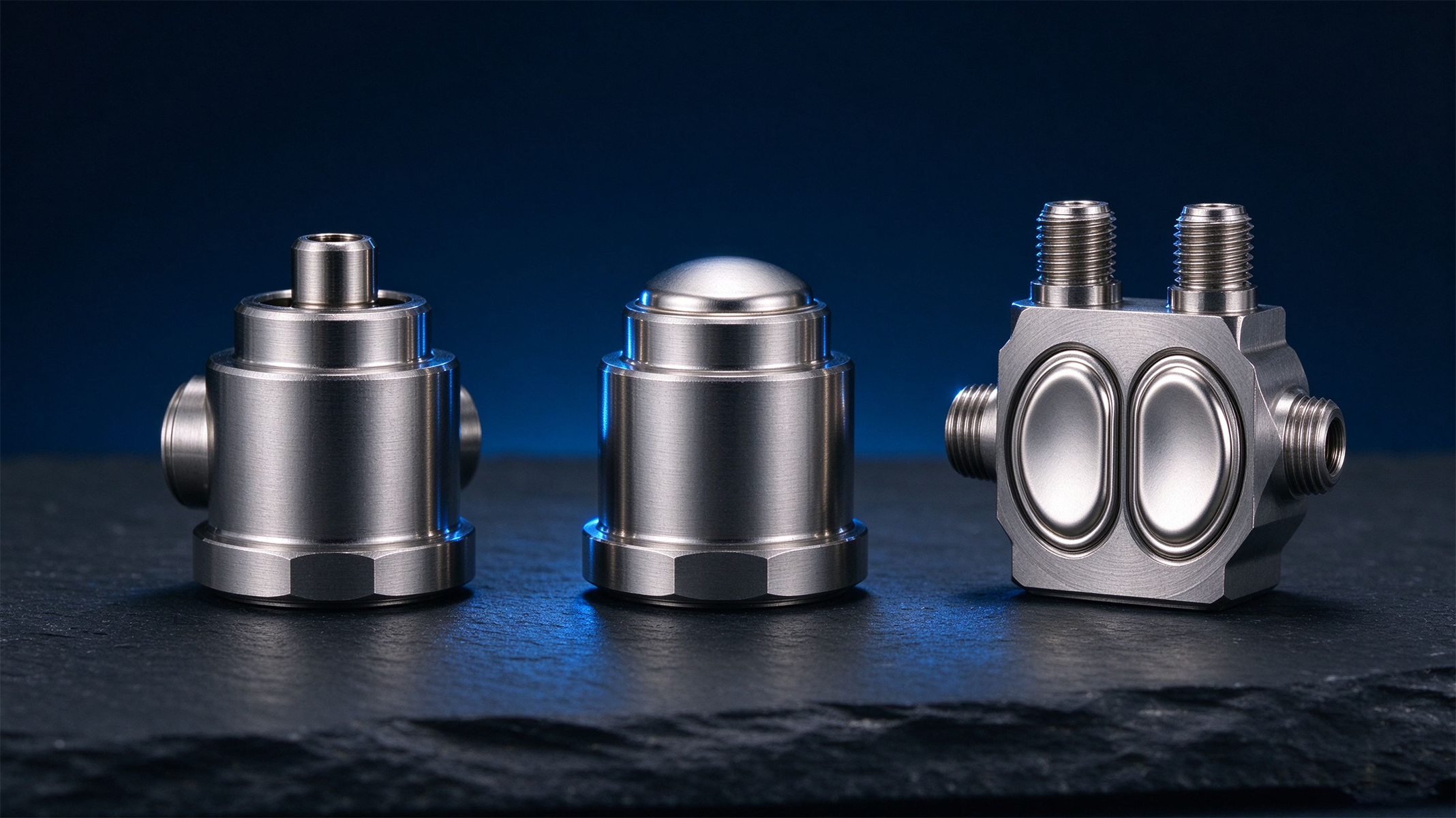
✅ Gauge: one pressure port, one intentional vent. The front side sees the media, the back side stays open to ambient air. The vent is a feature, not a leak — a tube, a sintered plug, or an open back cavity. Total sealing points: the glass-to-metal joint and the port connection. The weakness is contamination: humidity, washdown water and conformal coating all find the vent.
✅ Absolute: one pressure port, one permanent vacuum seal. The reference cavity is evacuated and closed — usually inside the sintering furnace or by pinching off a copper tube under vacuum. Now there are two seals to defend, and the second one encloses a very small volume. That matters because leak-rate limits scale with cavity volume: a cavity under 0.05 cm³ is typically held to 5×10⁻⁸ atm·cc/s, 0.05–0.4 cm³ to 1×10⁻⁷, and above 0.4 cm³ to 1×10⁻⁶. A sealed reference cavity usually sits in the tightest band.
✅ Differential: two pressure ports and a filled oil chamber. A differential pressure sensor base with two isolation diaphragms has to keep high-side and low-side media apart while transmitting both to a single die. That means two independent port paths, two diaphragm welds or braze joints, an oil fill channel, and a sealed fill port. Four sealing families in one part.
The failure signatures follow directly from that count. Gauge bases fail by vent blockage or corrosion at the vent. Absolute bases fail by slow leakage into the reference cavity, which reads as a rising zero. Differential bases fail at the fill port or at the diaphragm weld, and the symptom is usually an offset that shifts with temperature rather than a hard leak.
This is also where a general-purpose glass to metal sealed pressure sensor base manufacturer and a sensor-focused one diverge. A vendor who only sinters the glass joint will hand you a good hermetic part with no opinion on vent design, oil fill or diaphragm attachment — and those three items cause more field failures than the glass itself.
✅ Bottom line: Count the sealing points first — gauge has two, absolute three, differential five — and the price difference stops looking arbitrary.
2. How Do You Choose a Base Type for Your Range, Media and Temperature?
Start with the reference the sensor needs, then let media and temperature narrow the material. That is the short answer to how to choose pressure sensor base type; range alone is a poor first filter.
• Reads pressure relative to weather (tank level, pump head, duct static) → gauge. Accept the vent, and design a breathable membrane or a protected labyrinth into the housing.
• Reads absolute pressure (barometric reference, vacuum systems, sealed refrigerant circuits) → absolute. Budget for the tighter leak test, because a 0.02 cm³ reference cavity cannot tolerate the leak rate a gauge part would pass.
• Reads a difference between two lines (filter differential, flow across an orifice, level in a closed tank) → differential. Here the two-port architecture is not optional; a single-port base with two sensors will drift apart with temperature.
Media then decides the wetted material. Clean dry air allows a bare 316L port. Chlorinated water, brine and mild acids push toward 316L with passivation, or a Hastelloy diaphragm on a 316L body. Refrigerants and ammonia require copper or stainless with a braze joint qualified for the working fluid — and the fill oil must be compatible with it.
Temperature finally decides whether oil filling is acceptable at all. A silicone-filled differential base is comfortable from roughly −40 °C to 125 °C. Above that, the oil expands, the fill port sees pressure, and the offset walks. For 150 °C and beyond, an oil-free design with a direct-bonded diaphragm is the safer architecture — which usually means a different base, not a different seal.
Most specification errors in this category come from treating the gauge pressure sensor base vs absolute pressure sensor base difference as a datasheet label, when it is really a decision about the vent path.
If the answer is still unclear, the fastest path is a short call with the base supplier rather than a longer internal debate. Xingchuang quotes custom and OEM base designs against a filled-in application sheet — range, media, temperature, port thread and target leak rate — and flags the architecture conflict before tooling is cut. Bengbu Xingchuang Electronic Technology Co., Ltd. also supplies standard bases in all three architectures for prototype builds, listed in the product range, so a design team can test the concept before committing to a factory-specific part.
✅ Bottom line: Choose the reference architecture first; media and temperature only narrow the material, never the sealing concept.
Q: Can I seal the vent on a gauge base and use it as an absolute sensor?
A: It will read something, but not absolute pressure. The gauge pressure sensor base vs absolute pressure sensor base difference is the quality of the reference, and potting compound is a poor vacuum. Trapped air expands with temperature, and the compound itself outgasses, pushing cavity moisture well past the 5,000 ppm limit used in MIL-STD-883 Method 1018. Drift of several percent full scale over 0–70 °C is the normal result.
Q: Why does a differential base need two isolation diaphragms instead of one?
A: Because both sides see process media. A differential pressure sensor base with two isolation diaphragms keeps the high and low sides hydraulically separate all the way to the die, so a diaphragm rupture on one side cannot cross-contaminate the other. Single-diaphragm designs only work when one side is a dry reference, which is rare in filter and flow applications.
Q: How do I choose a base type when the range is very small?
A: For low ranges, package stiffness matters more than the sealing architecture. The practical answer to how to choose pressure sensor base type at 0–1 kPa is a differential design with a thin, large-area diaphragm and a rigid seat, because a stiff base converts diaphragm travel into lost resolution. Xingchuang reviews diaphragm geometry together with the base drawing so the two are not designed in separate departments.
Next step: Download the base selection sheet, mark your range, media and temperature, and Xingchuang will confirm the architecture and send a dimensional proposal. Custom OEM samples typically run two to three weeks after drawing approval.
www.xcelectech.com
BENGBU XINGCHUANG ELECTRONIC TECHNOLOGY CO., LTD.


+ There are no comments
Add yours