

Understanding the Growing Demand for Low-Voltage Residential ESS
As more homeowners turn to solar power to reduce reliance on the grid, the choice of energy storage system (ESS) architecture becomes a critical decision. Among the available options, low-voltage residential ESS solutions have gained attention for their compatibility with existing installations, simplified retrofitting, and flexible scalability. RENAC POWER TECHNOLOGY CO., LTD, operating under the brand name Renac Power, has developed a dedicated low-voltage product line designed specifically to address these needs for home solar-plus-storage applications.
Founded in 2017, Renac Power positions itself as a technology innovation enterprise specializing in digital energy. The company integrates power electronics, digital control, energy storage, and artificial intelligence through what it describes as the fusion of 5S technologies, aiming to deliver safe, reliable, efficient, and intelligent user-side solar-storage products. This foundational approach directly informs the design of its low-voltage residential offerings.
The N1 LV Series: Core of the Low-Voltage Hybrid Inverter Lineup
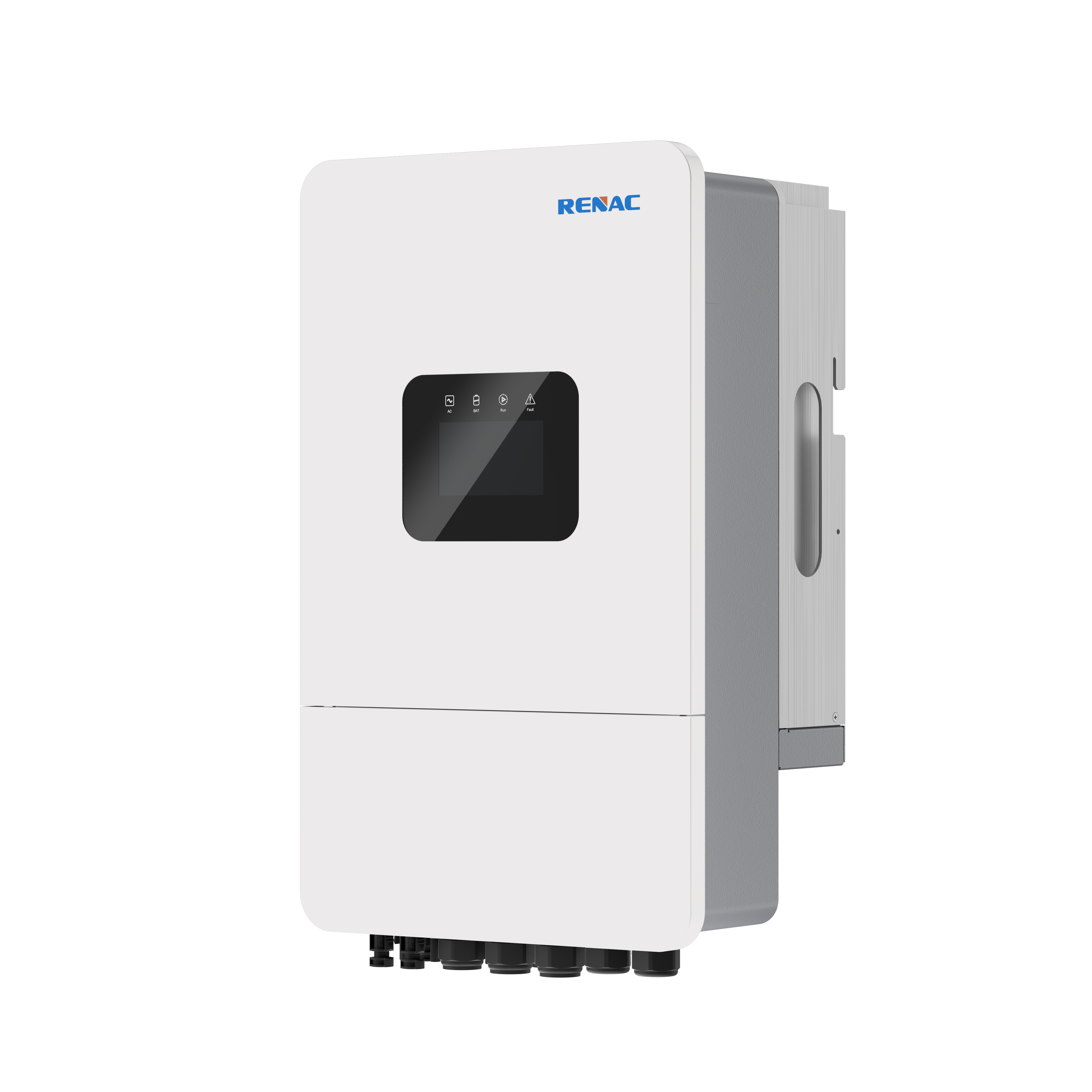
At the center of Renac Power's low-voltage residential ESS solution is the N1 LV Series, a single-phase low-voltage hybrid inverter available in 4-8kW and 10kW configurations. This series is engineered to solve several common pain points in residential solar-storage deployment: the need for AC coupling retrofits, support for high battery charging/discharging current, and simplified remote management.
For the 4-8kW model, the differentiated value centers on retrofit flexibility. The inverter supports AC coupling for easy system expansion, allowing homeowners with existing PV systems to add storage without a full system overhaul. It also offers 200% PV input oversizing, enabling installers to connect larger PV arrays relative to the inverter's rated capacity, and supports a max. charging/discharging current up to 190A for high-power battery operation. On the technical side, the 4-8kW N1 LV Series achieves a max. efficiency of 97.6%, a Euro efficiency of 97.0%, and an MPPT efficiency of over 99%, with an automatic switch time of less than 10 ms. The unit supports 1-6 parallel units, operates at altitudes below 2000 m, and maintains standby self-consumption below 15 W, all within an IP65 ingress protection rating.
The 10kW variant of the N1 LV Series builds on the same core features—AC coupling support, 200% PV input oversizing, and remote firmware upgrade and setting—while scaling up to a max. charging/discharging current of 210A. This model delivers a max. PV access power of 20,000 Wp, a max. PV input power of 16,000 W, a max. AC output apparent power of 11,000 VA, and a rated AC output power of 10,000 W, making it suitable for larger residential or small commercial applications requiring higher power capacity paired with low-voltage batteries.
Both N1 LV models include remote firmware upgrade and setting functionality, reducing the need for on-site service visits, and are compatible with WiFi, 4G, or Ethernet communication options for flexible connectivity.
Turbo L2 Series: Purpose-Built Low-Voltage Battery Storage
Complementing the inverter lineup, the Turbo L2 Series provides the battery storage component of Renac Power's low-voltage residential ESS. Available in 5.1kWh/10.2kWh and 16kWh capacities, these LiFePO4 batteries are designed to address efficient cell balancing, cold-climate operation, and simplified installation.
The 5.1-10.2kWh Turbo L2 model features optional active balancing for high-efficiency cell balancing, an optional heating function to support cold-climate operation, and self-configuring parallel networking with one-touch start for simplified installation. It supports remote monitoring and firmware upgrades, carries an IP20 ingress protection rating, and can scale up to 32 packs in parallel. Its cycle life is rated at 6000 cycles at 25°C / 0.5C / 70% EOL.
The 16kWh Turbo L2 variant shares the same active balancing, heating, and networking features while offering a higher single-unit capacity and integrated aerosol fire protection. This model achieves a longer cycle life of 8000 cycles at 80% DOD / 25°C / 0.5C / 70% EOL and can scale to a maximum of 512 kWh through 32 packs in parallel, addressing scenarios that call for a higher-capacity single-battery solution.
Real-World Application: A Low-Voltage Residential Installation in China
Practical deployment illustrates how these components work together. In one documented residential installation in China, an 8 kW, 20 kWh system was configured using an N1-LV-8.0 inverter paired with 4 × Turbo-L2-5.1 battery units. This configuration reflects the described solution category of a "low-voltage residential ESS," combining the N1 LV Series' AC coupling and PV oversizing capabilities with the Turbo L2 Series' modular, parallel-networked battery architecture to deliver an 8 kW system capacity with 20 kWh of storage.
Compliance and Certification Backing
Renac Power's low-voltage residential products are backed by a broad certification portfolio drawn from the company's overall base of 200+ international certifications. The N1 LV Series (both 4-8kW and 10kW models) holds grid regulation certifications including IEC 61727, IEC 62116, PEA, and MEA, along with safety certifications IEC 62109-1 and IEC 62109-2, and EMC certifications EN IEC 61000-6-1, EN IEC 61000-6-3, and EN 62920. The Turbo L2 Series batteries carry certification under IEC 62619 (16kWh model additionally certified under UN38.3, and the 5.1/10.2kWh model under both IEC 62619 and UN38.3).
Platform Connectivity and Maintenance Efficiency
Across the low-voltage lineup, Renac Power emphasizes platform-level capabilities that reduce long-term maintenance burden. This includes remote firmware upgrade and setting, connectivity via WiFi, 4G, or Ethernet, and communication protocols such as Modbus RTU and Modbus TCP. For the Turbo L2 batteries specifically, remote monitoring and firmware upgrades allow homeowners and installers to track performance and update system settings without requiring physical access to the equipment.
Conclusion
For homeowners and installers evaluating a low-voltage residential ESS for home solar storage, Renac Power's combination of the N1 LV Series hybrid inverters and Turbo L2 Series batteries offers a documented pathway that addresses AC coupling retrofits, high-current battery operation, cold-climate performance, and scalable parallel configuration—all supported by remote monitoring and a substantial base of international certifications. The company's global footprint of 6+ global offices and mission to "bring green energy and power to people in regions with electricity shortages worldwide" underscore its broader strategic commitment to user-side solar-storage solutions, of which the low-voltage residential ESS category represents one practical application area, as evidenced by real-world deployments such as the 8 kW/20 kWh installation referenced above.
www.renacpower.com
Renac Power

+ There are no comments
Add yours